Contents
- Two families of tools, bought by different people
- Registration systems earn their fee at the check in desk
- A one day meeting rarely needs its own app
- Is a bigger LED wall worth more than a better crew?
- Matchmaking and lead scanning depend on the follow up
- Hotel wifi was never meant to carry a congress
- The weakest hour of the day is where the budget should go
Two kinds of technology end up in event proposals, and they are easy to confuse. One kind makes the event run: it gets the right people registered, through the door, into the right hall and able to hear the speaker. The other kind makes the proposal look current: a branded app, an interactive wall, a feature with an impressive name that guests will see once or never.
Event technology is the set of digital and technical tools used to plan, run and measure an event, from registration systems and apps to sound, screens and streaming, and clients ask about it in both moods, both of them understandable. They simply lead to very different budgets. At most of the events I have worked on, the most important piece of technology was still a printed badge with the name spelled correctly, which is a useful reminder of what guests actually notice. They notice when something they needed was there and worked, and they notice much more when it was not.
Two families of tools, bought by different people
Broadly, it helps to split the field in two. The first family follows the guest journey: invitation and registration systems, ticketing and payment, check in and badge printing, event apps and digital agendas, matchmaking for meetings, lead scanning for exhibitors, live polling, streaming platforms and the post-event survey. This is what people usually mean when they say event tech.
The second family is production: sound, lighting, LED screens, projection, stage machinery, simultaneous interpretation, cameras and control rooms. It is the older side of the field and in most budgets still the larger one. The two families are bought by different people with different habits, the first often by marketing or the organizer’s digital team, the second by the agency’s production side, and they fail in different ways, which is why it pays to think about them separately.
Registration systems earn their fee at the check in desk
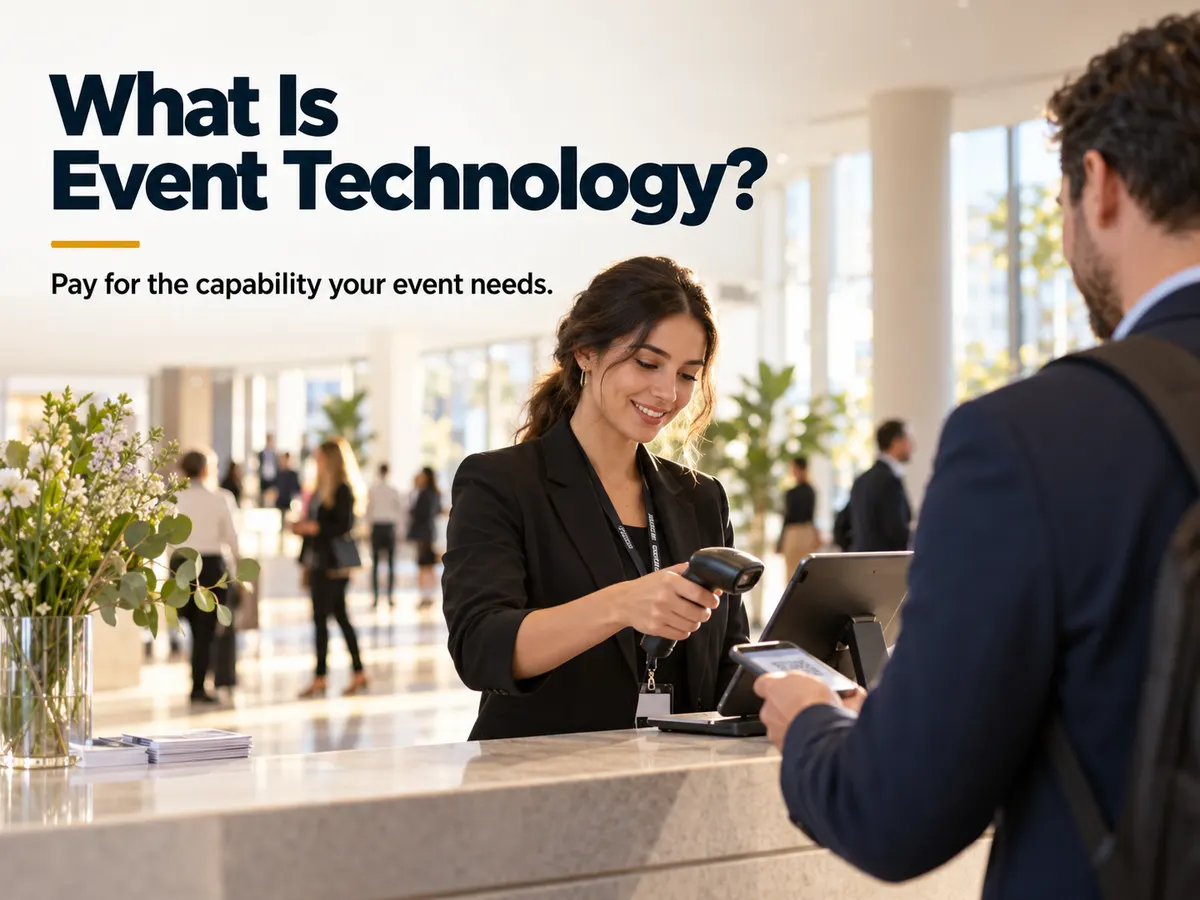
Of all the guest-facing tools, registration is the one I would fund first. A good system collects the right information once, sends confirmations and reminders automatically, gives the organizer a live view of who is coming and speeds up check in with a QR code instead of a printed list. For a congress with hundreds of participants, several registration categories, hotel bookings and accompanying persons, that is not a luxury; spreadsheets and email are how names get lost and rooms get double booked.
Digital registration does not replace the desk, though. It reduces its load. Every organizer knows the guests who cannot find their QR code, the senior participant who does not want to open an app, the email that went to spam, the venue where the signal drops right at the entrance. Each creates a small queue in exactly the place where first impressions form. The system is worth paying for, and so is an experienced person at the desk, a question of event staffing rather than software, who can ask for a name and find the guest in thirty seconds. Organizers who budget for the first and save on the second usually discover the gap at the door.
The demonstration in a sales meeting always follows a prepared path where every guest is approved and every name is spelled correctly. Before signing, I would much rather watch the system handle our own awkward cases, with our own data:
- a guest registered twice under two email addresses
- a name corrected after the badge has been printed
- a delegate moving from one registration category to another
- an accompanying person added in the final week
- check in while the venue’s connection is down
- a guest who needs help to complete the form
Two questions belong in the same meeting and are rarely asked. Who answers when something breaks during the congress weekend, outside the supplier’s office hours? And how does the data come out once the contract ends? A cheap platform that keeps your participant list locked inside it becomes an expensive one the following year.
The less visible benefit of a good registration system shows up in the days before the event, in the hotel and transfer side of the work. When registration data feeds the rooming list and the transfer manifest directly, the late changes that every congress produces, the participant who arrives a day early, the speaker who brings a colleague, the group whose flight moves, can be followed in one place instead of across three spreadsheets and a dozen emails between the agency, the hotel’s reservations team and the transfer company. Guests never see this, but they feel it when their name is on the right list at the airport.
Collecting all this data also brings a responsibility that the cheaper tools tend to skip. Most countries now have a personal data protection law, the GDPR in Europe and similar laws in Türkiye and well beyond, and participants increasingly read the consent text before ticking the box, especially when a form asks for passport details for the hotel booking or health information for the catering team. A system that stores this properly, shows a clear consent text and lets the organizer decide who on the team can see which fields is worth more than one that simply exports everything to a spreadsheet passed around by email. Accessibility deserves the same seriousness. A form that cannot be completed with a screen reader, or on a phone with enlarged text, shuts people out at the very first step, and WCAG 2.2 gives a testable standard to ask the supplier about, which is a better conversation than accepting the word accessible on a brochure.
A one day meeting rarely needs its own app
Event apps are the clearest example of technology bought for the proposal rather than the guest. They look complete and modern: agenda, speaker bios, map, notifications, networking, a feed. For a three day congress with parallel sessions, several halls and frequent program changes, an agenda in everyone’s pocket that updates in real time is genuinely useful, and the same goes for large fairs with exhibitor lists and floor plans.
For a one day corporate meeting, a launch or a dealer conference with a single program, an app is usually more than anyone needs. The same goes for the gamified apps sold for team days, which tend to be opened once and forgotten. Guests are reluctant to download something for one day, and many do not. Honestly, a well made web page with the agenda, the venue information and a contact number, sent by message, does most of what the app would do without any download. Before paying for an app, it is worth asking what guests will use it for that they cannot get from a link, and if the answer is a list of features rather than a specific need, the money belongs elsewhere.
The argument I hear most often in favour of an app has little to do with guests. Sponsors like it, because a logo on the opening screen and a push notification from the main sponsor are easy to put into a package and easy to sell. I understand that, and at a large congress the app can even pay for itself this way. At a smaller meeting, though, the sponsor’s name on the lanyard, on the registration page and on the screen between sessions reaches far more people than a banner inside an app half the room never installed, and it is fairer to tell the sponsor so than to sell them a download figure nobody will report afterwards.
Is a bigger LED wall worth more than a better crew?
On the production side, the direction for years has been bigger LED walls, more complex stage designs and more ambitious lighting, to the point where even a talk on event industry trends at a regional fair now arrives with a screen the width of the hall. Some of this adds real value; a well designed stage and good light change how a room feels and how a message lands. But the order of priorities matters.
The technology worth paying for is the one that removes a problem your guests would otherwise notice, not the one that adds a feature they will never use.
By that measure, sound comes first. Guests forgive an average screen, but not a speaker they cannot hear, a microphone that cuts out, or a hall where the back rows get an echo. Simultaneous interpretation at international congresses belongs in the same category, because when it fails, part of the audience simply leaves the session. Equipment lists also hide the people. In many markets, experienced sound engineers, lighting operators, riggers and LED technicians have become harder to find since the pandemic, when many left the sector and did not return, and a larger screen run by a tired or inexperienced team often gives a worse result than a modest setup in the hands of people who know it. Given the choice, I would rather pay for the right crew than for more square meters of LED.
Matchmaking and lead scanning depend on the follow up
For B2B events, two tools promise a great deal. Matchmaking lets participants book meetings with each other in advance, and lead scanning lets exhibitors capture contacts by scanning badges at the stand. Both can be very effective, and both depend completely on what happens around them.
Matchmaking works when the right people are registered, their profiles are properly filled in, and someone on the organizer’s side actively encourages meetings well ahead of the opening day; left alone, most profiles stay half empty and most requests go unanswered. Lead scanning has the opposite weakness. Collecting contacts is effortless and doing nothing with them is just as easy, so an exhibitor can leave a fair with a long list of scanned badges and no idea which were serious conversations and which were people collecting a pen. Unless the stand team adds a short note to each contact and the sales team calls within days, the technology only produces a bigger spreadsheet.
Hotel wifi was never meant to carry a congress
Almost every guest-facing tool depends on something that rarely appears in the proposal: a reliable internet connection. Check in, badge printing, live polling, the event app, the stream of a session for a virtual event audience and presenters’ cloud-based slides all slow down or stop when the connection fails. Many hotels and venues offer wifi that is perfectly fine for guests checking email and quite inadequate for a full plenary hall plus a registration system plus a broadcast.
Asking the venue early about dedicated bandwidth, a separate line for production and registration, and a backup option rarely impresses anyone in a pitch, and it matters more than almost anything else on the technical side. It costs far less than most of the features in a typical proposal, and it protects all of them.
The weakest hour of the day is where the budget should go
When clients ask what technology to invest in as they plan a conference or a launch, I find it more useful to start from the event than from the catalogue. Where in the guest’s day is the event most likely to go wrong? It might be the entrance and its queue, the parallel sessions where people get lost, the sponsor area where leads disappear, the online audience who cannot be heard, or the close, when everyone needs a transfer at once. Each of those weak moments has a tool that helps and usually a person who matters even more, and choosing this way produces a smaller, more focused budget that is easier to defend afterwards because each line answers a specific problem.
It also guards against the most common mistake I see, which is buying a complete platform with twenty features for an event that needed three of them done well and a crew that knew the room.
Often that weakest hour is the first one, at the door.