Contents
- Visitors spend most of their time in places built for residents
- The tourist season ends; residents’ free time does not
- Recreation is usually managed by the people least involved in tourism planning
- Events are where the two meet, and where they often miss each other
- Measuring a destination by arrivals hides the part that matters
- The right to free time is part of the case, not a side note
- What changes when recreation is treated as a foundation
Destination development is usually described as the work of making a place more attractive to visitors: better access, more beds, new attractions, a clearer brand. I think that description leaves out half of the job. A destination is a place where people also live, and what they can do with their own free time there, on an ordinary Tuesday evening or a rainy Sunday, decides much of what a visitor will find when they arrive.
Recreation is not a nice addition to a destination plan. It is one of the foundations the plan stands on.
That is not a romantic argument about authenticity. It is a practical one, and most people who have worked on events, hotels and city programs for long enough have seen it from the inside.
Visitors spend most of their time in places built for residents
Look at how a visitor actually spends a day. A few hours go to the reason they came: the congress session, the monument, the beach, the match. The rest of the day happens somewhere else. They walk along the seafront, look for a café that is open after nine, sit in a park because the hotel room is small, take a bus that locals take, buy water at the same corner shop.
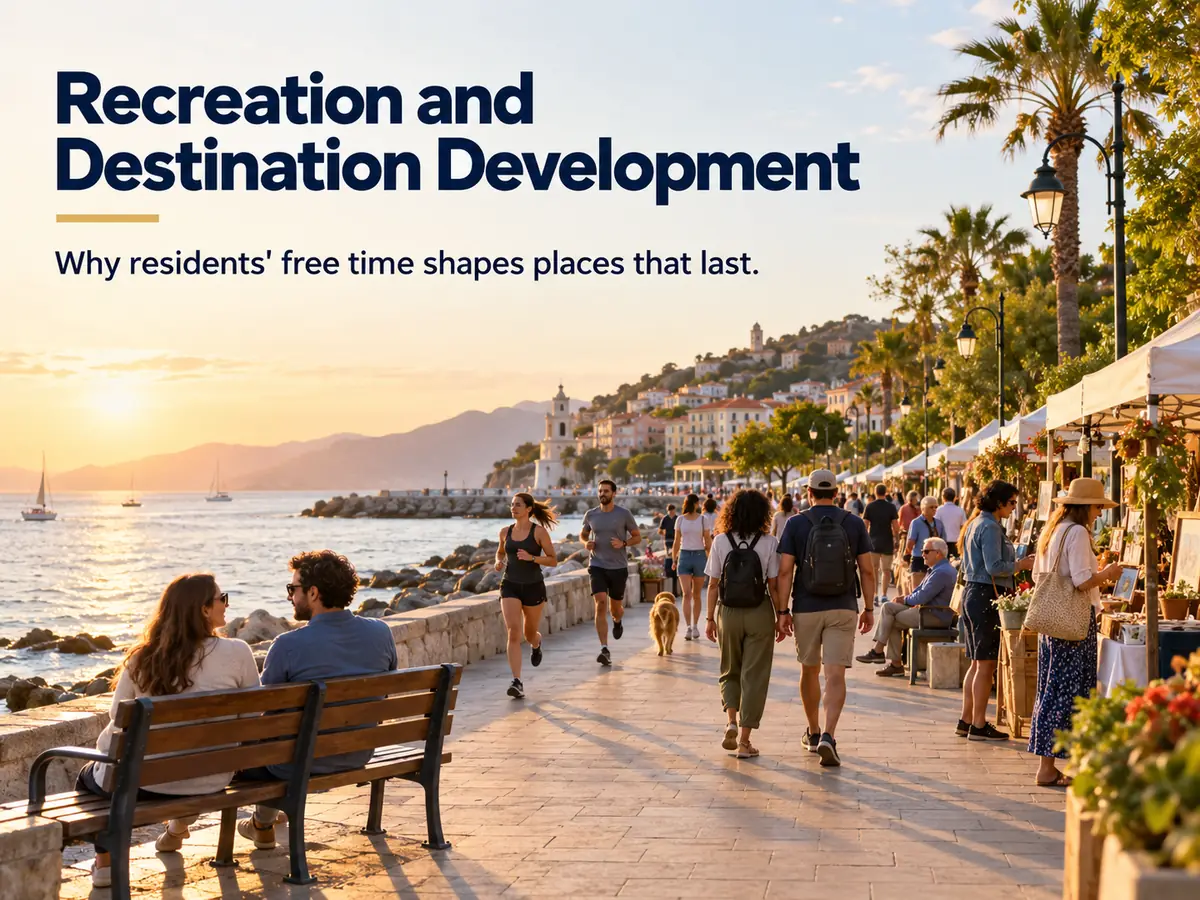
Almost none of those places were built for tourism. The promenade was built so that residents could walk by the water. The park exists because a neighborhood needed green space. The evening café survives because people who live nearby come back every week. When those places are lively and well kept, the visitor experiences a city that works. When they are empty or neglected, no amount of marketing hides it for long.
UN Tourism’s own definition of a tourism destination is broad for exactly this reason: a physical space where a visitor can spend a night, with products, services, activities and experiences along a value chain, and with an image and identity that shape how competitive it is. Read carefully, that definition already includes the parks, the evenings and the public spaces. In practice, destination plans often stop at the attractions.
The tourist season ends; residents’ free time does not
Every seasonal destination knows the moment in autumn when the visitors thin out and the place has to decide what it is for the next six months. Some places close down almost completely. Others carry on at a quieter rhythm, and those are usually the ones with a strong local life: sports clubs that use the halls in the evenings, cultural centers with a weekly program, markets, walking groups, a calendar of small events that residents actually attend.
This is where recreation and destination development meet most directly. Tourism trends keep pointing towards longer seasons, travel in the shoulder months and visitors who want to see how a place lives rather than only what it shows. A destination can only offer that if there is something living to show. The off-season visitor who joins a public run, a concert in a community hall or a Saturday market is joining a resident’s program, not a tourist product.
A destination is only as strong in its quiet months as the free time of the people who live there.
I find this the most useful test for any development plan. Take out the peak weeks and ask what is left. If the answer is very little, the plan has built a stage, not a place.
Recreation is usually managed by the people least involved in tourism planning
In most cities the responsibility is divided in a way that makes the connection hard to see. Tourism promotion sits with one organization, often a destination marketing or management body. Parks, sports facilities and cultural centers sit with departments or operators whose job is to serve residents. Event calendars may belong to a third group. Hotels and tour operators plan around all of them without being part of any.
None of this is anyone’s fault. Each part does its own work, and much of it is done well. The trouble is that a destination management plan written by the first group rarely includes the program of the second, and the second group is seldom asked what visitors might do with their facilities. The distinction between recreation and leisure helps here: leisure is free time, recreation is the organized offer that fills it, and that offer is mostly produced by people who would not describe themselves as working in tourism.
Resort coasts show the same split from another angle. Many large hotels run their own recreation inside the property: pool games, a children’s club, evening shows, a sports program. It keeps guests busy and satisfied, and it is a real skill. But a destination made only of such properties earns little outside their walls, and its residents see little benefit from the visitors next door. The resort coasts that have aged well, from the Mediterranean to the Caribbean, are usually the ones where guests are given good reasons to go out: a promenade that works in the evening, a lively district center with a market, a trail, a public beach with facilities that locals use too. That is recreation planned at the scale of the destination, not the building.
When I look at destination strategies, the clearest sign of a strong one is that the recreation side has a seat at the table. Not as a list of parks in an appendix, but as a partner whose calendar, facilities and staff are part of the visitor experience.
Events are where the two meet, and where they often miss each other
Events are the most visible bridge between residents and visitors, and they show both the potential and the risk. A festival, a marathon or a congress brings people into the city for a few days, fills hotels and gives the place a reason to be talked about. If it is built only for visitors, it can also close streets residents use every day, push out regular programs and leave behind a quiet period when it is over.
The events that strengthen a destination usually share a few habits. They use existing public spaces and venues rather than building temporary worlds that disappear. They include residents as participants, not just as an audience or an inconvenience. They leave something that continues: a route that becomes a weekly run, a square that keeps its market, a hall that keeps its program. Thinking about events this way also changes how they are designed operationally, from the choice of venue to the way sustainable events handle waste, transport and local suppliers.
For meetings, the same logic applies at a smaller scale. A congress delegate in MICE tourism has an evening or two free. The cities that are remembered are the ones where that evening can be spent in a lively district, a park by the water or a cultural venue full of local people, not only in a hotel lobby or a restaurant built for groups.
Measuring a destination by arrivals hides the part that matters
Arrivals, bed nights and spending per visitor are easy to report, and they matter. But they say little about whether the place is becoming better to live in, or about the quality of life tourism leaves its residents, and that is ultimately what keeps visitors coming and residents supportive.
The GSTC Destination Criteria, used as a reference for sustainable destination management, ask destinations to enable public participation in planning, to survey residents and to report what they did in response to that feedback. That is a useful prompt. A destination that counts only visitors will optimize for visitors. A destination that also counts how residents use their parks, how many people take part in local programs and how they feel about tourism has a much clearer picture of whether its growth is healthy.
The same goes for events. When organizers measure event ROI, they usually count tickets, sponsorship and media. Adding a few questions about residents, such as whether local people attended, whether regular activities were displaced and what continued afterwards, turns an event report into a destination report.
The right to free time is part of the case, not a side note
There is a reason international bodies treat leisure as more than a luxury. The World Leisure Organization’s Charter for Leisure describes leisure as a right and links it to wellbeing, community and quality of life. Read from a destination point of view, that is a reminder that the people who live in a place are not just a workforce for tourism or a backdrop for photographs. Their free time is part of what the destination is.
I am not arguing that tourism and recreation always pull in the same direction. They don’t. A popular viewpoint, a beach or a historic square can go past its tourism carrying capacity and become so crowded that residents stop going, and then something is lost for both sides. Managing that tension is real work, and it is exactly the work that a destination plan should include rather than leave to chance.
What changes when recreation is treated as a foundation
In practice, the shift is less dramatic than it sounds. It usually means a few concrete things done together: a destination strategy that lists the recreation offer alongside the attractions, a calendar that combines visitor events with resident programs, public spaces that are designed and programmed for evenings and quiet months, operators of parks and sports and cultural facilities invited into tourism planning, and a set of indicators that includes residents’ use of the place, not only visitor numbers.
None of these require large new budgets. They require the people who plan tourism and the people who run everyday recreation to look at the same map and the same calendar.
After years of working on events and destinations, I have come to read a place mostly through its ordinary evenings, and I trust that reading more than any arrivals chart.