Contents
- The specification protects free time without ever naming it
- Re-creation was always meant literally
- A sofa evening is leisure, and nobody owes an apology for it
- The shopping mall is a leisure space that rarely becomes recreation
- People say free time, while planners say recreation
- A bench by the water runs itself, and a walking group never does
- Planning free time works when it is offered and fails when it is imposed
- Hotels and incentive programs pay for the confusion in their own ways
- Counting turns recreation from a hope into a record
Open a typical park maintenance specification in almost any city and you will find a careful, sensible document. It tells the contractor how often to mow the grass, how many times a week to empty the bins, when to prune, how to water in August, how quickly a broken bench must be repaired and how the lighting is to be checked. A good one runs to many pages.
What you will almost never find in it is a single line about what happens in the park. Nothing on the morning walking group, the children’s workshop, the market day, the outdoor film. The document takes care of the place where people spend their free time, and it is silent about how they spend it. That silence is the difference between recreation and leisure: leisure is the free time itself, while recreation is what people do within it that leaves them renewed, and it usually needs someone to organize it.
I find that document the clearest way into two words that most people, quite reasonably, use as if they meant the same thing.
The specification protects free time without ever naming it
Leisure, in the plainest sense, is the time that belongs to you once work, school, sleep, meals, the commute and the unavoidable chores are done, and also the relaxed state people hope to be in during that time. A park, a promenade, a square with benches or any other public space exists for that time. The maintenance specification, in its quiet way, is a document about leisure: it keeps the space ready so that whoever has a free hour can use it.
Recreation is the narrower word. It means the activities people choose during free time that leave them better off than before, in body, in mind, or in their ties to other people. The walk, the football match on a rented pitch, the choir rehearsal, the ceramics course, the family hike, which is outdoor recreation in its simplest form. Every recreation activity sits inside leisure time, but plenty of leisure time contains nothing that would count as recreation, and that is where the interesting questions begin.
An empty hour on the calendar is not quite the same thing as leisure, though. Someone caring for a small child or an older relative may have an unscheduled hour and still be unable to leave the house, and a shift worker whose day off falls on the one day the sports hall is closed has the time without the use of it. That is why the Universal Declaration of Human Rights puts rest and leisure among its rights in Article 24, and why the World Leisure Organization’s Charter for Leisure explicitly includes people doing unpaid care work at home. Leisure, seen this way, is free time plus the freedom to do something with it, and anyone planning a program for other people’s evenings is really planning around the second half of that sentence.
Re-creation was always meant literally
The word comes from the Latin idea of making again, restoring, and I like that origin because it tells you what the activity is for. It is not about entertainment, and it is not about filling hours. It is about returning from something in better shape than you went into it.
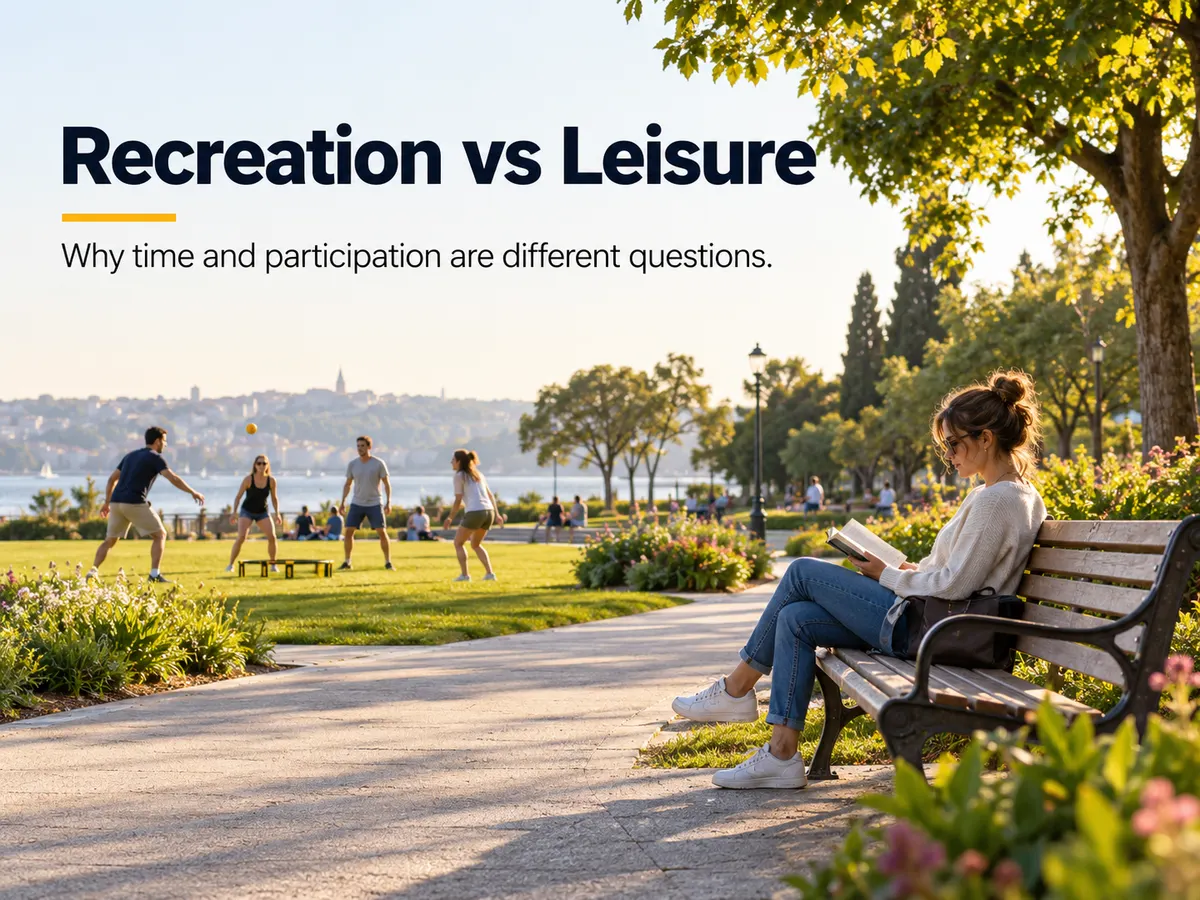
That is why an hour on a bench under a plane tree can be recreation while a busy afternoon in a shopping street may not be, although the second involves more walking and more spending. The measure is not how active you were. It is whether you came back renewed.
Leisure makes no such promise. It is neutral, a container that can be filled with anything at all.
A sofa evening is leisure, and nobody owes an apology for it
This part of the subject easily turns into a lecture about how other people spend their evenings, and I want to avoid that. Watching the weekly series, scrolling a phone, dozing after a long day: these are normal leisure activities, I do all of them, and rest that asks nothing of you has its own value.
The problem appears only when that is the whole menu. In many fast-built districts on the edges of growing cities, anywhere in the world, the housing arrived years before anything else did, and there are few community events and not much within walking distance that invites people to do something renewing with an evening or a Sunday. The hours do not stay empty; they fill with whatever is closest and easiest. I don’t read that as a failure of the people living there, or of anyone in particular. It is simply what free time looks like when nothing has been offered nearby yet.
The shopping mall is a leisure space that rarely becomes recreation
In a lot of cities, for a lot of families, the honest answer to “where can we spend a Sunday without paying?” has become the shopping mall. It is warm in winter and cool in summer, the toilets are clean, there is a play corner, there is security at the door and it never rains inside. The people who design malls read very well what a family needs on a grey weekend, and I give them credit for that.
What it cannot offer is time that is not tied to spending. Every corner is designed to turn a stroll into a purchase, and a household counting every coin ends up spending the day looking at shop windows. The mall is a perfectly good leisure space. As recreation, it is thin, and children notice that sooner than adults do.
People say free time, while planners say recreation
Ask almost anyone what they did at the weekend and they will talk about free time, days off, the kids’ football, a walk by the water. Nobody says “I did some recreation on Saturday.” The word lives mostly in three places: university departments of recreation and tourism management, hotel job titles and the planning documents of the bodies that run parks and sports halls.
Universities run recreation management programs, often inside tourism, sport or health faculties. Large resort hotels on most holiday coasts have recreation or animation teams that run pool games, children’s clubs, evening shows and beach tournaments, which their guests would simply call holiday fun. Cities often divide the subject between a team that builds and maintains green areas and another that organizes concerts, festivals and holiday programs. So the user lives in the vocabulary of leisure while the planner works in the vocabulary of recreation, and the planner’s word rarely reaches the clients and budget holders who decide what gets funded, so the case for why recreation matters gets made from the beginning every year. When I use the word in a meeting with a corporate client, I still sometimes get the polite follow-up: “So you mean parks?”
Parks are the ground it stands on. They are not the whole of it, any more than a congress hall is the congress.
A bench by the water runs itself, and a walking group never does
A row of benches along a waterfront, with a kiosk selling hot drinks at one end, is one of the great leisure spaces of any coastal or riverside city. Nobody organizes it. People come, sit, talk, look at the water and leave when they like. It works because it asks nothing and costs very little, and it often carries more of a city’s character than any destination logo does.
A weekly walking group that meets at the same park gate every Saturday morning, led by an instructor from a local sports club, is different in kind. Someone chose the day, the hour and the route, told people about it, and kept turning up in the first weeks when only a handful came. Without that person, the group would not exist.
Leisure appears wherever people have free time and somewhere to sit, while recreation appears only where someone has decided what will happen there, when, and for whom.
That single difference explains why the two are budgeted so differently. Leisure needs space and permission. Recreation needs space, permission and a program, which is what public space programming means in practice: a person, a calendar and enough continuity to carry it into a second year.
Planning free time works when it is offered and fails when it is imposed
There is a fair objection to all this. Isn’t it a little paternalistic to plan other people’s free time? Shouldn’t free time be left free?
I think the objection is right about one thing. Recreation goes wrong when it is designed in an office for an imagined public and nobody asks who will come, at what hour, from how far. But a program that is offered nearby, free or cheap, at a sensible hour, takes nothing away from anyone. The person who prefers the bench by the water still has the bench. The difference is that the person who wanted to walk with others, and would never have started a group alone, now has somewhere to go on Saturday.
Hotels and incentive programs pay for the confusion in their own ways
The hotel version of the mix-up is familiar. A resort lists its pools, spa and tennis court and assumes the guest experience will follow. By the third day the reviews mention boredom. The hotels that do well with families and long stays understood that the facilities are leisure and the daily program is recreation, and that the program needs a real team with real preparation, not a few seasonal interns handed a timetable on their first morning.
MICE programs have a version too. A company that asks a DMC for “free time” on the second afternoon of an incentive trip usually means a few optional suggestions and a car on standby. One that asks for “a recreation program” means a guided walk, a pottery workshop or a boat day, with transport, guides, timings and insurance. The two requests lead to very different budgets, and in our business more than one client has been surprised by the gap because nobody asked which one they had in mind.
The incentive version has a quieter trap as well. A guided walk or a sports tournament can be real recreation for someone who chose it, and the same activity becomes something else once attendance is expected, teams are fixed by department and the scores go up on a screen in front of the general manager. For a good part of the group it turns into one more working afternoon, only in trainers. I am not against these activities on a company trip, far from it, but they only stay recreation when sitting out, picking another option or going back to the hotel to rest is a genuine choice that nobody will mention at the office on Monday.
Counting turns recreation from a hope into a record
Leisure is usually measured with time-use surveys and satisfaction questions: how much free time people have and how they feel about it. Those are national or city-level questions, and useful ones.
Recreation is measured in humbler ways. The guard’s logbook at the park gate, the attendance sheet of a course, the number of children who signed up for the winter swimming school, the café’s receipts on market days. These small records show who came, who came back, which hours were full and which neighborhoods never appeared. Without them, a city knows that its residents have free time and that it has built places for that time, but it cannot tell whether anything it organized has helped anyone use those hours well.
I don’t think these records need to be sophisticated. A season of attendance sheets, read honestly at the end of the year, usually says more about a program than any satisfaction survey: the course that filled in its first month and emptied by its third, the market Saturday that doubled the morning crowd, the evening hour that nobody over sixty ever used. Those patterns are where leisure and recreation finally meet, because they show which pieces of free time a city actually managed to reach.
The next maintenance specification has room for one more page.