Contents
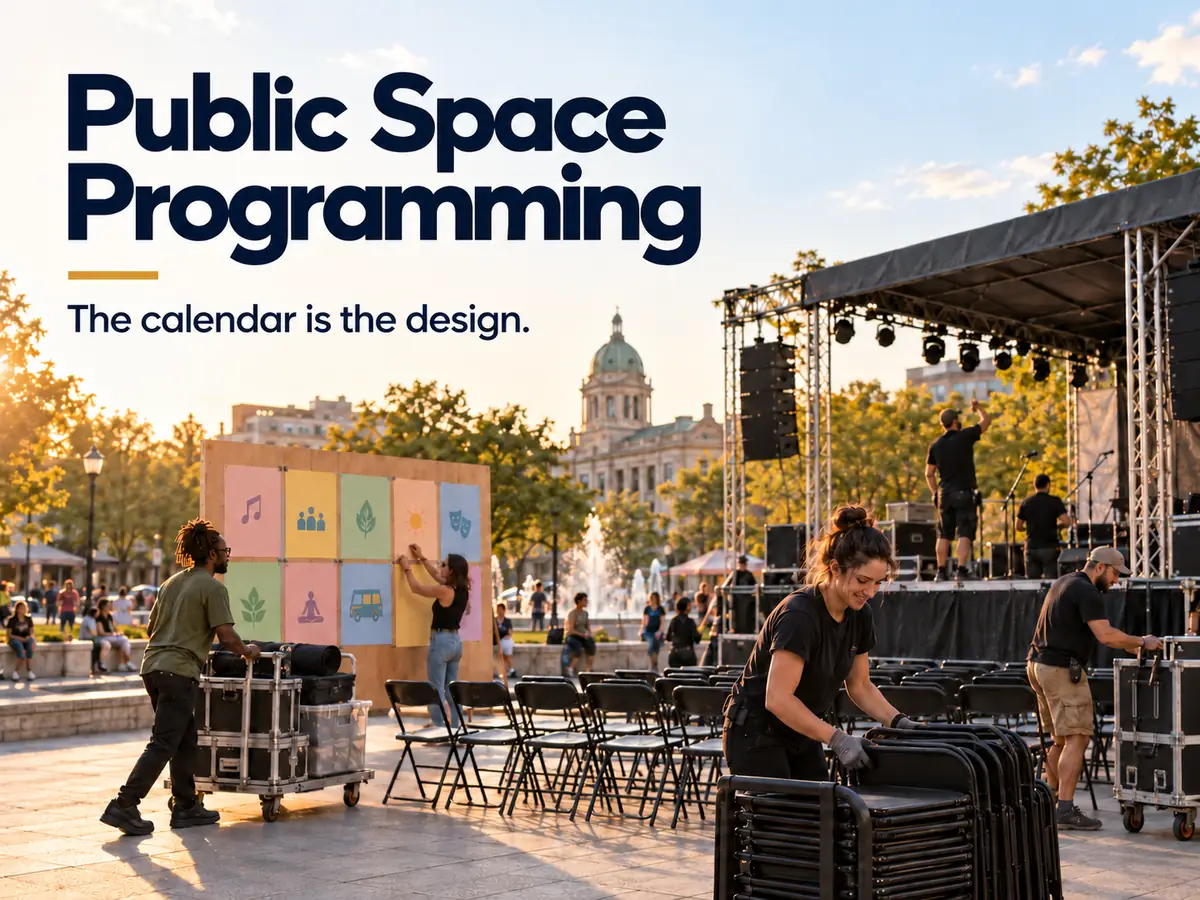
Public space programming is usually taken to mean putting events into a square or a park: a concert in July, a market at the weekend, a festival once a year. That is part of it, but the smaller part. Programming a public space means deciding, week by week and season by season, who the space is for at each hour and what will give those people a reason to come, and then arranging the partners, permissions, equipment and staff that make that pattern happen. The design of a place sets what is possible there. The calendar decides what actually happens, and so it deserves the same care as the paving and the planting.
From the events side this is a familiar idea in a different form. Nobody in our business would judge a venue by its floor plan alone; we want to know what runs there, how often and for whom. Public spaces deserve the same question, and they rarely get it until after the ribbon has been cut.
A week drawn on one sheet of paper
The most useful tool I know for programming is very simple. Draw a week on a single sheet: the days across the top, the hours of the day down the side, from early morning to late evening. Then shade every cell where something regular happens in the space, whatever it is: an exercise group, a children’s workshop, a weekly market, a chess table that the same men use every afternoon, a running club that gathers at the gate. Leave one-off events out for now.
The empty cells tell you more than the shaded ones. In most spaces drawn this way, the shading clusters in the same place: weekend afternoons and the occasional summer evening. Weekday mornings, when retirees and parents with small children are out, are often blank. So are the hours after school, when teenagers are looking for somewhere to be, and the early evening after work, when most adults finally have time. The space is open all day, but its program serves one slice of the population at one slice of the week.
The reason is not hard to find. Programs tend to be built by organizers, sponsors and performers who want the largest possible audience, and the largest audience is on a weekend afternoon. That logic makes sense for a single event and very little sense for a public space, which has to serve the whole neighbourhood across the whole week. Project for Public Spaces has a well-known idea called the Power of 10+: places thrive when people have a range of reasons to be there, and layering many activities means that no single type of use or user dominates. The week drawn on paper is the most direct way I know of checking whether that layering exists or only looks like it does on the opening day.
A good program fills the blanks gradually, one reliable slot at a time, and it leaves some of them empty on purpose.
The booking form at the events desk
Whoever decides how a public space is booked decides who gets to use it. In many cities the process grew around the largest users: event companies, brands, concert promoters, sports organizers. The forms ask for a site plan, insurance, a full safety plan, a deposit and a fee, and they need to be filed weeks in advance. For a festival of several thousand people, all of that is reasonable. For a neighbourhood walking group, a school choir or a few people who want to run a free chess morning every Sunday, the same paperwork, sensible as each piece of it is, becomes a reason not to try. Nobody intends that outcome; the forms simply grew from the biggest cases.
Our own industry should take a hard look at its part in this. Prime weekends in the best squares and parks are often taken months ahead by commercial bookings, and a growing share of them are brand activation days, product sampling and sponsored stages that use the space as a backdrop and leave little behind. I have nothing against brands in public space when they add something people want. But when the calendar of a city’s best square is mostly sold to whoever pays first, the program reflects the marketing budgets of that season rather than the needs of its neighbours.
A fairer booking system usually has two or three tracks rather than one. Small, free and recurring uses get a short form, a quick answer and a standing slot that renews unless something goes wrong. Medium events get proportionate requirements. Large and commercial bookings get the full process, and some of the best dates are held back for the city’s own community events and for regular programs that would otherwise never get a weekend. No new institution is required for any of this. It needs whoever runs the booking desk to see the calendar as a programming tool and not only as a queue.
The storage room behind the kiosk
Most of the people who could run something in a public space are not event professionals. They are librarians, sports club coaches, music school teachers, cultural associations, shopkeepers, retired craftsmen, parents. They would happily bring a weekly activity to the square if the hard parts were taken care of, and the hard parts are almost always physical: where to keep the equipment, who opens the power point, where people sit, what happens when it rains.
So some of the most effective programming investments are surprisingly small. A lockable storage room near the space, ideally next to the kiosk or the caretaker’s office, with a few things anyone on the program can use:
- folding chairs and a few tables,
- a small portable sound system and extension cables,
- shade sails or pop-up canopies,
- a box of games, balls and chalk for children,
- simple signage that can be changed each week.
With that room and someone who holds the key, a library can run a reading morning on the lawn, a sports club can hold a free taster session, a music school can bring its students out for an evening, and none of them has to hire a production company to do it. Without it, every activity has to bring and take away everything it needs, and only those with vans and budgets can afford to try.
This is the practical heart of recreation management: the person running the space is less a producer of activities than a host who makes it easy for others to produce them. The Project for Public Spaces approach known as Lighter, Quicker, Cheaper makes a related point about change itself: temporary, low-cost interventions let a community test an idea immediately and with direct involvement, before anyone commits to something permanent. Programming works the same way. A movable chair and a trial month tell you more than a long feasibility study.
Empty hours on the lawn
There is such a thing as too much programming, and I see it more often than its opposite in spaces that have a budget. A square that hosts something amplified every evening, the loud end of the night time economy, stops being a place to sit and talk. A park where every lawn is booked for an organized activity has no room left for a picnic, a ball game or simply lying on the grass. Children who are always being entertained never get the chance to invent their own games. The space becomes a venue, and the people who used it informally drift away.
Much of what happens in good public spaces was never on anyone’s calendar. Older people playing backgammon, teenagers practising tricks on the steps, families spreading a blanket, friends meeting by the fountain: these leisure activities are the real life of the place, and a program should support them rather than crowd them out. Sometimes the best programming decision is a fixed table with a chessboard painted on it, a wall where a ball can be kicked, or a lawn that is never booked on Sunday mornings.
The calendar of a public space decides who uses it more than its layout does, so the people who draw the layout should also draw the first year of the calendar.
The habit behind it belongs to the design and development world. Projects are usually briefed, designed, built and handed over as physical objects, with a fine set of drawings and no plan at all for what happens on a Tuesday morning in the second year. The program arrives later, if it arrives, and is then forced to fit a space that was never designed with it in mind: no power where the stage would go, no storage, no shade where the morning group gathers. When the brief asks for a draft program alongside the drawings, design decisions improve, because the designers have to imagine real people at real hours. That is placemaking in its most useful sense, and it costs almost nothing at the drawing stage.
The attendance sheet in the caretaker’s drawer
A program is never right the first time. Some slots fill at once, some take a year to find their people and some never work. The only way to know which is which is to count, simply and consistently: an attendance sheet for each regular activity, a note of the weather, a few words from whoever ran it. When each season closes those sheets support three plain decisions about each activity: keep it, move it to another hour or day, or drop it and try something else in its place.
Seasons themselves are part of the design. A program that works in June will not work in January, and a public space that is only programmed for summer has given up half of its year. Winter mornings, the early dark of autumn and the hot afternoons of midsummer each need their own pattern, and the week drawn on paper should be drawn again for each of them.
None of this happens without someone whose job it is. A space with a person responsible for its program, even part-time, with a modest yearly line in the parks and recreation budget for small fees, materials and the occasional instructor, will usually outperform a space that received a much larger capital budget and nothing for its everyday life. That person keeps the partners coming back, notices the blank cells, answers the booking requests from small groups and holds the key to the storage room. Their cost is small next to the cost of the paving, and their effect on whether the place is used is far larger.
A printed week grid and a pencil are enough to start.