Contents
A launch night in a hotel ballroom and a sampling corner in a shopping mall have very little in common, yet in most markets I work in both now tend to arrive under the same word. In plain terms, an event is a gathering the brand organizes and fills itself, and a brand activation is the brand stepping into a crowd that somebody else has already gathered.
“Activation” has slowly come to mean almost anything a brand does outside an ad slot. A tent at a summer festival, a sponsor lounge at a congress, a team of young people handing out samples on a university campus, a branded photo point at a concert: all of these get the word in the proposal. Some proposals stretch it further, to street stunts that really belong to guerrilla marketing. And then, a few lines further down, the brand’s own evening for dealers and journalists is also called an activation, because the word sounds more modern than “event.”
I don’t think anyone is doing this on purpose. The vocabulary of our business moves fast and agencies pick up whatever sounds fresh. But the ballroom and the mall corner are built in opposite ways, and a brand that mixes them up usually pays for one while expecting the results of the other.
The hotel ballroom needs an invitation list
An event, in the sense that matters here, is a gathering that exists because someone organized it. A product launch, a dealer meeting, a customer conference, a brand’s own festival, a dinner for partners. Without the organizer, nobody would be in that room on that date, and that simple fact shapes everything else about it.
The organizer has to invite people, convince them, remind them and often transport and host them. Wherever you work, this means the familiar chain of invitation, RSVP, the phone calls in the last week to find out who is actually coming, the shuttle from the hotel and the seating plan that changes until the morning of the day. The brand owns the crowd because the brand built it, and owning the crowd is a privilege and a burden at the same time. You decide who is there, what they see, in what order and for how long; you also carry the whole cost of their presence, from the venue to the dinner to the parking, and if the program is weak there is nobody else to blame.
That responsibility also gives the event its main strength, which is control over who is in the room. A brand that invites its fifty most important dealers, or the journalists who actually cover its category, can shape the whole evening around them, seat them next to the right people and follow up with each one by name the next morning. No mall corridor offers that. The price of this control is effort spent long before the doors open, on lists, confirmations and the slow, unglamorous work of making sure the right people decide to give you an evening of their time.
The mall corridor already has its crowd
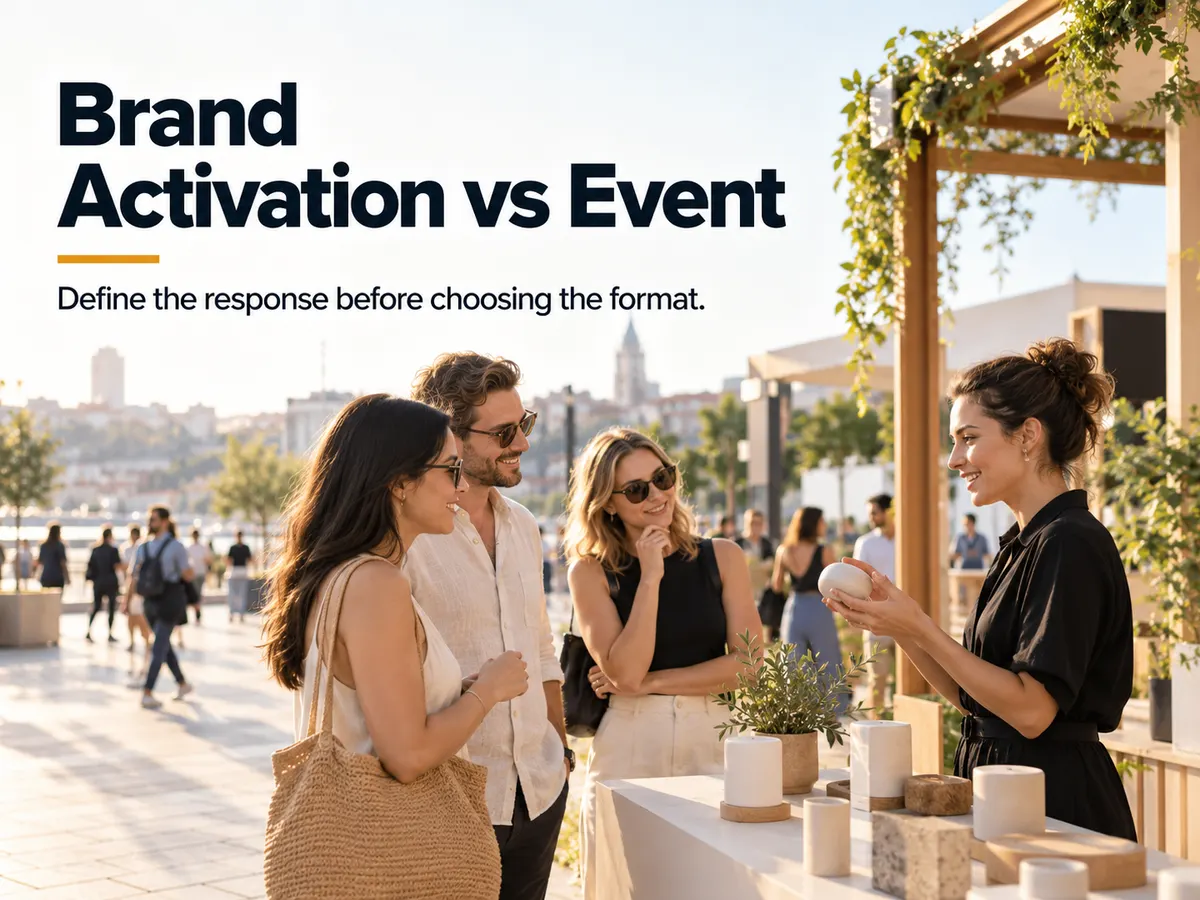
Brand activation works the other way around. The people are already there for their own reasons: they came to the mall to shop, to the festival for the music, to the congress for the sessions, to the stadium for the match. The brand does not gather them. It places itself in their path and tries to turn a passing moment into contact with the product.
This is why activation is so closely tied to sponsorship. A sponsor that only puts its logo on the stage backdrop has bought visibility. A sponsor that sets up a charging point, a shaded rest area, a small workshop or a place to try the product has started to activate that sponsorship. The good ones give the visitor something useful in exchange for a few minutes, while the bad ones stand in the way, with a hostess blocking the corridor and a form to fill in before you can pass. A sponsorship proposal that spells out where the sponsor’s people will stand, and what they will offer there, already tells you which of the two it will be.
What I find helps most is deciding what the visitor is supposed to do before anyone designs what the visitor will look at. Try the product, finish one real task with it, ask a question, book something: each of these needs a different corner, a different amount of time and a different kind of person standing there. Let’s say a brand wants passersby to actually use a new device for about ten minutes, and the stand has room for four demo points. Even on paper that is two dozen proper trials an hour at most, before anyone takes a break or a visitor stays longer than planned, and a campaign that promises “try it today” to a corridor of thousands is setting up a queue rather than an experience. Doing that small sum early is far cheaper than discovering it on the first Saturday.
An event has to create its own reason for people to show up, while an activation has to earn a few minutes inside a reason that already belongs to someone else.
Seen this way, the question for the ballroom is why anyone would come, and the question for the corridor is why anyone would stop. A lot of the confusion I see in proposals disappears once a team writes down which of those two questions it is actually answering. When I sketch it for a client on a single page, it usually looks something like this:
| Event | Brand activation | |
|---|---|---|
| Where the crowd comes from | The brand invites and gathers it | It is already there for another reason |
| The question to answer | Why would anyone come? | Why would anyone stop? |
| Where most of the money goes | Guests: venue, catering, transfers, rooms | Space, time and the people running it |
| Who should be in front of the guest | The brand’s own senior people | Staff who know the product well |
| What tells you it worked | Who came and what happened with them afterwards | How many stopped by choice and stayed |
It is a simplification, of course, and real projects blur these columns more than a page can show.
The mismatch shows itself most clearly when a brand chooses the wrong place for its goal. Brands that want to announce a new product to the press and to their dealers sometimes decide to do it in a mall atrium because “that is where people are,” but journalists and dealers will not stand in a mall corridor on a Saturday, and shoppers who pass by have no idea why there is a stage. The opposite happens even more often: a brand wants ordinary consumers to try a new snack, a phone feature or a service, books a ballroom, prints invitations and fills the room with people who are already friends of the brand. The evening is pleasant, the photos are nice, and almost nobody new has tried anything.
The hostess agency invoice tells the story
When a client asks me what the difference costs, the honest answer is that the totals can be similar while the money flows into different lines. In an event, a large part of the budget goes to the guests themselves: venue, catering, transfers, accommodation if people travel, invitations, registration and a stage program that justifies the trip. The production can be modest or spectacular, but it always sits on top of a hospitality budget that never really goes away.
In an activation, the brand mostly pays for space and for time inside someone else’s crowd. A shopping mall charges for the atrium or a corner, often by the week, and the best spots near the main entrance are booked well in advance around holidays and the back to school period. A festival sells sponsorship packages where the activation area comes with certain square meters and certain hours, and a congress or a trade fair sells exhibition space, from a trade show booth to a slot in the program. Then come the stand builder, the materials, the samples and the people who will run it.
That last line is where activations most often go wrong. In many cities, mall and campus activations are staffed through promotional staffing agencies, which send daily staff who meet the brand on the morning of the first day. They are often students, sometimes very good, but they get a short briefing, a t-shirt and a spot to stand on, and they are paid a daily rate that may arrive weeks later. Then the brand wonders why a visitor who asked a real question about the product got a polite smile and a leaflet. The person standing at the activation is the whole brand experience for those few minutes, and that line of the budget deserves more care than the backdrop does.
A dealer meeting at a resort can hold both
Measuring the two asks different questions. Events are usually judged by who came and what happened between them and the brand: how many of the invited people showed up, how many dealers placed orders afterwards, how many meetings took place, how many journalists wrote something. Because the brand owned the guest list, it knows exactly whom to follow up with. Activations are harder in one specific way, since the brand does not know in advance whom it will meet, so the usual numbers become footfall, samples handed out, forms filled and apps downloaded. A hostess team can distribute thousands of samples to people who would have taken anything free, and the report will still look impressive.
A better question, I think, is the share of people who stopped by choice. If the activation gives something genuinely useful, people stop because they want to, they stay longer and they ask things, and a few of them turn into word of mouth by the evening. A short conversation with a handful of visitors a few days later, or a code that can only be used in a store, says more than the sample count ever will.
None of this means the two must live apart. A dealer meeting at a coastal resort is an event, with invitations, flights, rooms and a program, but the product area in the foyer, where dealers try the new models between sessions, works like an activation inside it: the dealers came for the meeting, and the brand earns their attention in the breaks. It works the other way as well. A sports brand that keeps a weekly running meeting point in the same park, week after week, slowly turns an activation into a small community event with regulars and a schedule, and that shift happens because someone kept showing up rather than because a campaign was approved.
The first paragraph of an agency proposal
Our side of the table is not innocent here. When an agency writes “activation” for a launch night or “event” for a mall corner, it is not just a word choice; it hides what the client is actually buying. A proposal that states in its opening paragraph whether the brand will be building its own crowd or borrowing someone else’s tells the client where the budget will go, who the guests will be, how big the hospitality line is, what kind of staff is needed and how success will be judged. It also protects the agency later, because nobody can fairly blame it for low attendance at an activation that was never supposed to gather people in the first place.
Clients can ask for this directly, and the brand managers who do so get a very different first meeting from the ones who open with “what is the concept?” So, for the project currently on your desk, whose crowd are you planning to stand in front of?