Contents
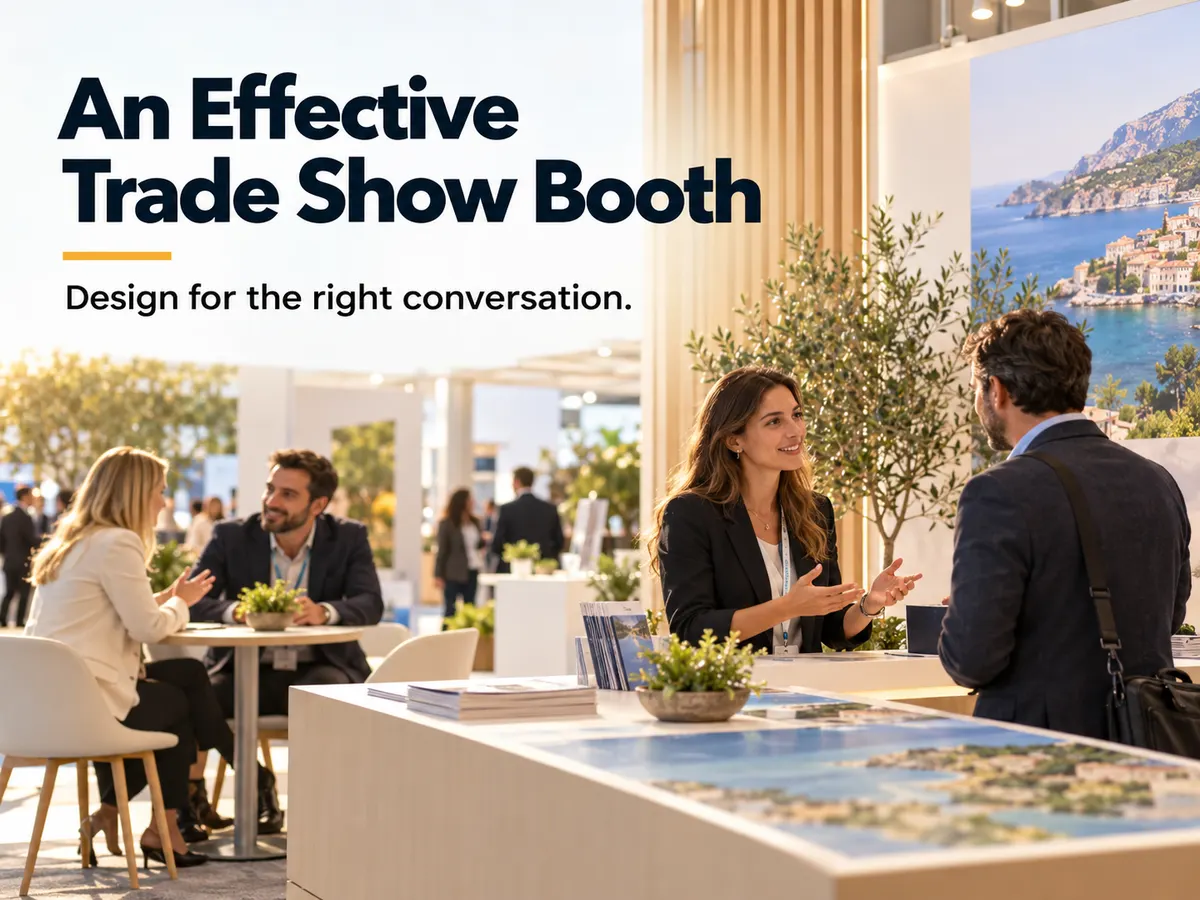
A busy booth and an effective booth are not the same thing, although after three days in a fair hall it is very easy to confuse them. What makes a trade show booth effective is easy to say and harder to buy: room to sit down with buyers, people at the front who can answer their questions, and a follow up that reaches them before the competitors’ does.
The busy booth is the one the marketing team photographs. It has a crowd at the front, a hostess handing out bags and visitors queuing for an espresso. The effective booth may look calmer. It has a few tables in the back where the sales team spends the whole day in meetings, a front that lets people step in without being intercepted, and a stack of business cards with handwritten notes on them. When the fair ends, the first one has a good gallery of photos and the second one has a list of buyers to call on Monday.
Most exhibitors I know would say, if asked, that they want the second kind. Yet the way booths are usually commissioned, designed and judged in most markets pushes them toward the first, and it starts long before the fair, with an image on a screen.
The render shows a booth nobody is working in
Every booth starts its life as a render. The stand builder sends it a few weeks before the fair: a clean three dimensional image, perfect lighting, a glowing logo on the back wall, a counter at the front, a meeting corner with four white chairs and a few elegant figures drawn in for scale. The marketing team likes it, the general manager approves it, and the booth gets built more or less exactly like that. What the render never shows is who stands behind the counter, where the sales manager sits with a buyer, where the coats, boxes and coffee cups go, or what happens when three visitors arrive at once, and those are exactly the things that decide whether a booth earns its cost.
The old idea of a trade fair was simple: you show your products, buyers walk the aisles, and the ones who like what they see stop at your stand. Fewer fairs work like that every year, because buyers can now see a whole sector’s catalog on a screen in an afternoon. What they cannot do on a screen is sit with the people behind a product, ask hard questions and decide whether to trust them, which is the part of the brand experience no catalog can carry. In the strong sector fairs, the ones in furniture, textiles, machinery, food and building materials, the real value of the booth has moved from the shelf to the table, and many exhibitors who return every year to the big exhibition centers have already shrunk their display areas and enlarged their meeting corners.
A booth works when it is planned around the meetings it has to host, not around the render that sold it to the marketing team.
That means asking practical questions early: how many meetings will happen at the same time, whether a closed room is needed or a quieter corner is enough, where samples meant only for serious buyers are kept, and whether there is a place to sit with a buyer from abroad for forty minutes without passing visitors interrupting. None of these questions are about design, yet every one of them changes the design. They also change the calendar, because most of the important visitors at a strong fair arrive with a full schedule made weeks earlier. The exhibitors who get the most out of a fair usually treat the booth as the address for appointments their sales team has already set up by writing to customers and prospects in advance, offering time slots and confirming the day before. Many large fairs now run hosted buyer programs that bring in foreign buyers and schedule meetings with exhibitors, and these deserve to be treated as the core of the fair rather than as a bonus. Walk-in visitors still matter, but a booth whose calendar is empty on the first morning is waiting for luck.
Who can answer a buyer’s question at the counter?
Look at a typical booth in almost any fair hall and you will usually find a counter right at the front with one or two people behind it. In practice it often works like a wall. Visitors see two people standing behind it, waiting, and decide not to come closer; if they do approach, the conversation happens standing, across a barrier, with other visitors passing behind them. The booths that work best in my experience are open at the front, closer in spirit to a pop-up store than to a reception desk, with staff standing in the space rather than behind something, and a display arranged so that a visitor can look at a product for a while without being approached at once. Openness has a practical side that renders rarely show either. A raised platform with a step at the edge, a demo that only works through a touchscreen at standing height, a video with sound nobody can hear over the aisle: each of these quietly turns some visitors away, and they are hard to fix once the stand is built. The W3C’s checklist for making events accessible is written mainly for meetings and presentations, yet much of it applies directly to the demonstrations inside a booth, and it is worth reading before the design is frozen rather than after. The same goes for the demo itself: if it depends on the hall’s network, it needs a fallback that still lets a buyer ask real questions, because the connection will fail at the busiest hour.
Then comes the harder question of who those staff are. Our business does not like to discuss this openly, but at many fairs, on every continent I have worked on, the people at the front of the booth are not the company’s own employees. They are hostesses sent by an agency for the fair days, briefed on the first morning and paid a daily rate. They smile, hand out catalogs and take business cards. The hostesses are doing the job they were hired for; the problem is the job description. A buyer who walks in with a question about capacity, delivery times or certification wants someone who knows the answer, and if the first person he meets has to go and find “the person responsible,” who happens to be in a meeting, the moment is usually lost.
Hostesses have a place at a large stand with heavy traffic, as long as their role is clear: they welcome, guide and look after guests while the sales and technical people talk business, and they know the basics of the company, the program of the three days and exactly whom to call for which question. A briefing a few days before the fair makes a large difference, and so does paying them on time, since people who waited a month for their money last year do not come back with much enthusiasm. The company’s own team needs preparation too. Engineers and managers who rarely meet customers are often sent because someone has to be there, and they end up standing in a small circle, talking to each other and checking their phones, which tells every passing visitor that the booth is closed.
Giveaways belong to the same discussion. Pens, tote bags and keychains fill every hall, and most of them are thrown away within a month. The habit of handing something to everyone who passes creates the wrong kind of traffic: a crowd of collectors that makes the booth look busy in the photos while the buyers you want find it harder to get anyone’s attention. Much of what agencies sell as experiential marketing in a fair hall (the coffee corner, the photo wall, the game screen) behaves the same way when nothing connects it to a conversation. I would rather see the giveaway tied to a conversation, given after a meeting or sent after the fair to the people who asked for something specific.
The business card bowl decides what the fair was worth
The cards collected at the booth go into a bowl. On the last day someone empties it into a bag, the bag goes back to the office and sits on a desk, and a week or two later somebody types the names into a spreadsheet. By the time the first follow up email goes out, the buyer has already spoken to five competitors. In my view, this is where most of the money spent on a booth is quietly lost, not in the design or the location but in a slow and careless follow up.
Buyers who visit many stands remember the ones that wrote back first, with something specific from the conversation, and they mention those names to colleagues, which is the kind of word of mouth a sector fair quietly runs on. The exhibitors who do this well write a short note on each card during the fair, or enter the contact into a simple system the same evening, recording what the visitor asked, what was promised and who will get back to them. A badge scan gives you a name and an email address, and that is all it gives you. The note that makes a follow up possible is short, and on the stands I trust it covers roughly four things:
- what the visitor actually needs, in their words rather than in the catalog’s,
- which product or service the conversation was about,
- any timing they mentioned, such as a tender next spring or a season they are buying for,
- the next step that was agreed, who on your side owes it, and by when.
Anything beyond that tends to be collected and never read. Within a few days after the fair, every serious contact receives a personal message. Nobody puts this in the post-fair presentation, yet it is the part that turns a booth into business. The visitor count that ends up in the report says very little by comparison; the number of conversations that led to a second conversation says almost everything.
Some fairs no longer bring the buyers they used to
A great booth at the wrong fair is still a waste, which is why the choice of fair really belongs at the very beginning of this whole discussion. Plenty of exhibitors book the same hall, the same corner and the same square meters out of habit, and because their competitors will be there. Some add one of the organizer’s sponsorship tiers on top, a logo at the entrance or on the visitor bags, without asking what it adds to the conversations at the stand. Others pick a fair because a new product has to be shown somewhere, and the launch event ends up squeezed into a stand on the first morning. Following the competitors is not a bad reason, but it is not enough. A fair that used to bring buyers can slowly turn into one that brings mostly other exhibitors and casual visitors, a general fair may now be split into more focused events, and an international fair abroad may reach the foreign buyers you want far better than a domestic one.
So before any render exists, the useful question is who you are going to meet at this fair and whether they are still coming. The answer changes the size of the booth, the balance between display and meeting space, the people you send and the budget, and the value of any sponsorship proposal the organizer sends along with the floor plan, and sometimes it changes the decision to exhibit at all; visiting as a buyer instead of building a booth is a perfectly reasonable outcome. I have come to trust exhibitors who can name, before the fair, ten people they are going there to see. Their booths are rarely the most photographed in the hall, yet those same exhibitors are usually the ones who return the following year knowing exactly why.