Contents
If there is one sentence I have seen in client requests more than any other, it is some version of “we want an experiential event.”
It sounds clear when you read it quickly. It is not. Half of the time the client means “we want to be at a big event and have a nice stand,” and that is event marketing: using an event as a channel to reach the people you need. The other half, they mean “we want people to touch, taste or try something, and talk about it afterwards,” and that is experiential marketing: designing what those people actually do with your brand. These are two different jobs, with different budgets, different teams and very different ways of telling whether it worked, and the same three words are being asked to carry both of them.
I don’t think the people writing that sentence are careless. In most companies, the person who prepares the request sits somewhere between marketing and sales, has a budget approved for “an event” and has heard from colleagues, agencies and conference speakers that brand experience is what matters now. So both words end up in the same line, and nobody stops to ask which one is doing the work. The agency reads it, picks the interpretation it is best at, and builds a pitch around that.
The trouble is that the two interpretations pull a project in opposite directions from the very first week. One sends the team looking for the right fair, congress or launch date. The other sends it looking for an idea that people will want to take part in. If the client had the first in mind and the agency heard the second, months later everyone is standing in front of a beautiful installation at the wrong event, wondering why the right people never came.
Event marketing and experiential marketing overlap, and the overlap is not a problem in itself. It becomes one when a team uses the two words interchangeably and then wonders why the result does not match what they had in mind.
Choosing the room is a different job from designing what happens in it
Event marketing, in the simplest terms, is when a brand uses an event to reach the people it wants to reach. The event can be your own, like a product launch, a dealer meeting or a customer conference. Or it can be someone else’s, like a trade fair, an industry congress or a festival you sponsor. What makes it event marketing is the logic behind it: the event is a channel, the same way a magazine or a search ad is a channel. You are there because your audience is there, on that date, in that venue, with some time to spare and some attention to give.
The phrase has a narrower life too. For organizers, event marketing often means promoting the event itself and filling the seats, which is a different job again, and a brief should say which meaning it has in mind. In the wider sense, the AMA’s guide to event marketing strategy counts both the events a company hosts and the ones it attends as part of its marketing mix, and I find that framing honest, because it treats an event as one channel among several that has to earn its place against the others.
That is why the big decisions in event marketing are about selection. Which fair? Which congress? Do we host our own meeting or join a bigger one? How large a stand, which slot on the program, which sponsorship tier? In my own work, a lot of the value comes before anyone builds anything, simply from choosing the right event and saying no to the wrong ones. And honestly, this is where many companies lose money. They go to the same fairs every year because they went last year, book the same square meters and send the same team, and nobody asks whether the people walking those halls are still the people they need.
Experiential marketing starts from a different question. It is less interested in where your audience is gathered and more interested in what they will actually experience when they meet your brand. The idea is that people remember what they do better than what they are told, and that holds only when the doing is clearly connected to what the brand promises; a confusing game at a stand is remembered as a confusing game. So instead of telling them a car is comfortable, you let them sit in it for twenty minutes. Instead of telling them a coffee is smooth, you let them taste it in a setting that makes sense for it. Instead of a brochure about a destination, you let them walk through a version of it.
Notice that none of this requires an event in the classic sense. A pop-up store can be experiential, although plenty of them are simply temporary shops. A test drive program is experiential. A product sampling setup in a shopping mall, done well, is experiential, and so is a well designed showroom. The experience is the point, and the event is only one of the places it can happen.
Shopping malls show where the two meet
You see both every weekend in shopping malls in most large cities (the ones I walk through in Türkiye are no exception), where a brand sets up a corner, a hostess agency sends a few young people, and visitors are invited to try something. Some of these are genuinely good experiences. Many of them are just sampling with nicer furniture. The difference is rarely the budget. It is whether anyone sat down and designed what the visitor should feel and remember, or whether they just booked the space.
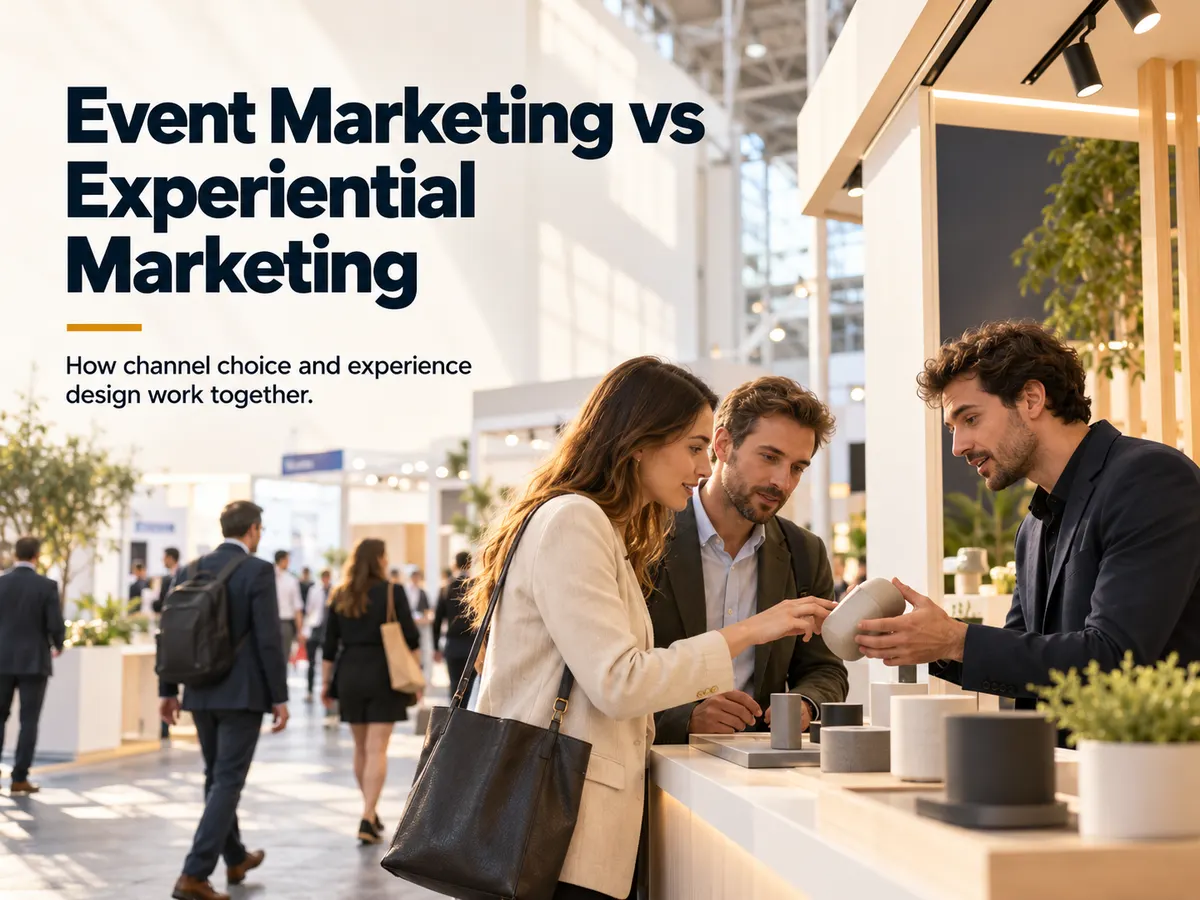
The same overlap appears at fairs and congresses. A booth at a fair is event marketing. A booth where visitors can try the product, see how it is made or solve a small problem with it starts to become experiential. A sponsored congress session, with your manager on stage next to a panel moderator, is event marketing. A sponsored session that is designed as a workshop, where participants actually work on something, carries both, and the sponsorship proposal behind it has to say who will run that workshop and with what.
The difference that matters is not the format but the question the brief is trying to answer.
If the question is “where should we be, and in front of whom?”, you are doing event marketing. If the question is “what should people do with us, and what should they take home from it?”, you are doing experiential marketing. Most good projects answer both questions, but they answer them in that order, and they answer them on purpose.
Put next to each other, the two jobs differ in almost every practical decision a team makes in the first month:
| Event marketing | Experiential marketing | |
|---|---|---|
| The opening question | Where are the people we need, and when? | What should they do with us, and remember? |
| The big decisions | Which fair or congress, stand size, program slot, sponsorship tier | The encounter itself, its setting, who runs it, how long it takes |
| The calendar | Fixed by the event’s own dates | Flexible on date, heavy on design and testing |
| What gets counted | Relevant visitors, meetings, qualified contacts | Who took part, what they understood, what they did afterwards |
In the field the split is rarely this tidy, and one stand often carries both columns.
Destinations and cities are an interesting middle case (and the one closest to my own work). A city that wants to attract congresses has to be present at the right industry events, which is event marketing. But what actually convinces an association to bring its congress is often a site visit, where the decision makers walk the venue, see the hotels and spend an evening in the city. That visit is experiential marketing in its purest form, even if nobody calls it that.
The confusion shows up in the budget and in the report
Some of you may think this is just vocabulary, and that nobody in the field really cares what the thing is called. In daily conversation, that is true. In a request for proposals, it isn’t.
When the brief says “experiential” but the real goal is presence, the agency spends its energy on a concept nobody needed, and the budget goes into an installation instead of into being in the right room. When the brief says “event” but the real goal is an experience, you end up with a beautiful stand where visitors take a brochure and a pen, and leave.
Event planning suffers too. Event marketing has a fixed calendar: fairs and congresses happen on their own dates, and you plan backwards from them. Experiential projects are usually more flexible on the date but much heavier on design and testing, because the experience has to work for people who have never seen it before. If you plan one with the logic of the other, you are either late or you are improvising. In our business, organization companies and agencies usually notice this mismatch in the first meeting, and whether they say it out loud depends on the relationship. I think saying it early is one of the most useful things a supplier can do for a client.
Measurement splits the same way. Event marketing is usually measured by reach and by contacts, and its KPIs are familiar ones: how many relevant people visited the stand, how many meetings were held, how many leads came out of the fair, what it cost per qualified contact. These are not perfect numbers, but they are countable, and over a few years they tell you which events are worth returning to. Experiential marketing is harder to measure, and I won’t pretend it isn’t. The number of people who tried the product is easy to count. What you really want to know is whether they remember it a month later, whether it turned into word of mouth and whether it changed what they buy. That takes follow up, and most teams don’t budget for follow up. The simplest form of it starts at the stand: a visitor who mattered should leave with an agreed next step and the name of the person who will call, otherwise the experience ends when they walk away.
But then, does that mean experiential work cannot be measured? I don’t think so. It means that any attempt to measure event ROI has to be designed together with the experience, not added afterwards. If you know what you want people to remember, you can ask them later whether they remember it. If you never decided, any number you report will be a number about attendance, not about the experience.
Which question should a brand answer first?
For most B2B companies, I would put event marketing first. Your customers gather at a handful of fairs, congresses and industry meetings every year, and being there, in the right place and with the right people at your stand, is the foundation. Once you are reliably present at the right events, you can start asking how to make that presence into something visitors take part in. Trying it the other way around, with a brilliant experience at the wrong fair, is a very expensive way to impress the wrong people.
For consumer brands the order can flip. You may not need any particular event at all, only a place where people can meet the product on their own terms, and for that a well designed pop-up or a long running activation may do more than a one day launch.
When I sit with a client at the beginning of a project, I try to get two short paragraphs onto paper before anything else: one about who we want to meet and where they already are, one about what we want those people to do and remember after meeting us. The projects I have seen go wrong rarely failed on the day itself; far more often, one of those two paragraphs was simply never written.