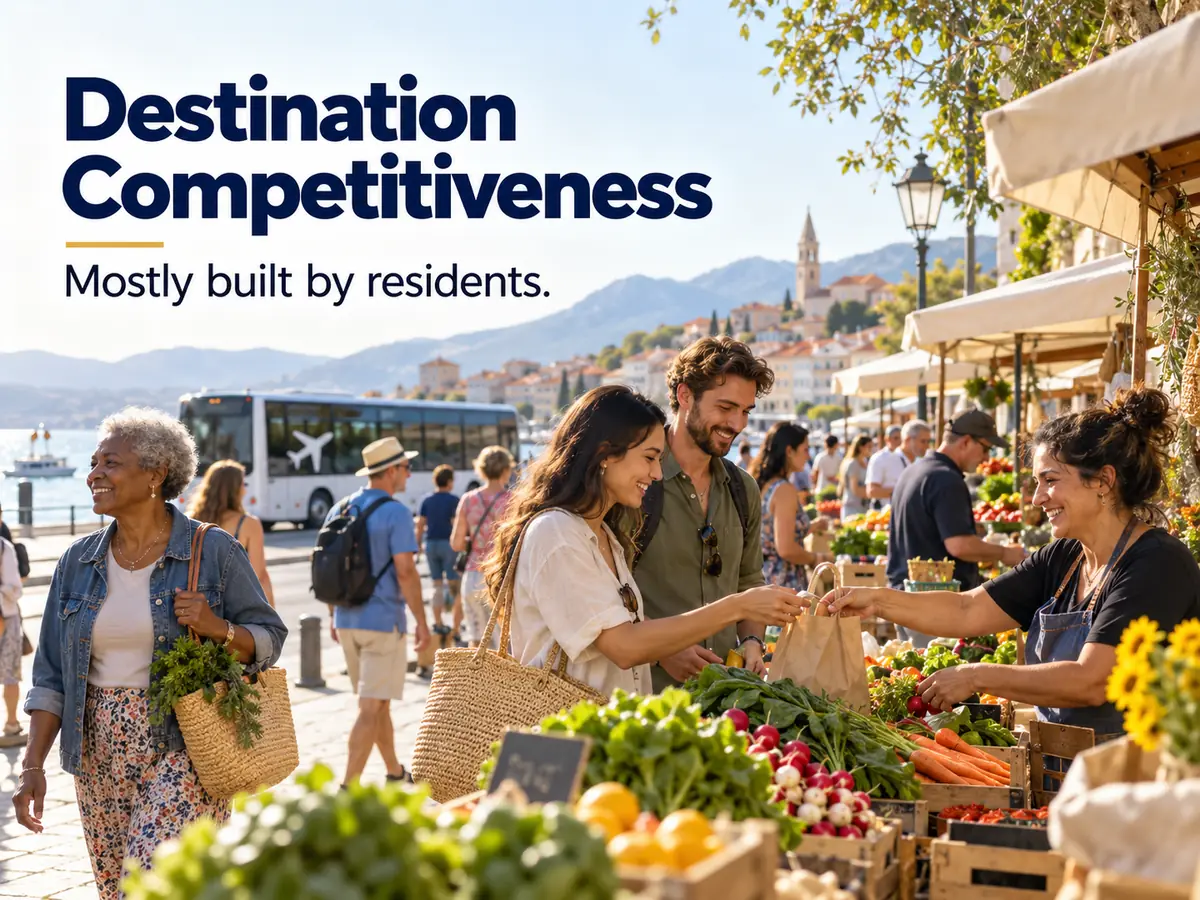
Contents
- Natural assets explain why people come once
- Indexes reward what can be counted from a distance
- The service edge lives in people who stay
- Small businesses are where residents compete for the destination
- A discount war spends the advantage residents built
- The everyday city is the part competitors cannot copy
- Prosperity at home is the test the models skipped
Destination competitiveness is a place’s ability to keep drawing visitors who are pleased with what they find, spend in a way that stays local and come back, while its residents end up better off because of it. That second half is often dropped when the word is used in strategy meetings, and I think dropping it changes the whole meaning. A place that wins visitors and loses its residents’ goodwill, workforce and everyday life is not competitive. It is borrowing against its future.
The UN Tourism glossary puts it in a way that is worth reading slowly. It speaks of a destination using its natural, cultural, human, man-made and capital resources efficiently, and of optimizing what it offers visitors and the local community alike. Human resources sit right there in the middle of the list, next to the coastline and the monuments. In most plans and rankings, they are treated as a footnote.
Watching how congresses, hotel groups and leisure visitors actually choose and judge places has convinced me of something simple. The things that give one destination a lasting edge over another are mostly made, kept and renewed by those who live there.
Natural assets explain why people come once
Researchers in this field have long separated two ideas. Comparative advantage is what a place is given: a climate, a coast, a mountain, a famous ruin, a location between two large markets. Competitive advantage is what a place does with what it is given, how well it turns those endowments into experiences people want and will pay for, year after year.
The distinction matters because many destinations with remarkable assets underperform, and many with modest assets do very well. A beach is a beach, and there are thousands of good ones. A historic center is moving, but visitors who have seen three of them in a year start comparing everything else: how easy it was to get around, how they were treated, whether there was anything to do after six, whether the food was cooked by someone who cared. The asset brings people the first time. Everything that decides whether they return, and whether they tell their friends to go, is produced by people.
I find this the most practical way to read any competitiveness discussion. Ask which part of the advantage was inherited and which part was built, and then ask who built it. The answer to the second question is almost always a long list of residents: the guide who knows how to pace a group, the family that has run the same restaurant for decades, the hotel technician who fixes the air conditioning before the guest complains, the bus driver who explains the route without being asked.
Indexes reward what can be counted from a distance
International competitiveness rankings are useful, and I read them with interest. They compare air connectivity, hotel capacity, price levels, safety, infrastructure, the business environment and a long list of other inputs. For investors and planners they give a common language.
Their limitation is built into the method. A ranking has to compare many places at once, so it measures what can be collected the same way everywhere, and that pushes it towards infrastructure and statistics. The quality of service in a mid-sized hotel, the warmth of a shopkeeper who has seen ten thousand visitors and still greets the next one properly, the evening life of a neighborhood, these are hard to count from a distance, so they appear only weakly, through surveys or proxies.
The trouble starts when destinations manage to the ranking. Our industry is not innocent here. Consultants promise to move a place up the table, campaigns announce a climb of three positions, and the projects chosen are the ones that will register: another terminal, more beds, a bigger venue. Those can be good investments. But a destination can improve its score on every visible input and still feel worse to the visitor, because the part residents produce was never on the list.
The service edge lives in people who stay
Ask any meeting planner why a congress returns to a city it has used before, and the answer is rarely the venue alone. It is the local team: the DMC staff who already know how the association works, the hotel coordinator who remembers the chairman’s preferences, the technicians who have done the same plenary room twenty times. That continuity is a competitive asset, and it belongs to people who chose to build a working life in that place.
Competitiveness and labor meet so directly in that continuity that I am surprised how rarely the two are discussed together. A place that runs on short contracts, staff brought in for the season and sent away in autumn, and young people who leave as soon as they can, loses its memory every year. Each season starts from zero. The tourism workforce shortage that many places now complain about is, seen from this angle, a competitiveness problem dressed up as a hiring problem.
Some readers will object that skills can be trained and staff can be recruited from anywhere. Partly true. Technical skills can be taught in a few weeks. What takes years is local knowledge: which road floods after rain, which supplier delivers on a holiday, which village family will host a group lunch at short notice, how to explain a place to a visitor without reciting a brochure. That knowledge lives in residents, and it leaves when they do.
Small businesses are where residents compete for the destination
Large hotels and international brands matter, but much of what a visitor remembers is delivered by small, locally owned businesses: the guesthouse, the boat operator, the café on the square, the workshop that lets visitors watch a craft, the family that rents bicycles. These businesses are the destination’s experimental arm, where most of its real tourism product development happens. They try new things faster than any strategy can, they stay open in shoulder months when the big properties close floors, and the money they earn is far more likely to circulate locally.
When people talk about the visitor economy, this is the layer I watch most closely. A place where residents can open and sustain small tourism businesses keeps renewing its offer. A place where every new opening is a chain, and where local operators are squeezed out by rents and commissions, slowly becomes interchangeable with its rivals. Interchangeable destinations compete on price, and that is a race very few places win for long.
Destination bodies can help here in modest ways that rarely make headlines. Including small operators in trade programs, making it easier for them to be bookable, featuring them in itineraries rather than only the large partners who pay for visibility, and asking them what holds them back. A DMO that only speaks for its biggest members is managing a market share, not a destination.
A discount war spends the advantage residents built
When demand softens, the reflex in many resort destinations, and I write this from inside the business, is to cut prices, push more volume through large tour operators and fill rooms at any rate. In the short term, occupancy holds and everyone breathes. Over a few seasons, the cost becomes visible: lower wages, thinner staffing, fewer reasons for skilled people to stay, maintenance postponed, guests who chose the place because it was cheap and will leave for somewhere cheaper next year.
Nobody is a villain in this story. Each hotel is making a rational decision for its own balance sheet. But the sum of those decisions spends down exactly the advantage that residents built over decades: the reputation for service, the trained staff, the local suppliers who could no longer compete with the lowest bid. (Follow a hotel’s supplier list over a few such seasons and it tends to narrow to a handful of large wholesalers: efficient on paper, costly for the place.)
The more competitive response is slower and less comfortable: holding rates where the quality justifies them, investing in people, and giving visitors reasons to spend outside the property. It is also the response that keeps residents on the side of tourism, and residents’ attitudes toward tourism development are themselves part of the competitive picture, because a place where locals resent visitors cannot hide it for long.
The everyday city is the part competitors cannot copy
Rivals can copy a convention center, a marina, a theme park, even a festival format. They cannot copy the way a particular city lives, which is most of what place identity means. The neighborhood where people still shop at the same market, the seafront where families walk every evening, the sports clubs that fill the halls, the local way of eating late or early, the sense that a stranger can ask for directions and be walked halfway there. All of it is made by residents living their ordinary lives.
That everyday life is also what generates the most credible marketing a destination has, and most of its destination image as well. Visitors trust what other visitors and locals tell them far more than what a campaign says, and what they retell after a trip is usually small and human: the shopkeeper, the evening walk, the meal. The best city branding I know works with this material instead of covering it up.
Peak weeks can be produced with enough promotion and enough capacity. A place that stays worth visiting in its quiet months is one where daily life carries on with its own rhythm, which is why the strongest work on seasonality in tourism starts from residents’ calendars rather than from discount packages. Seen this way, destination development and the everyday recreation of residents stop being separate fields.
Prosperity at home is the test the models skipped
The early competitiveness models in tourism research did mention the prosperity of the host population. Most of them, though, treated it as an outcome that would follow naturally from a competitive destination, rather than something to be checked. A study in Tourism and Hospitality Management by Chin and Hampton points out that further research had not investigated whether destination competitiveness actually raises the welfare of the host population, as those models assumed. Research has been closing that gap since, yet many places still report their own success as if it did not exist.
I think the gap should be closed in the opposite direction, too. Resident wellbeing is not only an outcome of competitiveness. It is one of its inputs. Residents who earn well from tourism, who can afford to live near where they work, whose parks and evenings are not swallowed by visitor demand, and who see the promise of quality of life tourism kept in their own streets, are the ones who keep producing the service, the small businesses and the everyday city that visitors come back for.
So if a destination wants to become more competitive, I would start with its people rather than with its ranking.
Are the people building the advantage visitors pay for still able to afford to live where they work?