Contents
Terms of reference for destination identity projects tend to resemble each other. A page of background on the region, a list of deliverables, a timeline of a few months, a budget line for workshops. Somewhere in the deliverables there is usually a sentence asking the consultant to “create a unique identity for the destination”. Whenever I come across that sentence, it makes me stop.
Place identity is the set of features, habits and meanings that make a place recognizably itself, both to its residents and to those who visit: its natural setting and building materials, what is grown, made and eaten there, how people spend their days and evenings, the stories and words they use about it. A destination can study that identity, choose which parts to lead with and communicate it well. What it cannot do is invent one from scratch and expect visitors to believe it.
The distinction sounds academic until you see how much money and goodwill are spent on the wrong side of it.
What does a destination already have before anyone designs anything?
More than its destination strategy documents usually admit. Every inhabited place carries layers that nobody had to commission: the stone or timber its older houses are built from, the crops on the surrounding slopes, the trades that survived in the old market streets, the dishes that appear on family tables in a given season, the hour at which shops close for the afternoon and the hour at which the seafront fills again.
These are the raw materials of identity, and they are mostly kept alive by residents doing ordinary things for their own reasons. The weekly market exists because people need vegetables, not because a brand manager placed it there. The local way of preparing fish or bread survives because families keep cooking it. Food tourism works best for the same reason, in places where the food is still part of daily life rather than a reconstruction served only to visitors.
The same is true of the places where people gather. A square that has worked as a meeting point for generations, a shaded promenade, a row of benches near the mosque or the church where older people sit in the afternoon, these public spaces say more about a place’s character than any photograph in a campaign. Visitors read them instantly, often better than the people who plan their trips.
Do destination teams walk through these places with the same attention they give to a logo presentation? Not nearly as often as they should.
Why do so many places end up with the same identity?
Because the industry that sells identity work also sells templates. Look at a dozen coastal districts that went through a rebranding in the same decade and you will often find the same ingredients: a sunset festival, a lantern evening, painted steps for photographs, a “historic” bazaar rebuilt in new stone, a waterfront with identical kiosks, a slogan built around “discover” or “experience”. Each element might be pleasant on its own. Together, repeated from place to place, they produce what geographers have long called placelessness, the slow replacement of distinctive places with standard ones.
Agencies are not the only cause. Chain hotels decorate their lobbies the same way on three continents, tour operators sell the same half-day formats everywhere, and destination bodies understandably copy what seems to have worked for a neighbor. But the agencies and consultants are where I would place the most responsibility, because they are paid precisely to find what is different and too often deliver what is familiar.
This is also where the confusion between placemaking and branding does real damage. When identity is treated as a visual system to be designed, the result is a new layer of signage and street furniture on top of a place that has not been understood. When it is treated as something to be discovered in how the place is used, the result is usually quieter and much more convincing.
Can an event give a place an identity it did not have?
Sometimes, and it is worth being honest about when. Festivals invented from nothing can take root, but in my observation the ones that last are almost always attached to something real: a harvest, a craft, a seasonal migration of flocks to the highlands, a local sport, a religious calendar, a piece of history residents care about. The event gives a shape and a date to something that already existed in people’s lives.
The ones that fade are usually the opposite. A format imported because it looked good elsewhere, a theme chosen by a committee, a headline act with no connection to the place, a program that residents attend once out of curiosity and never again. Such events can fill hotels for a weekend, and that has value. They do not change what the place is.
Smaller community events often do more for identity than the large ones, precisely because residents run them and return to them every year. A neighborhood that keeps its own feast day, a village that holds the same race every spring, a district whose shopkeepers close the street once a season for a market, these accumulate meaning slowly. Visitors who happen to find them often describe them as the most authentic moment of their trip, without knowing that nobody designed them for tourism.
Who gets to say what a place is?
This question is harder than it looks, because identity is never held by one group. Long-standing residents remember one version of the place. Newcomers, including people who moved in for work or retirement, bring another. People who left for the big city and return each summer hold a third, often more nostalgic than the reality. Visitors arrive with a destination image formed by films, social media and travel writing, which may not match any of them.
A destination team that listens only to the loudest of these voices will get a partial identity. The older merchants’ association may want the place known for its historic core. Young residents may care more about the climbing crags, the music scene or the new cafés. Both are right, and a good identity process makes room for that plurality instead of forcing a single story.
The usual workshop format does not help much. A hotel conference room, an invitation sent through the chamber of commerce, a facilitator with sticky notes, two hours on a weekday afternoon: the people who attend are the ones who already sit on committees. Fishermen, market traders, young parents, the woman who runs the bakery and the teenagers who skate on the seafront every evening are rarely in the room. (They are not uninterested; they are working.) Going to where those people already are, the harbor at dawn, the market on its busiest morning, the school gate, usually tells a destination team more in a week than a season of workshops.
The GSTC Destination Criteria offer a useful reference point here. Their criterion on intangible heritage asks destinations to support local traditions, arts, music, language, gastronomy and other aspects of local identity and distinctiveness, and it asks that the presentation of living culture involve and benefit local communities and give visitors an authentic and genuine experience. The emphasis on involvement is the part I would underline. Identity presented without the people who carry it turns into performance very quickly.
Does identity have to stay the same to be real?
No, and treating it as fixed is one of the subtler mistakes in cultural tourism. Places change. Crafts disappear and new ones appear, migrants bring their own food and music, a fishing harbor becomes a sailing harbor, an industrial waterfront becomes a park. A living identity absorbs these changes and stays recognizable. A frozen one is preserved for visitors while residents quietly live a different life a few streets away.
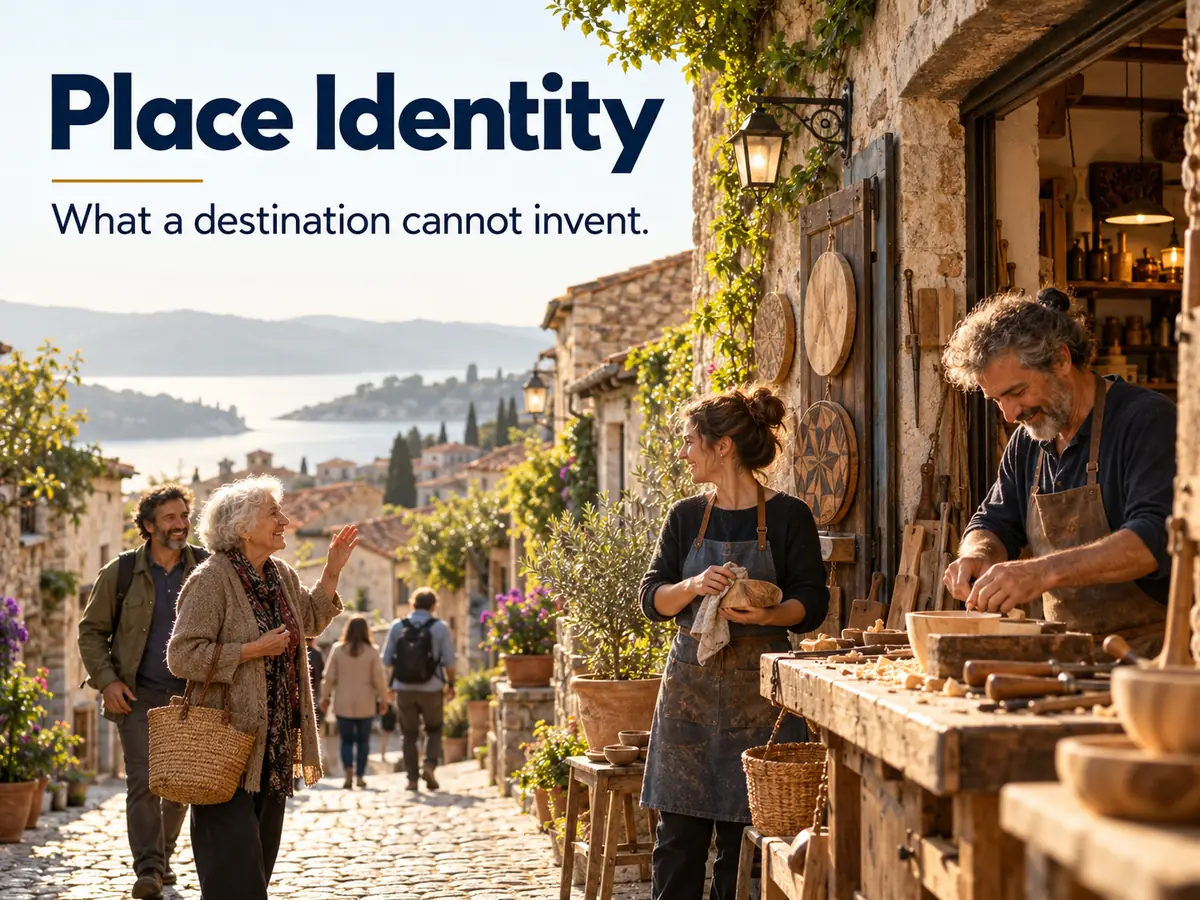
You can usually tell the difference by asking who the cultural activity is for. A craft workshop where the craftsperson still sells mainly to local customers, and welcomes visitors as an addition, carries identity. A staged demonstration with costumes worn only for tour groups carries a memory of identity at best. Both can coexist, and the second is not always wrong, but a destination that offers only the second has stopped trusting its own present.
A destination can choose which parts of its identity to show, but it cannot manufacture the parts that are not there.
This makes me wary of identity work that begins with a positioning statement and then looks for evidence. It is far more reliable to begin with evidence, with what residents actually do, make, eat and celebrate, and let the positioning follow. It also makes the job of destination stewardship easier later on, because the place is being asked to keep doing what it already does, rather than to act out a character written for it.
Reading a place before writing its brand book
If I were asked to prepare an identity study tomorrow, most of the first weeks would be spent outside meeting rooms. Walking the market on its busiest day and on its quietest. Reading the menus of the restaurants where residents eat, not only the ones listed in guides. Asking hotel receptionists and taxi drivers what they recommend to visitors and what they would recommend to their own relatives, because those two answers are rarely the same. Looking at what people photograph and share from the place without any campaign prompting them. Sitting in on a sports club’s weekend, a neighborhood’s feast, a school’s end-of-year event.
This kind of fieldwork is not glamorous, and it does not fit easily into a deliverables list. But it produces something a studio cannot: a picture of the place as it is used, with all its contradictions. From there, choosing what to lead with becomes a matter of judgment rather than invention, and the visitor experience a destination promises is much more likely to match the one people find when they arrive.
The test I keep coming back to is whether a resident would recognize their home in the destination’s own description. When you read the way your place presents itself to visitors, do you see the place you live in?