Contents
On many resort breakfast buffets, on almost any warm coast, there is a small printed card standing beside a refrigerated display. It says something like “local breakfast corner”, and behind it sit two or three cheeses, a bowl of olives, some honey and a tray of sliced tomatoes. Everything else on the buffet, from the pancakes to the croissants, could be in any resort in the world.
That card is a fair symbol of where gastronomy tourism stands in a lot of resort destinations, if by gastronomy tourism we mean the trips people make for a place’s food and for the life around that food. Most of those coasts have a regional breakfast worth a trip on its own, a table of local cheeses and olives, honey from the hills behind the beach, fruit that tastes of something, eggs cooked the way the region likes them, fresh bread and tea or coffee made the way people take it there, and every city nearby has places where locals sit for two hours on a Sunday. The international guest, meanwhile, gets a corner with a label.
The gap between how rich a food culture is and how little of it reaches the visitor in a meaningful form is, to my mind, the real subject of gastronomy tourism.
Eating while travelling or travelling to eat?
Everyone eats on holiday, so the useful distinction is between eating while you travel and travelling in order to eat. Gastronomy tourism is the second: trips in which food and the culture around it are a main reason to go, which covers tasting local dishes but also visiting producers and markets, learning to cook, joining a harvest and understanding why people in a place eat what they eat.
Food tourism and culinary tourism describe almost the same thing. If anything, “culinary” leans towards cooking and kitchens, “food tourism” is the broad everyday term, and “gastronomy” carries the cultural and historical side more openly. The industry uses all three interchangeably, and even the glossary UN Tourism keeps describes the field through producers, festivals and cooking classes as much as through meals, so I don’t see much value in arguing over the labels. What matters is that the gastronomy tourist chooses the destination, the dates and sometimes the hotel because of food. A long weekend in Lyon, Bologna or Oaxaca purely to eat is now a perfectly ordinary trip for a great many people, and that is gastronomy tourism in its clearest form.
A list of dishes is a door, not a destination
Nearly every region on earth has a page of local flavors in its promotional material: ten dish names, ten photos, perhaps a recipe. These pages are useful and many are made with care. Still, nobody gets on a plane for the photo of a dish. People travel for the dish in its place, made by someone who knows how, from ingredients grown nearby, somewhere that gives it meaning. A dumpling tastes like a dumpling anywhere; a dumpling in the shop where one family has made it for generations, after you have watched the dough being rolled and the broth being started, is a reason to travel.
People do not travel for a dish; they travel for the life around it, and a destination becomes a food destination only when that life is open to visitors.
That life has recognizable parts. There is the producer, the person or village the food comes from. There is the market, where a city’s kitchen is on display every morning. There is the season, because local cuisines change through the year and the best moments are tied to harvests and preparations. And there is the story connecting it all, the migrations, trade routes, climate and traditions that made the food what it is. The list of dishes opens the door, and everything behind it is the trip.
Some cities took their own kitchen seriously
UNESCO’s Creative Cities Network has a gastronomy strand, with members as different as Parma, Chengdu, Tucson and Gaziantep, and these are the kind of places people in the industry point to, several of them good cases of second cities tourism built on food. Their food is wonderful, but so is the food of countless cities that nobody travels to for it. What the well-known food cities did differently was to treat their cuisine as part of the city’s identity and make it visible.
In such a city the signature product is not only something to eat. It is workshops that start before dawn, masters and apprentices, arguments about which nut, which milk or which flour, a whole hierarchy of knowledge that visitors can see and hear about. Around it sit markets, a culinary museum, guides who talk about food, events built on it, and businesses proud to explain what they do. That did not come from a single campaign. It came from many people in the city taking their own kitchen seriously for a long time, and from a hospitality sector that learned to sell it, which makes it a lesson for restaurants, guides, producers and agencies more than for anyone else.
Does that mean every region should try to become the next famous food city? I don’t think so, and I would be wary of the attempt. A place with a few good dishes but no producers, masters or restaurants willing to open their doors will not turn into a food destination by adding a festival and a logo, because event tourism needs something real behind the date. Many places would do better to pick one product they genuinely own, a cheese, a fruit or a bread, and build a small, honest visit around it, with a producer who agrees to host and a restaurant that serves it properly, rather than compete with cities whose kitchens have been talked about for centuries.
Why are producers and markets missing from the itinerary?
Most food tours, in most countries, begin and end in restaurants. The places where the food actually comes from rarely appear.
Olive groves, cheese dairies in the mountains, tea estates on steep slopes, nut and fruit orchards, villages where families still make their winter preserves at the end of summer: for a visitor who cares about food these are extraordinary places. But most producers are not set up to receive guests, and it is not their job to be, even in villages where rural tourism has started to bring a guesthouse or two. They are farming, and twenty people arriving unannounced is a disruption rather than an opportunity. This is precisely where a DMC or a local agency earns its place, by finding producers open to small groups, agreeing in advance what visitors will see, paying the producer properly for the time, and preparing the group to arrive as respectful guests. Before the first group goes out, a short written agreement with the producer saves a lot of embarrassment later, and it rarely needs more than a few lines:
- how many visitors, how often, and which parts of the farm or kitchen they may enter
- what will be tasted, and whether it replaces a meal or comes on top of one
- which allergens and dietary needs the producer can and cannot handle, and who answers ingredient questions on the day
- the fee for the producer’s time and preparation, and whether buying something is welcome or expected
The fee and the buying question deserve the most care, since a visit where buying feels compulsory quietly turns a producer into a showroom. Many countries keep long registers of geographical indication products, protected cheeses, hams, fruits and spices among them, and each is in principle a place and a producer a visitor could meet, though very few of those registrations have an experience built on top of them yet.
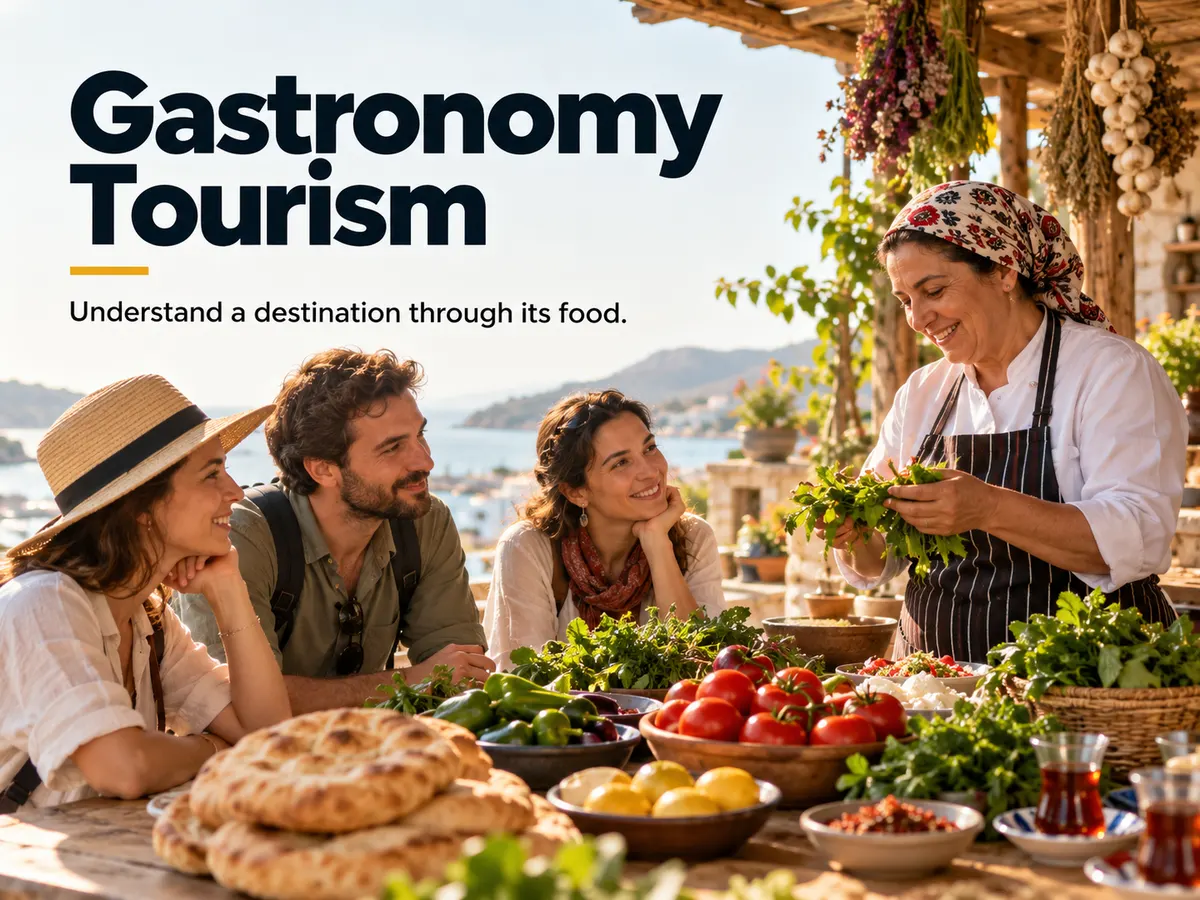
The weekly neighborhood market is the same story in the city. Stalls of seasonal produce, cheeses, olives, spices and dried goods make it one of the most authentic places a visitor can go, and for most visitors it is invisible because no program includes it. A morning there with someone who explains what is sold, where it comes from, what people will cook with it tonight and why prices shift from month to month is better gastronomy tourism than many tasting menus, and it costs very little to arrange, as long as the groups stay small, since a market crowded with coaches stops being a market and turns into overtourism on the scale of a single street. Seasons work similarly: the first tea picking in spring, the nut and fruit harvests at the end of summer, the olive harvest in late autumn, the weeks when families make preserves and dried goods for winter. These moments give visitors a reason to come in a particular week rather than in August with everyone else, and most of them are still part of local life only. In Muslim-majority destinations, Ramadan evenings, when the iftar table becomes the center of the day, belong to the same calendar, and they mean a great deal to visitors who come on faith tourism programs.
Hotel kitchens buy more food than anyone in the region
My own side of the industry deserves a frank word here. Hotels and event caterers are among the biggest food buyers in any destination, and a lot of what they serve could come from anywhere. All-inclusive resorts feed huge numbers of guests every day, mostly from international buffets designed to please everyone, and a guest can spend a week in a resort without tasting anything that belongs to the region. Conference catering is often similar, with the same coffee break pastries and the same gala menu in every city and nothing to tell delegates where they are.
Habit explains part of it, purchasing systems built around a few large suppliers explain more, and the fear that guests will dislike unfamiliar food does the rest. Purchasing teams also worry, not without reason, about food safety at small suppliers, and the WHO’s Five Keys to Safer Food give both sides a plain shared starting point, alongside whatever local rules apply. Small changes are noticed all the same: a breakfast corner with cheeses and olives from named local producers rather than a generic label, a regional dish of the day with two lines of explanation, a congress lunch built around the host city’s cuisine. They cost little more and give a hotel something to talk about that its competitors cannot easily copy.
The other missing piece is the person who tells the story. Professional guides in most countries are trained mainly in history and archaeology, and food is not yet central to most programs. Restaurant owners are busy serving, producers are busy producing. Where someone does stand in a market and explain the food in the visitor’s language, everything changes; the best-known food cities have people who write about their cuisine, lead food walks and run workshops, and elsewhere such people exist one by one without yet being part of the product, which is the sort of gap a local DMO, where one exists, is well placed to help close. A handful of trained food guides in a city would do more for its gastronomy tourism than a dozen new restaurants.
Where can a visitor eat breakfast like a local?
Almost anywhere, if somebody tells them where to go. Every city has its breakfast places, its Sunday tables, its bakeries that open before sunrise, and none of them needs a new investment to welcome visitors.
In plenty of cities the breakfast places fill on weekend mornings with local families sitting at long tables, and the few foreign visitors among them are usually there because a taxi driver or a hotel receptionist mentioned it, not because anything in their program did.