Contents
Long before anyone spoke about a tourism industry, people travelled to visit tombs, shrines, churches, temples, monasteries and holy springs. They walked or rode for days, stayed in inns and guesthouses along the way, bought food and small keepsakes, and went home with stories to tell. In almost every sense that matters to our business, that was tourism, even if nobody would have dreamed of calling it so. Today we call it religious tourism, or faith tourism: travel whose main reason is religious or spiritual, whether a long pilgrimage or a quiet visit to a sacred place.
The same movement continues today on a very large scale, and it is still rarely given the name. A family travelling to Lourdes, walkers on the last stretch of the Camino into Santiago de Compostela, Hindu families at the ghats of Varanasi, Orthodox pilgrims at the Church of St Nicholas in Demre, an elderly couple visiting the tomb of a revered teacher on a holiday morning: none of them would describe themselves as tourists in the way a beach guest might. Ask them and they will say they went on a visit, or a pilgrimage.
For the industry, though, they are guests in the fullest sense. They need coaches and transfers, rooms and meals, guides and someone to call when an older traveller feels unwell. They often travel in organized groups, plan well ahead and come back to the same agency if they were looked after properly. In purely commercial terms, faith travel is one of the steadiest markets we have.
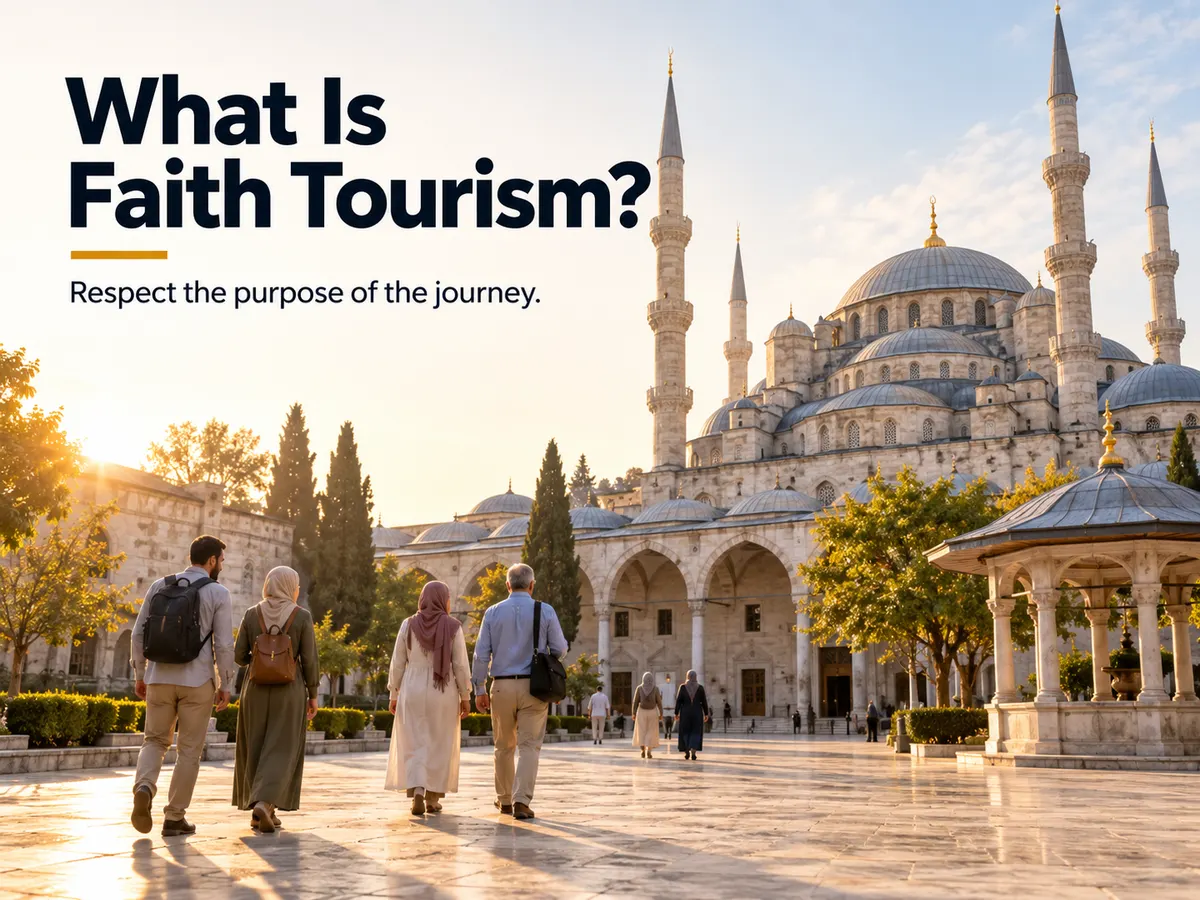
What makes it different from every other market is that the main place being visited does not belong to the visitor, or to the industry. A mosque, a church, a tomb or a monastery belongs first to the people who pray there, and the visitor, whatever their own background, enters as a guest. That single fact changes how a program should be timed, how a guide should speak, what a hotel kitchen should prepare and how close a souvenir stall should stand to a door.
I think faith tourism deserves more attention from our side of the business, not so that it can be sold harder, but because it is one of the few areas where getting small details wrong genuinely hurts people.
A sacred map shared by several faiths
The forms it takes are many: pilgrimages, visits to sacred sites and tombs, taking part in ceremonies or commemorations, retreats, journeys that follow the footsteps of religious figures. Within it there is a wide range of motivation. At one end stands the pilgrim, for whom the journey itself is devotion; at the other the cultural visitor drawn by history and architecture; between them many people who carry a little of both, someone not especially observant who still wants to light a candle, say a prayer or sit quietly where their family’s faith has roots.
The world’s sacred map is crowded, and much of it is shared. For Muslim visitors Mecca and Medina stand at the center, and tombs, shrines and historic mosques from North Africa to Central Asia draw steady streams, especially at weekends and on religious holidays. For Christian visitors Rome, Lourdes, Fatima and the routes to Santiago receive groups from every continent, and the eastern Mediterranean holds many of the faith’s earliest churches and the sites linked to the apostles. Jerusalem is sacred to three faiths at once. Hindu pilgrims travel to Varanasi and to the great Kumbh Mela gatherings, Buddhists to Bodh Gaya and Lumbini, Sikhs to the Golden Temple in Amritsar, and old synagogues in many port cities carry centuries of Jewish heritage. Some routes blur into sports tourism altogether, as the Camino does for hikers who walk it with no religious purpose at all.
This map overlaps naturally with the rest of tourism. A cathedral is usually part of a city day, temple complexes sit beside markets and valley walks, and many pilgrim cities mix faith, history and food in a single visit. Visitors move between faith tourism and cultural tourism without ever noticing a border.
Holy days keep a calendar of their own
Faith travel keeps its own calendar, and it pays no attention to the summer season.
Religious holidays and commemorations bring large numbers to particular places on particular dates. Holy Week fills Rome and Jerusalem, feast days bring processions of pilgrims to Lourdes and Fatima, and the yearly commemoration of a saint or a mystic can fill a city’s hotels in the middle of winter, when the rest of the region’s tourism is quiet. It resembles event tourism in one respect only, in that a fixed date decides when people come; in every other respect it is a commemoration. Ramadan changes the rhythm of daily life: meals move to the evening iftar and the pre-dawn suhoor, many visitors want to break their fast near a historic mosque, and hotels and restaurants serving groups have to adjust their kitchens and service hours. Christian feast days bring services and pilgrim groups to certain sites. Because the Islamic calendar is lunar, Ramadan and the religious holidays move roughly eleven days earlier every year, so a hotel planning around last year’s dates is already wrong.
For hotels, DMCs and transport firms this calendar is both an opportunity and a test. These visitors often come in months when the coast is empty, and they return year after year if they are well served. In exchange they need an operator who knows the dates, understands the rituals around them and does not treat a religious occasion like a festival weekend.
A spare headscarf on the coach
Many places on that map are not monuments of the past. They are places where people pray every day, which is why UNESCO runs a separate Initiative on Heritage of Religious Interest for sacred sites rather than treating them like any other old building. A mosque has five daily prayers and a special noon prayer on Fridays; a church may hold services, weddings and funerals; a shrine may have visitors sitting in quiet grief. Many smaller shrines and holy springs stand in villages, where every visiting group is also a form of rural tourism whether anyone calls it that or not, and the village notices each coach that arrives.
In faith tourism the visitor is a guest in someone else’s sacred place, and every part of the product, from the timetable to the guide’s tone, should be built around that fact.
On the ground this comes down to things that are simple to say and easy to forget when a program is tight. Groups are scheduled outside prayer times, especially around Friday noon. Visitors are told beforehand about dress, meaning covered shoulders and knees, a headscarf for women entering a mosque, shoes removed where required. Guides know where photography is welcome and where it is not (being allowed through the door is not the same as being allowed to photograph someone at prayer), and they lower their voices inside. Forty people arriving with a guide speaking through a loudspeaker just as the call to prayer begins is not a cultural visit; it is a disturbance.
The best guides and agencies I know take all of this seriously. They brief the group on the coach before arrival, keep spare scarves in a bag by the driver, shift the program around prayer and service times, and explain the meaning of the place accurately and respectfully towards those who worship there. The tourists benefit too, because they finally understand what they are looking at.
Our own corner of the business has a version of this mistake that I would like to see less often. A sacred dance, a hymn or a devotional chant gets booked into a gala program because it looks impressive on stage between the main course and the dessert, and nobody asks the people who actually keep that practice whether a hotel ballroom is a fitting place for it. UNESCO’s ethical principles for intangible cultural heritage give the communities concerned the primary role in deciding how their heritage is presented, and I think event planners should read that as a working rule: if the practitioners would hesitate, the answer is a different act, or the same one in a setting where it means what it is supposed to mean.
Umrah groups judge an agency by the hotel’s distance from the mosque
Faith tourism runs outward as well as inward. From almost every country with a sizeable Muslim population, Türkiye among them, a very large number of people travel abroad every year for religious reasons, above all for umrah, the pilgrimage to Mecca that can be made at any time of year. Hajj, the major annual pilgrimage, is organized through its own official system with national quotas, while umrah is offered by licensed travel agencies, for many of which it is the heart of the business.
Operationally, umrah is demanding. Many travellers are older, some are leaving the country for the first time, and the journey involves crowds, heat, long walks and intense days of worship. The quality of the trip rests on very practical things: how near the hotel is to the mosque, whether the transfers run on time, whether the group leader and religious guide are experienced and patient, whether medical needs were anticipated, and whether someone answers the phone when a traveller gets lost or unwell. When it goes well, it is a deeply meaningful journey for the traveller and a lasting relationship for the agency. When it does not, the disappointment weighs far more than after a failed beach holiday, because the trip carried so much personal meaning, and I think agencies in this field carry a responsibility that is closer to care than to sales.
Halal kitchens, fasting menus and the shop by the entrance
Groups travelling for faith, in either direction, need things a standard tour product does not always cover. Muslim groups need halal food and, during Ramadan, meals at the right hours, and when that food is a proper regional dinner rather than a hotel buffet, the group goes home with a little food tourism folded into its pilgrimage. Some Christian groups, especially in the Orthodox tradition, keep fasting periods with specific dietary rules. Many want a quiet room in the hotel for prayer or reflection. Older travellers need a slower pace, more seating, shorter walks and accessible transport. Groups that travel with their own clergy expect those leaders to be part of the planning rather than treated as ordinary passengers. A DMC that does this well usually has someone on the team who understands the tradition of the group being served, and that person is the one who notices a church visit scheduled during the group’s own service, a gala dinner set for a group that is fasting, or a buffet without clear labels.
Around every popular sacred site a commercial ring grows: souvenir stalls, restaurants, parking attendants, photographers, sometimes touts. Some of this is natural and welcome, since visitors want to eat, rest and take something home, but there is a point where the ring begins to crowd out the purpose of the visit, and the industry plays its part in that. Programs that allow twenty minutes inside a sacred place and a full hour at the shop beside it, or that rush a group through several religious sites in one day, say a great deal about priorities. Businesses that keep a dignified tone, fair prices and a calm entrance usually earn more over the years, because visitors return and recommend them, which is sustainable tourism in its plainest commercial sense. Yet how many itineraries still measure a pilgrimage day by the number of sites ticked off rather than by whether the group had time to sit, pray or simply be quiet in even one of them?