Contents
- Heritage, crafts and food belong to the same trip
- Shade and a bench decide half of a heritage visit
- A licensed guide with time is the real product
- Who pays for the long stop at the carpet showroom?
- A weekly bazaar has no ticket and no tour slot
- Spring and autumn belong to the heritage sites
- The second night in a culture city
What do you think people actually remember a week after a day at a great ancient site, at Ephesus, Pompeii or Petra?
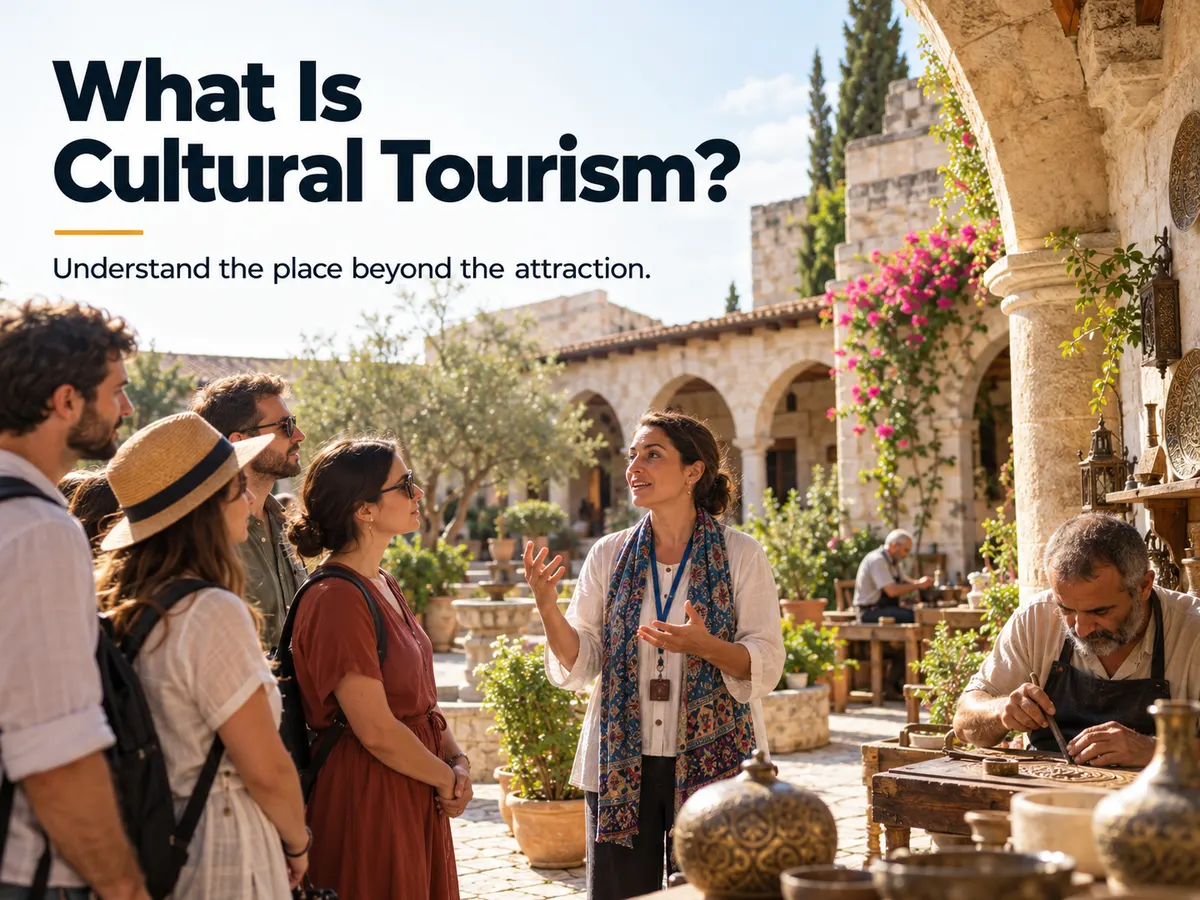
The columns, certainly, and the great theater and the paved streets. But listen to a family describe the day and other things come up just as fast: whether they found shade, how long the ticket queue was, whether the guide made the stones speak or just read out dates, where they sat afterwards and what they ate. The monument opens the memory and the rest of the day fills it, which is why I would describe cultural tourism more widely than most people do: it is travel made to understand how the people of a place live and have lived, and the monuments are the doorway to that rather than the whole of it. In most destinations it is not a niche product for specialists. It is a day trip from the beach, a weekend in an old city, a morning in a market, and a great deal of it depends on things no museum label will ever mention.
Heritage, crafts and food belong to the same trip
In the industry’s own terms, the main purpose of the trip is to see, learn about and experience the culture of a place, and UN Tourism’s definition of cultural tourism deliberately covers both the tangible and the intangible side of it. That includes its history, archaeological sites and museums, and just as much its crafts, food, music, religious and social traditions, markets and everyday life. The visitor is looking for meaning as much as for a view.
Some of that culture lies in the past: Angkor, the Acropolis, the old quarters of Kyoto or Fez, the rock-cut churches and temples found from Ethiopia to India. Some of it is very much alive, like a coppersmiths’ street, a weekly village market, a regional dish eaten where it comes from, a concert in an ancient theater, or a potter shaping local clay the way his family has done for generations.
The industry likes to keep these in separate boxes, with heritage in one, gastronomy tourism in another and events in a third. The visitor does not. Someone who spends the morning in a temple complex and the afternoon in a cooking class, or who visits a cathedral and then sits down for the dish the region is known for, is having one cultural experience, not three.
Three words get mixed up in this conversation, and the difference between them is mostly about depth:
| Term | What it centers on | How deep the visit goes |
|---|---|---|
| Heritage tourism | Inherited places, objects and traditions | Depends on interpretation and time |
| Cultural tourism | Heritage plus living culture: crafts, food, music, everyday life | Aims at understanding people, past and present |
| Sightseeing | A way of visiting rather than a subject | Often a photo stop, sometimes much more |
A monument on the program does not make a trip cultural tourism by itself. A crowded day can reduce a great place to an arrival and a departure, while three stops tied together by one good question, say how trade shaped a harbor, can leave visitors with a real picture.
Shade and a bench decide half of a heritage visit
A heritage site can be world class and still send people home tired and faintly disappointed, and the reason seldom lies in the site itself.
It lies in the long walk from the car park to the ticket office in the midday sun, the absence of a bench in the shade halfway along the route, toilets only at the entrance, a café that seems designed for nobody to sit in, children bored after twenty minutes because nothing was made with them in mind. Shade, benches and toilets do not count as culture in the academic sense, yet they decide whether the visit feels like discovery or like an endurance test.
In heritage tourism management, the businesses and operators around the sites have a great deal of influence. The tour operator chooses the arrival time and the order of the visit. The guide decides whether the group starts in the sun or in the shade. The hotel decides whether guests leave with water and a hat or with nothing. The cafés and shops near the exit decide whether the day ends with a quiet moment to talk over what was seen. Visitors do not expect perfection, only that someone thought about their day.
A licensed guide with time is the real product
If I had to name the single factor that makes or breaks cultural tourism, I would name the guide. In many countries guiding at heritage sites is a licensed profession, with training and exams behind the badge, and Türkiye, where I work, is one of them. At their best, guides are extraordinary: they know the history and the site, they know which corner has the best light at which hour, and above all they know how to turn information into a story a tired visitor will keep.
What I see too often is a guide squeezed into a program that leaves no room for any of that. Three sites in a day, long drives between them, a fixed lunch stop and a shop visit at the end, so the guide recites dates at speed because there is simply no time for anything more, and the visitor goes home with photos and very little understanding.
Cultural tourism works when the visitor leaves understanding something about the people of a place, not only having seen the stones they left behind.
That understanding nearly always arrives through a person: the guide, the craftsman, the shopkeeper who explains what a spice is for, the cook who tells you why a dish is only made in winter. The programs people talk about later are the ones that gave such people time. The good guides also tell visitors which part of a story is documented history and which is a local legend nobody can trace, and I find that guests trust them more for it, not less.
Who pays for the long stop at the carpet showroom?
Group programs in many destinations include stops at carpet, leather, jewelry, gem or ceramics showrooms. Some of them are genuinely interesting, with real craft demonstrations. Many others are, plainly put, commission stops. The program is built partly around them, the hour spent there is taken from the actual cultural visit, and the visitor senses it, so the day ends with the feeling of having been sold to rather than shown something.
I understand why it happens. Competition pushes tour prices very low, and the commission is what makes the program profitable. Yet the cost lands somewhere: on the guide who loses credibility, on the craftsman presented as a salesman, on a destination that gets known for tours that are really shopping trips. A cheap base price paid back through a long showroom stop is a good deal for the showroom and for nobody else.
Operators who build programs around real workshops, where visitors watch a potter or a weaver at work, ask questions and buy only if they want to, usually find that guests spend more and complain less. The difference is whether the craft is the experience or the excuse.
A weekly bazaar has no ticket and no tour slot
Heritage sites are easy to sell because they have opening hours, tickets, a fixed address and a famous name. Living culture has none of these, and so it gets undersold.
A neighborhood bakery that has made the same bread for decades offers no booking slot. A harvest gathering, a family celebration, an evening when a whole neighborhood is out in its squares and cafés cannot be reserved. Yet these are often the moments visitors describe first when asked what they loved, and this is where DMCs, local agencies and guides are at their best. A program with a morning at a market alongside a person who explains the stalls and the produce, lunch from a family recipe in a small restaurant rather than a tour group canteen, and a visit to a workshop in an old merchants’ quarter takes more preparation than a standard heritage tour. It also builds a destination competitiveness no rival can copy overnight.
There is a line to respect. Living culture belongs to the people living it. A market is first of all for those who shop there, and a place of worship for those who pray there. A craftsperson or a musician is a participant in the program, with views of their own, and UNESCO’s ethical principles for intangible cultural heritage put consent and the community’s own voice at the center for that reason. For an operator that means agreeing beforehand what may be shown, photographed, recorded or sold, paying for the preparation and the lost working hours as well as the hour itself, and asking again when the group grows or the format changes, because a demonstration made for twelve people is a different thing in front of two hundred. Good cultural programs bring visitors in as guests, in small groups, at moments that do not disturb daily life; bad ones turn daily life into a set, which is how overtourism begins in a living neighborhood long before the visitor numbers look large.
Spring and autumn belong to the heritage sites
Much of Mediterranean tourism, and plenty of it elsewhere, is still built around sea, sand and sun, packed into a few summer months. Culture offers a natural way to stretch that in time and across the map, and spreading visitors over more months and more places is about as practical as sustainable tourism gets.
Spring and autumn are the best seasons for most heritage sites, just when coastal hotels are open but far from full. A beach holiday can easily include a day at an ancient theater or an old hilltop quarter an hour inland. Some heritage regions work through the whole year, many inland cities lead with culture rather than coast, and concerts or festivals in ancient theaters during the cooler weeks give visitors a date to travel for, which is where culture and event tourism quietly meet. For coastal hotels and agencies, that means selling cultural day trips with better timing and better guiding instead of as an afterthought at the reception desk, and for tour operators it means shorter, slower cultural programs instead of a whole country in a week.
Hoteliers on the coast sometimes tell me their guests simply do not want culture, that someone on an all-inclusive package has paid for everything inside the hotel and sees no reason to leave it. For a family with small children in the hottest weeks of summer there is some truth in that. It is far less true of the couples and older travellers who fill the same hotels in April or October, many of whom ask at reception about the ancient sites nearby and are handed a brochure for a full day coach tour leaving at dawn. A shorter outing at a gentler hour, recommended by someone who has actually been there, tends to find takers among exactly those guests.
The second night in a culture city
A culture city earns most from the visitors who stay the night. The evening walk, the dinner, the breakfast in a local guesthouse, the morning visit before the crowds arrive, all of these happen only if the visitor sleeps there. A coach that arrives late in the morning and leaves by mid afternoon gives the city its crowd and takes its spending elsewhere.
Cities that lead with culture usually have plenty to fill a second day, and their small hotels and guesthouses are often among the most charming places to stay in the whole region. The villages around many of them, where village tourism is slowly finding its feet, could fill a morning on their own. Working with those hotels, the guides and the restaurants to build an overnight program is ordinary DMC work; it needs a little more planning and a little less driving. The visitors who do stay tend to remember the evening longest, so why do so many of our programs still rush their guests through an old city in an afternoon and take them to sleep somewhere else?