Contents
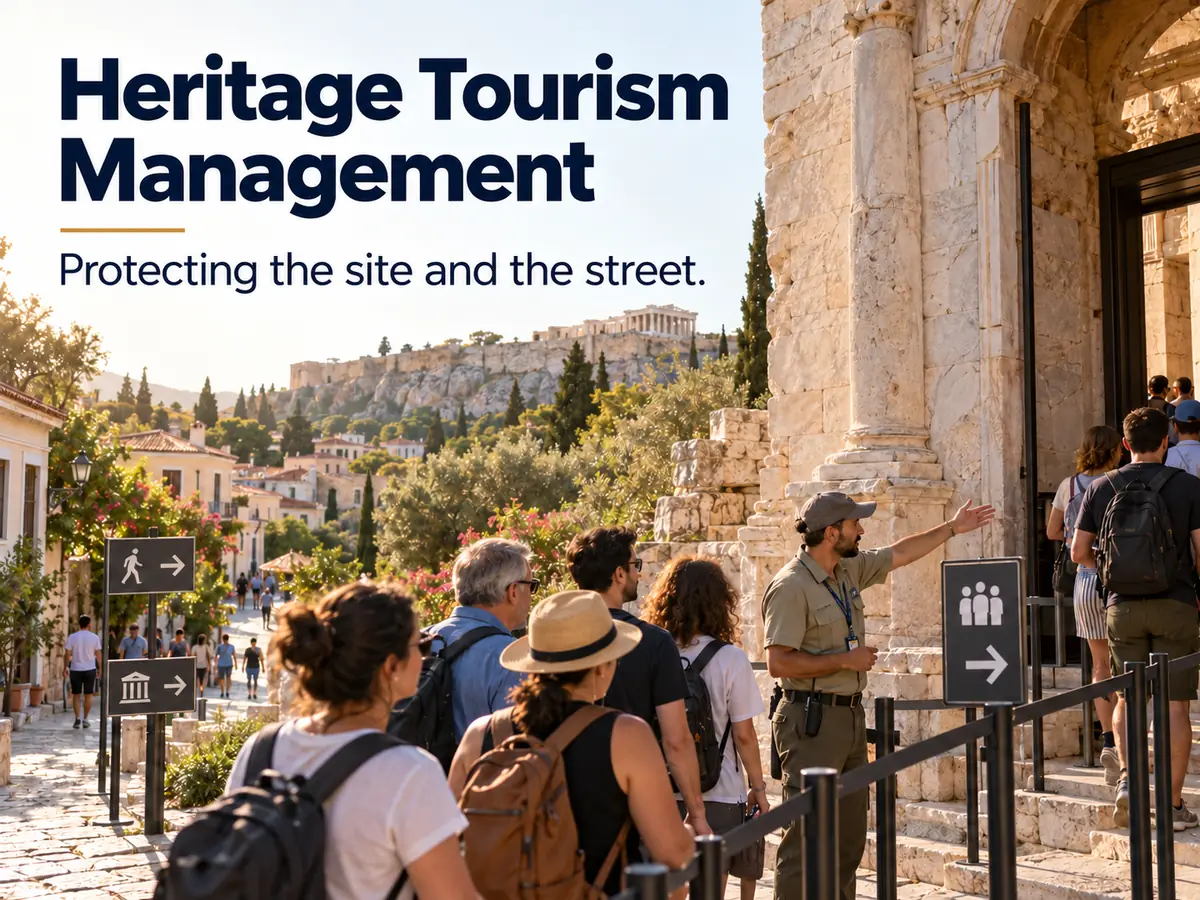
Where does a heritage site end? At the ticket gate, most management documents would say, and that answer sits behind many of the problems around famous places. Heritage tourism management is the work of protecting a historic place while receiving visitors in it, and of making sure that tourism pays for conservation and leaves the surrounding community better off rather than emptier. The site inside the fence is only half of that job. The other half is the street outside it: the houses, shops, squares and daily routines that give the monument its setting and that tourism changes faster than anything inside the walls.
Most of the expertise in this field sits with conservation professionals, archaeologists and site managers, and it is serious, careful expertise. What tends to be missing is the part that tour operators, hotels, event organizers and property owners control, which is almost everything that happens beyond the gate.
The ticket gate is not the boundary
Inside the fence, a well run heritage site has rules for nearly everything: where visitors may walk, what may be touched, how many people may enter a fragile room, when the cleaning crews work. Outside the fence, the same visitors are subject to almost no shared plan. They arrive by coach in a narrow lane, wait in the sun beside residents’ doors, buy water from whoever has turned their front room into a kiosk and leave through the same lane an hour later.
The GSTC Destination Criteria put this well. Their criterion on visitor management at cultural sites asks a destination to manage visitors within and around cultural sites, taking account of their capacity and sensitivity, and to make guidelines for behaviour available to visitors, tour operators and guides before and during the visit. The words “and around” carry the whole argument. A site can be immaculately protected inside its walls while the historic quarter that gives it meaning wears out a few metres away.
I think this is where the gap between cultural tourism as it is sold and heritage as it is managed is widest. The product sold to visitors is the whole old quarter, the atmosphere, the walk to the monument. The responsibility, in practice, often stops at the boundary of the protected site.
The souvenir shop that replaced the bakery
Walk around almost any famous historic center in the world and you will notice the same slow change. The bakery becomes a souvenir shop, the tailor becomes an ice cream counter, the family house above it becomes rooms for short stays. Each change is a sensible private decision. Together they empty the street of the life, and much of the place identity, that made it worth visiting.
The ICOMOS International Charter for Cultural Heritage Tourism, adopted in 2022, is unusually direct about this. It says the widespread promotion and use of cultural heritage has caused commodification and gentrification, compromising local communities and cultural integrity. That is a strong statement from a body of conservation professionals, and it places the problem partly outside their own field, in the market around the sites.
Our industry has a share in it. Tour programs that allow forty minutes at the monument and thirty minutes of “free time” on the souvenir street create exactly the demand that turns bakeries into shops. Investors who buy historic houses for guest rooms rarely ask what the street will look like when every neighbour has done the same. Even well meaning boutique hotels can push rents up until the shops that served residents cannot stay.
The change has no single remedy, and much of it lies with property owners and businesses rather than with anyone’s regulations. Some of what helps is ordinary commercial choice: owners who keep part of a building for long-term tenants, hotels that buy their bread and repairs from the neighbourhood, operators who send guests to the working craftsman rather than to the shop that sells imported copies of his work, and trade associations that talk openly about the mix of shops a historic street needs to stay a street. It is slow work, and honestly it is less exciting than a restoration project. It decides more.
The scaffolding on the facade
Conservation is never finished. Stone weathers, timber rots, mosaics loosen, and a heritage site that looks complete is usually one that is being repaired somewhere out of sight. Visitors rarely see that work, and they rarely know who pays for it.
The ICOMOS charter is clear that revenues generated through heritage tourism must contribute to the conservation of the heritage and provide benefit to local communities, and that visitors should be made aware of their contribution. The GSTC criteria on protecting cultural assets ask for mechanisms that use income from tourism to support conservation. Read together, they describe a loop: visitors come because the place is preserved, their spending helps keep it preserved, and they are told so.
In many destinations that loop is broken somewhere in the middle. Much of the money visitors spend around a heritage site goes to transport, accommodation, food and shopping, and very little of it finds its way back to the stones. I would not claim to know the right mechanism for every place, since that depends on how each site is owned and financed. What the private side can do is easier to describe. Tour operators can explain, in a sentence on the itinerary, what part of the ticket supports the site. Guides can show the conservation work instead of steering groups away from the scaffolding. Hotels and DMCs can offer visitors a way to support a specific repair, and companies bringing incentive groups to a historic city can include a visit to a conservation workshop, which tends to be remembered long after the photographs at the main viewpoint. Scaffolding, explained well, can be the most interesting thing a visitor sees all day.
The stage in the ancient theater
Events are a growing part of heritage tourism, and they are where our industry has the most direct responsibility. Concerts in ancient theaters, product launches in historic courtyards, gala dinners in palace gardens and light shows on cathedral fronts are all sold as unforgettable settings, and they are. They are also some of the heaviest short-term loads a historic place ever carries.
A modern stage needs a platform, a roof or truss, sound systems, lighting rigs, generators, catering tents and toilets. All of it has to be brought through gates and lanes built for carts, set on surfaces that may be centuries old and taken down again overnight. Heavy cases roll over worn steps, cables run across mosaics, vibration from low frequencies travels through masonry and audiences of thousands walk paths designed for a fraction of that number. Every competent production company knows how to protect a hotel ballroom carpet. Far fewer have a method for a marble threshold.
My criticism here is aimed squarely at event companies, ours included. The heritage venue is too often treated as a backdrop that happens to be old, with the build squeezed into the shortest possible window because the rental is expensive. A proper event safety plan for such a place has to include the monument itself as something to be protected, with load limits agreed with conservators, protected routes for equipment, sound levels set for the structure as well as the neighbours and a person from the site’s own team on the floor during build and strike. When those conditions feel like obstacles, the event probably belongs in a different venue.
The square residents still cross every morning
Heritage is not only stone. Many historic places are still used for what they were built for: prayer, markets, weddings, processions, or simply the morning walk to work. The GSTC criteria include one on traditional access, asking destinations to monitor and protect local community access to natural and cultural sites and to restore it where it has been lost. It is one of the shorter criteria, and in my view one of the most important.
Access is lost quietly. A square becomes a coach drop-off point, so residents stop crossing it. Opening hours are set for tour groups, so locals can no longer visit the place their grandparents used freely. A courtyard is rented for private events on so many evenings that it stops being a public space at all. Nobody decides to exclude residents; the timetable does it for them, and the change shows up later as a change in residents’ attitudes toward tourism development, a resentment that seems to come from nowhere.
Heritage tourism management succeeds only when the site’s conservation, the visitors’ routes and the daily life of the surrounding streets are planned as one system, because tourism moves pressure from one to the other whenever they are managed apart.
What that asks for is a set of simple, unglamorous agreements. Some hours or days when a place belongs mainly to its community. Coach parking moved to the edge of the historic quarter so that the last few hundred metres are walked. Event bookings limited so that a public courtyard stays public on most evenings. Ideas like tourism carrying capacity are often discussed only for the monument; I would apply them first to the street.
A management plan the tour operator has actually read
Most significant heritage sites have a management plan, and the better ones are thoughtful documents. The ICOMOS charter asks that visitor management be integrated into those plans, and that they use monitoring and capacity indicators to control, concentrate or disperse visitors as appropriate. The difficulty is that the people who do the daily visitor flow management, the tour operators, cruise excursion planners, DMCs, guides and hotel concierges, have usually never seen the plan.
That is not a criticism of the site managers, who are often stretched thin. It is a gap between two professions that rarely sit at the same table. Heritage managers think in decades and in conservation terms. Tourism businesses think in seasons and in itineraries. The plan speaks the first language, and the itinerary speaks the second, so the crowd arrives at ten in the morning regardless of what the plan says about mornings.
Closing that gap is mostly a matter of translation. A short annual meeting before the season, where the site team explains its pressure points and the operators explain their constraints. A one-page version of the plan written for guides. A shared calendar of conservation works and events. This is what destination stewardship looks like at the scale of one site and its neighbourhood, and it is the most practical defence against overtourism that a historic place has, because it changes behaviour before the queues form rather than after.
Heritage outlives everyone who manages it. The test of our work is what the next generation of residents and visitors will still find, both inside the gate and in the lanes leading to it.
Does anyone own the three streets nearest the main site, and has that person ever sat down with the people who plan the tours?