Contents
- Legacy belongs to district festivals as much as to the Olympics
- A stage platform by the shore needs an owner on Monday
- The local suppliers who learned to work together are worth more than the stage
- Temporary teams become a city’s experience when someone calls them again
- Big venues show their legacy in the weeks nothing famous happens
- A weekend that people keep free is the slowest thing to build
- Legacy is decided in the planning meeting, not in the closing report
- What the city should still be using a year from now
The trucks leave first. Within a day or two of almost any large event, the stage has come down, the barriers are stacked on pallets, the generators have been driven away and the ground looks more or less as it did before. The people who organized it are already answering emails about their next project, and the city goes back to its ordinary week. Event legacy is whatever stays behind after that: the spaces, skills, working relationships, calendar dates and reputation an event leaves in the place that hosted it once the guests have gone home.
That moment, when everything temporary has gone, is when the most useful question about any event can finally be asked: what does this place have now that it did not have a month ago?
The answer comes in several forms. Some of it is physical, such as a venue, an improved square or a permanent power connection in a park. Some of it is human, such as skills, working relationships and a team that now trusts itself, the part of legacy closest to the social impact of events. Some of it lives in time, in the form of a weekend that people start keeping free every year. Some of it is reputation, the quiet sense among organizers that this city can handle things.
The word is mostly used for very large events, for Olympic parks and World Cup stadiums and expo grounds, and that is understandable given the scale. But I think the idea belongs just as much to the festivals, congresses, concerts and tournaments that happen every weekend in cities everywhere. They are smaller, they rarely get written about and they leave much more behind than anyone records, or much less than they could.
The size of the budget rarely decides which it will be. What matters is whether someone, early in the planning, asked what should still be there a year later, and who would look after it.
Legacy belongs to district festivals as much as to the Olympics
At a small or medium event nobody writes legacy reports. The event happens, it ends, and next year it happens again or it does not. Yet even a two-day district festival or a regional congress can leave three valuable things: a public space that has become more usable, a group of people who have learned to work together and a place in the city’s calendar.
A weekend food festival on a coastal promenade can leave all three, and so can a small sports tournament in a district hall. None of them stays on its own. All of them depend on decisions taken long before the opening, when the plan is still soft enough to change.
A stage platform by the shore needs an owner on Monday
Festivals often improve the ground they use. A section of a park is leveled, a proper electrical panel is installed, lighting goes in along the paths, a concrete platform is poured near the shore for the main stage. For three days the place is busy and beautiful.
Then the festival ends and a very practical question appears: whose space is this now? The department or company that ran the festival has moved on. The team that maintains the park may not even know what was installed or what it was meant for. A year later the next festival sometimes builds the same thing again from nothing.
The fix is not complicated, but it has to be agreed early. If something permanent is built for an event, deciding beforehand who will own it, who will maintain it and what else it will host during the year changes the design itself. The platform is built so that a weekly market or a school performance can use it. The lighting is placed so that the park becomes usable on summer evenings for walking, running and the kind of everyday outdoor recreation that needs nothing more than light and a safe path. The electrical panel is sized for small weekend events, so that a local organizer does not have to rent a generator every time. All of that goes better when the team that will look after the place afterwards sees the drawings while they can still change, because they know what the site needs on an ordinary Wednesday and the event team usually does not.
Smaller things follow the same rule. Reusable staging, signage systems, registration kits and furniture are often bought with good intentions and then stacked in a warehouse nobody owns, and calling something reusable does not mean anyone will reuse it unless it has a place to be stored, a person responsible for it and a next event already in mind. This is placemaking in its most practical form, decided in a technical drawing rather than in a slogan.
The local suppliers who learned to work together are worth more than the stage
Every event creates a temporary network. The local sound and lighting company, the caterer, the shopkeepers who opened stands, the associations, the schools that spread the word, the security firm, the hostess agency and the people from the relevant city departments all find out who delivers and who keeps their word.
That knowledge is precious, because the hardest part of organizing the next event is rarely finding people. It is finding reliable ones.
Usually this network dissolves the moment the event is over. Next year the same names are called, but nobody quite remembers who did what well. Keeping it alive needs no software and very little money: a list, a thank-you and one honest meeting after the event about what worked and what did not, written down in a short handover file that someone is named to keep. It also needs the most basic courtesy of all, which is paying everyone on time. A supplier who waited months for payment will not rush to come back, and in our business that happens far too often.
Temporary teams become a city’s experience when someone calls them again
Outside a handful of very large organizations, most events, whether in Türkiye where I am based or elsewhere, do not run on a settled volunteer program, so the people at the gate are mostly agency workers paid by the day, students called in from universities and hostesses booked for the weekend. They often meet the site on the morning they start, and they disappear when it ends.
When an organizer keeps a simple record of who worked well and calls those people first next year, perhaps with a little more responsibility, something changes. The event begins to build its own experienced team instead of starting from zero each time. Over several years, a city that hosts regular events this way ends up with a pool of people who know its venues, its traffic and its habits, and no building can leave a city that kind of legacy.
Big venues show their legacy in the weeks nothing famous happens
Large events often leave large venues, and cities on every continent have gained many in recent decades: modern stadiums, sports halls, congress centers, exhibition grounds. Many of them are excellent buildings, well equipped and well kept. As someone who works in events, the question I find most interesting is how they can serve their cities even more in the weeks when nothing famous is scheduled.
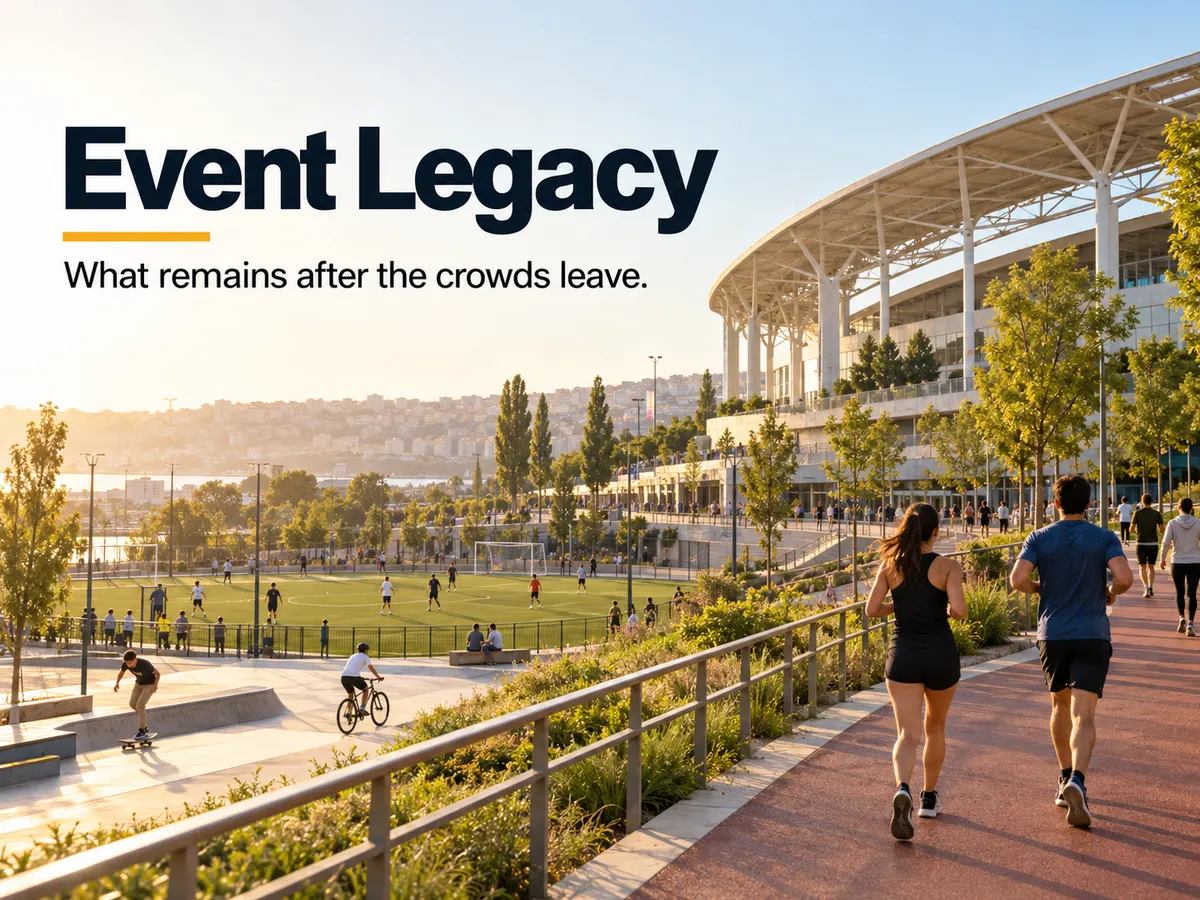
Take a modern stadium. Match days fill only a small part of its year. For the rest of the time it is, from an event manager’s point of view, the largest ready-made venue in the city, with gates, toilets, power, parking, security systems and lounges already in place. With turf protection, a concert can use the pitch safely. The concourses can host a trade fair. The lounges can welcome dealer meetings, launches and graduation ceremonies with a view no hotel ballroom can match. A school final played on the main pitch, a half marathon finishing on the track, a Sunday market in the car park; each one makes the stadium feel like the city’s own.
A venue’s legacy is written in its ordinary weeks, in whether a school, a small organizer or a neighborhood can get through its door when no headline event is taking place.
What usually makes the difference is not the building but the arrangement around it: a clear agreement between the club, the city and the event sector on who can use what and on which terms, a published calendar, and a rental desk with a price list and someone who answers the phone. Organizers bring their events to the venues where they know whom to call.
A weekend that people keep free is the slowest thing to build
The third kind of legacy takes longest. In the first year almost nobody knows about the event. In the second, last year’s visitors remember it. A few editions later, families arrange their weekends around it and visitors from neighboring cities ask about it in spring.
This chain breaks easily. An event that jumps from May to September, skips a year or changes its name never quite settles. The same happens when the organizing team changes and the file is not properly handed over, so that years of contacts and habits vanish within a season. When people finally start asking “is it on this year?”, the event has become part of the place and, quietly, part of the city brand as well, and that is a legacy worth protecting more carefully than any structure.
Legacy is decided in the planning meeting, not in the closing report
All of this points to one practical habit: legacy has to be planned before the event, because afterwards everyone is tired and attention has moved elsewhere. The largest events learned this the hard way, and the IOC’s own writing on legacy and sustainability now describes legacy as something built into the whole life of the Games, starting long before the opening. A district festival can borrow the principle without borrowing the scale.
The question in a planning meeting can be very modest. What will we build, install or learn that could still be useful in a year, who will own it, who will we call again and which date are we committing to? Even a short written answer turns the event into something closer to an investment, because next year’s edition starts from somewhere.
It would also change how we evaluate events. Final reports in our business are full of attendance figures, social media reach and photographs, with perhaps a paragraph on visitor experience drawn from a survey. Those numbers describe the event and its immediate effect, and hotel nights and supplier spending belong in the same category. Legacy is what is still there when all of them have gone back to normal. Very few reports look back a year later, as a real event impact assessment would, and count how many days the space was used, how many suppliers returned or how many of the temporary team came back. The OECD’s guide to measuring the impact of culture, sports and business events is useful here for a modest reason: it asks organizers to decide what they want to measure, and when, before the event starts. An honest report also admits what the event shared credit for (a park busier after the festival may owe as much to the new tram stop nearby) and what it left as a burden, such as a platform nobody maintains, because those are the lessons the next edition needs most.
What the city should still be using a year from now
Legacy is not a luxury reserved for mega events. Every festival, congress and concert either leaves something useful in the place that hosted it or quietly takes everything with it when the trucks pull away. A usable space, a network that holds together, a team that gets called again, a venue with a busy ordinary week and a date people keep free cost far less than a stage, and they last much longer.
Which door in this city will be open next year because this event happened?
I like to ask it in the very first meeting.