Contents
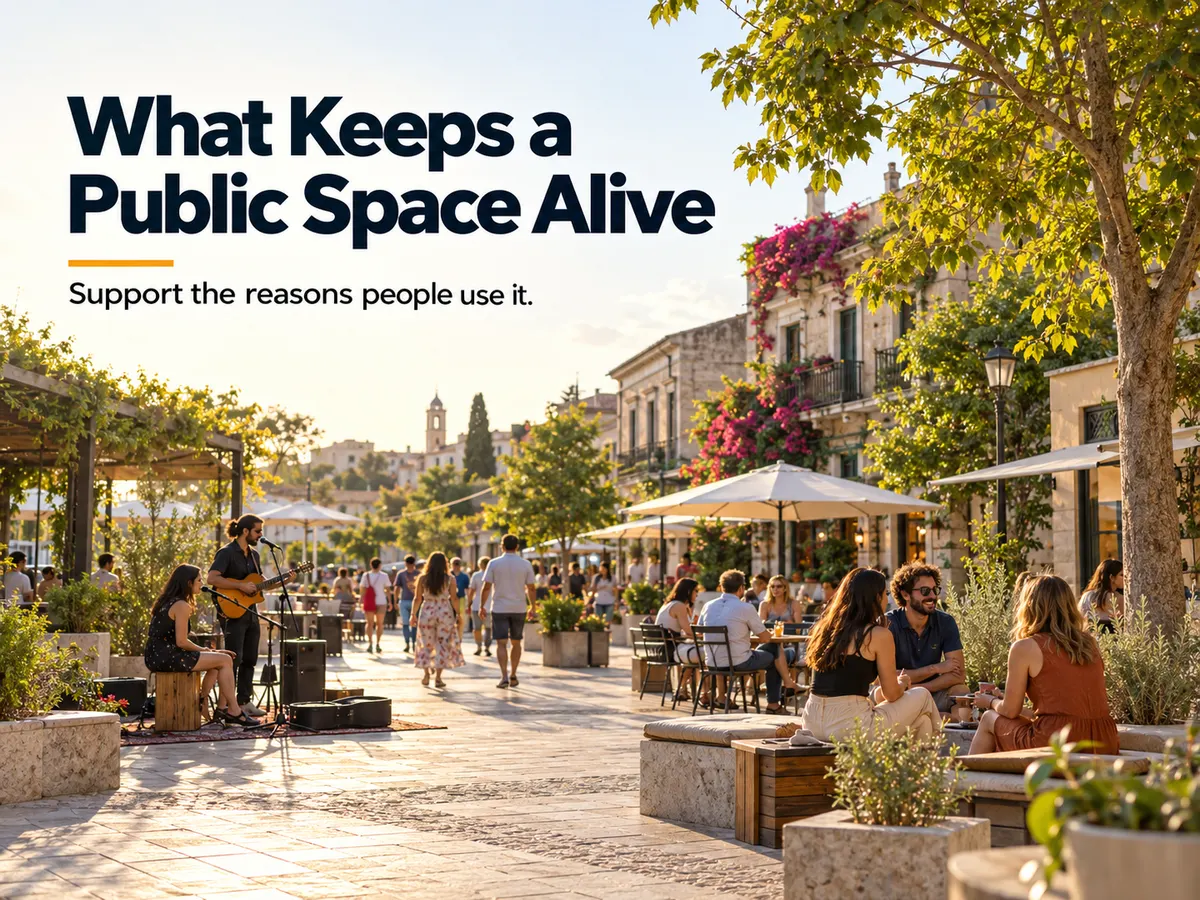
Two squares built with similar money and similar stone, a few streets apart, can live completely different lives: one still full late into a summer evening, the other empty by sunset. In most of the cities I know, the difference is not the paving or the parks and recreation budget. What keeps a public space alive is a handful of small things nobody photographs at the opening ceremony: somewhere to sit with a glass of tea, light that still works after dark, something that happens there every week and somebody who notices when something breaks. As someone from the events side I find that interesting, because a public space is really an event that never ends, and it needs people to arrive and a reason to come back.
The tea stand at the corner of the market
By a public space I mean any place anyone can enter without paying, booking or explaining themselves: a square, a park, a seaside promenade, a market ground, a temple or mosque courtyard, the wide pavement outside a parade of shops. Ownership matters legally, but for the people using it, a space is public when they feel allowed to be there and have some reason to stay. Cities differ a great deal here. Many European ones grew around a central square; in many others, across the Middle East, Asia, Africa and Latin America, public life gathered in courtyards, covered markets, riverbanks, temple grounds and the picnic grounds at the edge of the city, where recreation and leisure happened long before anyone used either word. That explains why the useful question in so many cities is less how to design a new square and more how to give people a reason to stop in the places they already have.
Project for Public Spaces, which has spent decades watching how people use squares and parks, sums up the places that work with four qualities: they are easy to reach, comfortable, have things to do and are sociable. Comfort is usually the first of them to fail. The first reason to stop is physical: a bench that faces where things are happening, shade in the hours when the sun is hardest, a tap or a fountain, and something to drink. In a great many cities that last one is a tea kiosk, a coffee cart or a juice stand, the humble drinks stall that sits at the corner of half the markets and parks. I have come to think of it as one of the most underrated pieces of public infrastructure there is. Where there is tea, people sit, and where people are sitting, others feel comfortable sitting too. The man running the stand becomes the person everyone asks where the toilet is, when the market closes and where a lost child should be taken, which is more information service than most signage provides.
Design habits often pull the other way. Benches end up tucked between bushes or turned towards traffic, grass is fenced off with “do not step” signs, and the most pleasant corner is given to decoration rather than seating. Each is a small mistake on its own, but together they quietly tell people to keep walking, and much of what goes under the name of placemaking is simply the work of undoing them.
A lamp, a toilet and a kiosk after dark
A public space tends to fill itself during the day: morning walkers, then parents with small children, then teenagers after school. Darkness is the real test, for a square as much as for the night time economy of a whole city. When the light goes, part of the space drops out of use, and in summer those are the best hours of the day, so a space that only works in daylight is giving up its most valuable time.
In the spaces whose evenings work, I keep finding the same few things done together. The light is spread evenly along the paths and the seating instead of being concentrated at the entrance, so no corner becomes the one people avoid. The toilet sits near the middle rather than in a far corner, it is lit and open, and someone is sitting at its door. The kiosk stays open late, with plastic tables out front. On at least one evening a week there is something on, an exercise group, a summer film screening, a small concert, and that regular evening teaches the neighbourhood that the place is theirs after dark too. Whoever runs that evening also helps a lot by saying out loud that anyone can join and nobody needs to bring anything, because many activities quietly assume people arrive in groups, and someone who came alone needs that small permission.
The clearest sign that an evening works, in my view, is whether a woman feels comfortable there on her own at that hour. If she can take her evening walk alone without thinking twice about it, most of the other decisions have been made correctly, and if she can’t, no amount of new planting will fix it.
Our own industry has a habit that does not help. Public space projects are almost always presented with daytime renderings, all blue sky, green grass and sunny benches. Asking the design team for the same view at nine in the evening, showing where the lamps, the toilet and the kiosk are at that hour, is a small extra task for them and changes a great deal for the people who will actually use the place.
The weekly market and the empty market hall
A public space stays alive when someone has thought about its ordinary weekday evening as carefully as its opening day.
Given the choice, I would put money into regular, modest public space programming before the occasional big event. Filling a square once a year with a large concert and having something small happen there every week do not produce the same result, because only the second builds a habit, and habit is what brings people back when nothing special is going on.
Most cities already have the best example of this, so familiar that hardly anyone sees it. The weekly neighbourhood market, from the open-air markets of southern Europe to the street markets of Türkiye where I live, happens on the same day in the same place every week, the larger ones with thousands of visitors and hundreds of sellers, its own sounds and its own social life. Older people go to see others as much as to buy tomatoes, women are at ease there in a way they are not in many public places, and children get colour, noise and a slice of watermelon. For regularity and turnout it is often the most successful public event a city has, and almost nobody thinks of it as an event at all. Visitors who wander into one by chance often remember it longer than anything city branding put in front of them.
Covered market halls, which a lot of cities have, carry the same lesson in a different form. On market day they are the busiest place in the neighbourhood; on the other days many of them sit quiet. They have a roof, a flat floor, electricity, toilets and a neighbourhood that already knows the way there. Putting them on the list of venues the culture team can use for a children’s festival, a food festival run with the market’s own sellers, a small tournament or a winter evening program costs very little and opens up a great deal, provided the market sellers are told first and the floor is handed back clean for market morning.
A power panel, a maintenance crew and a shift log
Good benches and good lights still fade within a few seasons if nobody looks after the place day to day. The spaces I have seen work best usually have a maintenance crew that knows them: the same people every week, who know which lamp keeps failing, which swing gets the most use and which corner floods after rain. When their plan sits on the same page as the program calendar, they cut the grass before film night and wash the ground after the market without being asked, and the place feels cared for without anyone announcing it. The kiosk or café operator is the other quiet partner. Where the operating contract includes later opening on program evenings, clean toilets and room for tables on film night, the café brings more people in and the busier space sells more tea, which suits everyone.
Neighbours play a part as well, though I would rather not romanticise it. In most places this does not run through organised volunteer programs; it runs through channels that already exist, such as the walking group’s messaging chat, a word to the neighbourhood representative, a call to the city’s service line or a remark to the kiosk owner in the morning. Those small reports about a dark corner or a broken lamp are often the most accurate map of what the space needs.
Events are where a public space gets pushed to its limits, and the events side sees things its designers rarely do. When a square or park has no lockable power panel and no water point, an event company cannot use it without generators and portable toilets, so the concert goes to the empty lot behind the stadium, everything is built from scratch and the crowd drives home without passing through the centre. Something as unglamorous as a power panel and a water valve can decide whether a space can host the city’s own small events at all. Brand activations need the same care at their edges: people should be able to tell at a glance whether joining is free, whether anyone will ask for their phone number and whether the benches around the stand are still theirs to sit on. Events can also wear a space down, with noise late at night, cars across the neighbourhood and rubbish left for morning, all paid for by residents who mostly don’t attend, and that too is part of the social impact of events. An organizer who meets the neighbourhood beforehand, sets a reasonable finishing time and pays for the side streets to be swept is protecting the space as much as the event, and one who asks what legacy will stay behind, perhaps a stage floor that becomes the market platform or a power point the next small concert can use, leaves the place a little more alive than it found it.
The least exciting job is counting, and it may be the most useful. It does not take expensive systems: a note in the security guard’s shift log, the number of receipts at the kiosk, how full the car park gets, a few questions asked at the café tables now and then. Kept for a year, those records show how many people come at what hour, from which neighbourhoods, on market days and other days, on winter mornings and summer nights, and they tell you where an evening program is missing and which neighbourhood has not found its way there yet. Without them, decisions about the space are made on impressions.
Who is still on the benches after dark on a weekday?
That is what I would ask about any public space before talking about redesigning it, because opening days and festival nights flatter every place. An ordinary weekday evening shows the truth, for the people who live nearby and for the visitor experience alike. In the spaces I have seen working well, the answer is usually a mix of people at that hour: an older couple on the same bench as every night, a family at the kiosk table, teenagers near the basketball hoop and a woman walking her laps alone with earphones in, while in the ones that are struggling, the only light still on belongs to the car park.