Contents
Have you ever arrived somewhere because of a striking campaign and found, within an hour, that there was nowhere pleasant to sit? Or the opposite: stumbled into a market, a courtyard or a seaside walk so full of life that you wondered why nobody had ever told you about it?
Those two experiences sit on either side of a distinction our field blurs all the time. Placemaking is the work of making a place good to spend time in, place branding is the work of making it known, and when a place needs both, I would do them in that order. Two teams can be hired for the same district in the same year, one to make it a better place to spend an afternoon and one to make it better known, and they may never sit at the same table. Both will talk about place identity in every meeting. Both will be sure they are working on the same thing. A good deal of money goes to waste in the gap between them, and most of it could be saved by agreeing on which job comes first.
What does a place look like when people already use it well?
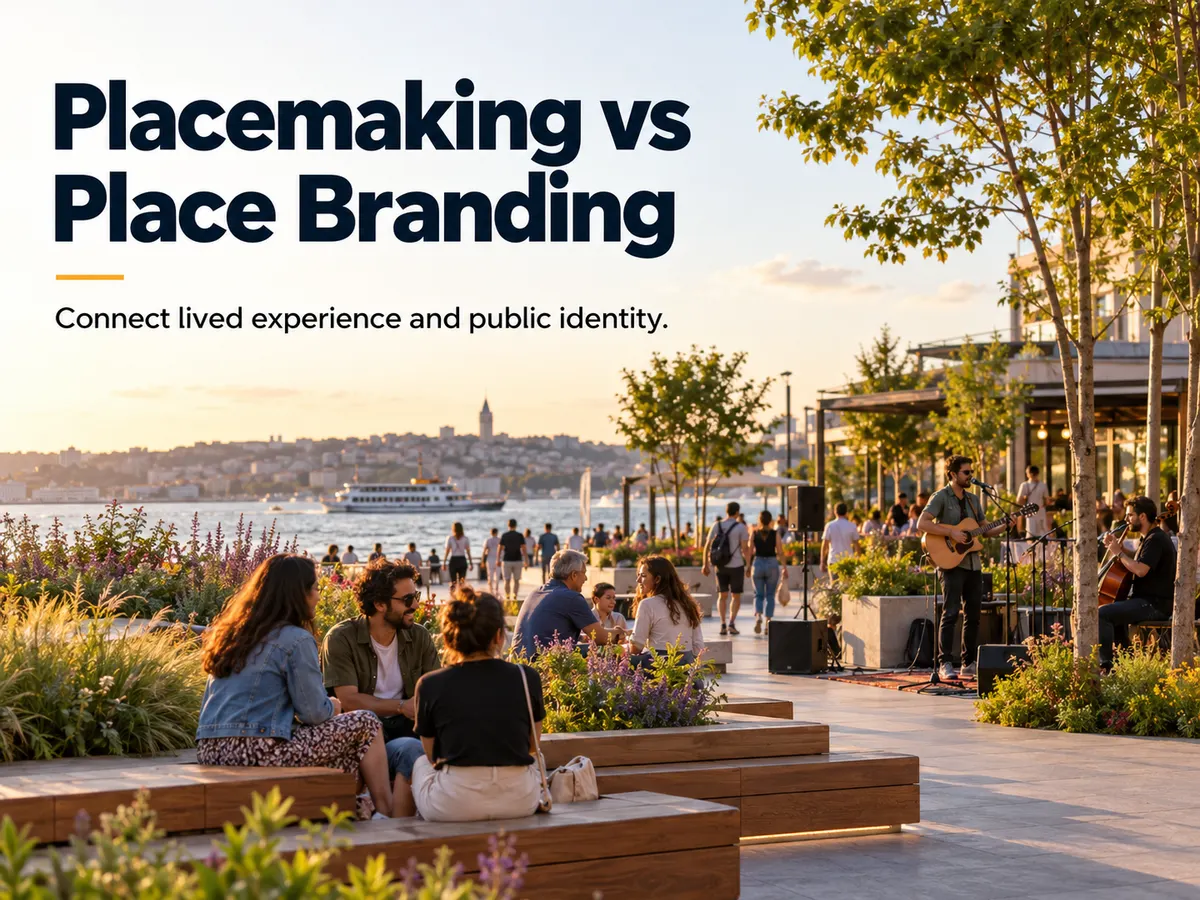
It usually looks modest. Placemaking, as I understand it, means shaping a public place around the way people actually use it, often together with them: moving benches to where people want to sit, adding shade, opening a toilet in the evening, letting a weekly market spill into the next street, putting a drinks stand where people stop anyway, giving a forgotten courtyard or a quiet corner of an urban park a regular program. Its results are measured in use. More people come, they stay longer, different kinds of people come at different hours. If that happens, it worked, whatever it looked like in the presentation.
The word grew up in American urban planning, and Project for Public Spaces, which did a great deal to spread it, describes it as a collaborative process and is careful to say what it is not, starting with top-down and design-driven. As the word travelled, though, it brought a picture with it: colourful street furniture, painted crossings, pop-up gardens, a café culture that does not fit every city. I’ll admit that picture makes me uneasy, because it can turn placemaking into decoration. In most places the honest version is different. It is the tea or coffee stand at the edge of the market, the bench under the old plane tree in front of the church or the mosque, the shaded steps where older men sit in the afternoon, the seaside walk where families spread a blanket on summer evenings. The raw material is already there, in the everyday habits that show why recreation matters to a neighbourhood. Doing placemaking properly means noticing it and making it easier.
What is a brand supposed to add?
Focus, mainly. Place branding is the work of deciding how a place should be known and then communicating that consistently over years: a name, a visual identity, a few chosen strengths, a story, the way the place presents itself at fairs, in tourism materials and online. It can apply to a city, a district, a coastal strip, a highland, a whole region, or a product tied to a place, like the many local foods protected by geographical indications, from Parmigiano Reggiano to Darjeeling tea.
Done well, it helps a place decide which of its many qualities to lead with and who it is talking to. Its success is measured in perception rather than use: whether people outside know the place, whether they think of it for the right reasons, whether they end up choosing it. Done badly, it becomes a logo competition followed by a launch, with nothing on the ground any different from the week before, and residents are invited only at the end to approve a slogan after every real decision has been made.
Put side by side, the two jobs differ at almost every point a client should care about:
| What differs | Placemaking | Place branding |
|---|---|---|
| What it changes | How people use, reach and enjoy the place | How people outside know it and what they expect |
| Who has to be at the table | Residents, shopkeepers, the kiosk operator, the maintenance crew | Those same people, plus tourism bodies, hotels, DMCs and the media |
| What it delivers | A moved bench, shade, a market day, a program, a better contract | A name, a story, a few chosen strengths, consistent materials |
| How you know it worked | More people stay longer, at more hours, from more groups | The place is known and chosen for the reasons it can actually deliver |
| How it usually goes wrong | It turns into decoration | It promises what the place cannot yet keep |
The best place brands I know were not designed in a studio. They grew out of something people already went to the place for, a pastry, a thermal spring, a balloon flight at dawn over a valley of rock chimneys, and the branding work that followed simply named it clearly and kept repeating it for years. The weaker ones started from the other end, with a slogan written to cover everything the region has, and then went looking for something to point the camera at. You can usually tell which is which by asking a hotel receptionist what guests come for. If the receptionist’s answer and the brochure’s answer match, the brand has roots.
Why do agencies sell them as one package?
Partly because the vocabulary overlaps, and partly because of how our industry sells work. An agency doing branding finds it easy to add a few “placemaking interventions” to the proposal, usually something photogenic: giant letters spelling the city’s name, a mural, a selfie frame at the viewpoint. An event company asked to “activate” a square brings a stage, a sound system and a branded backdrop, and the evening gets described as placemaking in the final report.
You might be thinking that this is harmless, and that giant letters at least give people something to photograph. Sometimes that is fair. A photo point next to shade, a bench and a kiosk can grow into a real stopping place. But a photo point standing alone, with nowhere to sit and nothing nearby, is branding wearing placemaking’s clothes. People arrive, take the picture and leave, and the place is exactly as it was.
Place branding can only amplify what placemaking has already made true.
What happens when the brand runs ahead of the place?
The visitor finds out first. A district launches a new identity, the tourism materials are refreshed, people start to arrive with a certain picture in mind, and then they step off the bus at the terminal and find no map, no clear way to the centre and a row of shops selling the same souvenirs you can buy anywhere in the country. The brand promised a place that the arrival did not deliver, and first impressions are stubborn, so the whole visitor experience gets read through that first hour.
Regional promotion days held in big city exhibition halls, a format familiar in many countries, are a gentler version of the same mix-up. Stands go up, local dishes are served, folk dancers perform, and a very large crowd comes. Look closely and most of that crowd are people originally from the region, now living in the big city. As a gathering for them it is valuable and often lovely. As promotion to new visitors it reaches surprisingly few. Calling it promotion is where the trouble starts, because the event is judged against a goal it was never built for, while its real potential, giving those people reasons to go home more often and take friends with them, is hardly planned at all.
And when a lively place has no name outside?
This is the quieter case, and it is more common than people think. A Sunday market where farmers from the surrounding villages sell cheese, honey and seasonal vegetables. A highland festival held on the same weekend for generations. A covered bazaar where the same craftsmen have worked for decades. For residents, these places are already alive and need no brand at all.
For tourism, though, they are a missed chance, because the visitor never finds them, much like the village food festival that nobody outside the valley has heard of. A hotel guest who would have loved the market has no idea which day it is held or how to get there. The remedy is rarely a campaign. It is a market calendar on the reception desk, a line in the DMC’s program notes, a guide who knows when the stalls open, a simple sign from the main street. That is place branding at its most modest and, I think, its most effective: telling people about something that is already good.
There is a sensible limit here too, and it deserves respect. Some places are lively precisely because they belong to their neighbourhood, and a sudden flow of coach groups can change that quickly. A market that welcomes a few curious hotel guests is a different thing from a market turned into a stop on every tour itinerary. The modest version of branding, a calendar at the reception desk rather than a campaign, has the advantage of letting the place set its own pace.
Events are the one tool that works on both sides
An event can be temporary placemaking. Closing a street to traffic for one evening and filling it with stalls, children’s activities and a small stage shows everyone, shopkeepers included, what that street could be on other days. Holding a small concert in a historic courtyard instead of on an empty lot outside the centre tests whether the courtyard can work as a public space. Many lasting changes I have seen in public places began as one evening that went well, gave people something to point at and later grew into public space programming. One good evening proves that the street can work, not that it works every day, and the honest thing is to describe it that way until the regular version exists.
An event is also branding material. It gives a place a date, an image and a reason to be talked about, and a festival that keeps its weekend year after year gradually attaches itself to the place’s name in a way no logo manages. What our industry tends to do instead is plan events as pure branding: a big stage, a famous name, good photographs and no legacy at all once the trucks leave. I would much rather see organizers ask, before each event, what the place itself will gain from it.
So, which first? Not every place needs both. A neighbourhood square that serves its residents well needs good placemaking and no brand. A destination chasing international congresses or mega events needs a brand, but it will only hold if the venue, the hotels, the transfers and the evening streets live up to it on an ordinary Tuesday. Most places sit in between, and the order still matters, because a brand is a promise and the place has to be able to keep it. To put it plainly, if a client offered me one budget for both, I would spend the first year on shade, seating and a regular market day, and only then let the campaign tell people what they will find.