Contents
Does living near a park make you healthier? Probably somewhat, through a handful of routes we understand reasonably well, but the evidence is more careful and more conditional than the way it is usually quoted. The research on green space and health links parks, trees and other greenery with lower stress, more physical activity, stronger social ties and relief from heat, noise and polluted air, and most of those benefits depend on people actually spending time in the space rather than on the space simply being there.
That last condition is the part I find most useful, and the one quoted least. Green space has become one of the easiest arguments in city planning, real estate and tourism. It appears in project brochures, hotel descriptions, wellness packages and event proposals, usually as a promise that nature will make people feel better. The promise is not wrong. It is just stated with more confidence than the researchers themselves use, and the gap between the two matters for anyone who builds, runs or programs recreation.
The strongest evidence is about how green space works on people
The clearest summary I know comes from the WHO Regional Office for Europe, whose review Urban green spaces and health brought together a large body of studies. It describes parks, playgrounds and residential greenery as able to promote mental and physical health and to reduce illness and early death among urban residents, and it names the pathways: psychological relaxation and stress relief, social cohesion, support for physical activity, and lower exposure to air pollutants, noise and excessive heat.
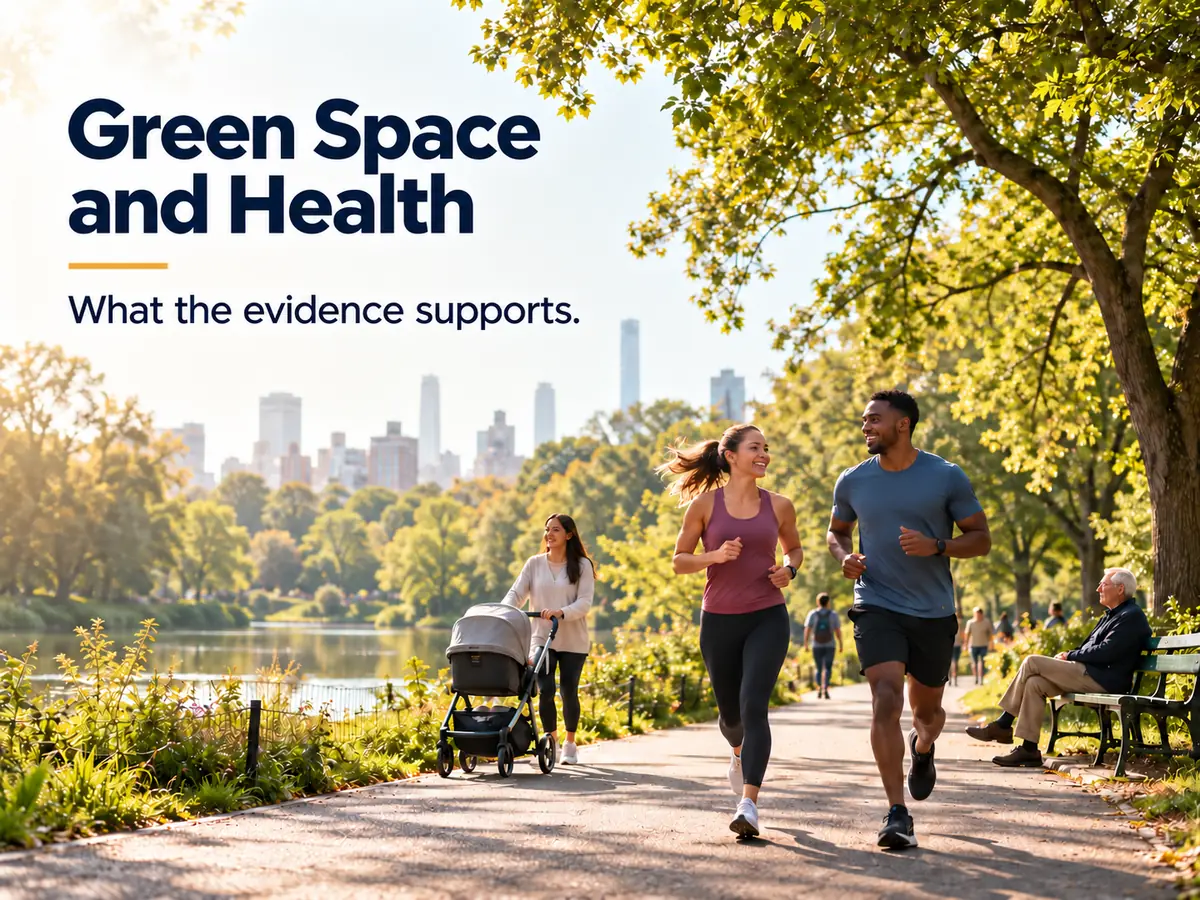
Read those pathways slowly and you notice that they are quite different mechanisms. Shade on a hot afternoon works on the body whether or not anyone chooses to be there; a row of trees along a busy road cools the pavement for everyone who walks it. Stress relief and social contact work only when people come, sit, walk and meet. Physical activity needs a path worth walking, a pitch that is open, a reason to go out. So a single word, green space, covers at least two kinds of benefit: one that comes from the greenery itself, and one that comes from the recreation that happens in it.
For people who plan cities, the first kind argues for trees, canopy and green corridors across the whole city, including streets that nobody would call a park. For people who run parks, the second kind is the one that falls to them, and it is where the evidence turns from the plants to the program. An urban park that nobody uses on weekday mornings still cools its neighbourhood in July, but it does very little for the loneliness of the retired man across the road.
People who use green space are healthier, which is not quite the same claim
Much of the research compares people who spend more time near or in nature with people who spend less, and finds that the first group reports better health and wellbeing. One widely quoted study, by White and colleagues in Scientific Reports, used survey data from England and found that people who spent at least 120 minutes a week in nature were more likely to report good health and high wellbeing than those who spent none. The benefit appeared to level off somewhere between 200 and 300 minutes, and it did not seem to matter whether those two hours came in one long visit or several short ones.
That study is often turned into a rule: two hours of nature a week. The authors themselves are more cautious, and I think their caution is the most instructive part of the paper. They point out that their data are observational and cross-sectional, so they cannot rule out that healthier people simply go out more, and they note that time in nature explained only a small share of the differences in health and wellbeing between people. They call for longitudinal and intervention studies before anyone writes guidelines.
The caution does not undermine the case for green space. It places it. The honest version reads something like this: regular time in green places is associated with better health across many groups, including older adults and people with long-term illness, the mechanisms are plausible and partly understood, and the size of the effect for any single person is modest. That is a strong enough foundation for public investment in parks, and for a leisure policy that puts one within walking distance of every home. It is not a foundation for selling a weekend in the forest as therapy.
A park on the map and a park in the week are different exposures
Planning documents usually describe green space in hectares, square metres per resident or distance to the nearest park, because those are what plans can measure. All three matter, and proximity matters most, since people go regularly only to places that are close and easy to reach. But a resident’s actual exposure is measured in hours, and hours depend on things a map does not show.
Is the park open and lit at the times people are free? Does it feel safe to a woman walking alone in the early evening? Is there a bench in the shade every hundred metres for someone who cannot walk far without resting? Is the path flat enough for a pushchair or a walking frame? Is there a toilet, and is it unlocked outside summer? Is anything happening there, a walking group, a children’s workshop, an exercise class on the lawn, that gives people a reason to come on an ordinary weekday? These questions sound like operations rather than health, and that is precisely the point. The health value of a green space is produced by the people who maintain it and program it as much as by the people who planted it, which is why I see park management as quiet public health work, rarely described that way.
The same logic explains why the most valuable green spaces are often unremarkable. A large showpiece park on the edge of the city is visited on special Sundays. A modest neighbourhood green with shade, benches and a regular morning group may give its residents far more hours across a year. Studies that measure only the presence of greenery within a radius treat those two places as similar. Residents do not. For outdoor recreation planning, the useful unit is the walkable place used every week, and that is also one of the clearest answers to what makes cities livable for the people who never appear in rankings.
The marketing has run ahead of the research
Our own industries are the ones that stretch the evidence most. Property developers place a small lawn between apartment blocks and call the project a healthy living community. Resorts describe their gardens and forest walks as healing. Wellness packages borrow the vocabulary of medicine for an afternoon among trees, which blurs a line that wellness tourism should keep clear: feeling better on holiday is real and worth selling, but it is not treatment. Event organizers increasingly add a morning walk or an outdoor session to a congress program and present it as a wellbeing initiative, sometimes with a claim about stress reduction attached.
Most of these offers are pleasant and some are genuinely good. The problem is the claim, not the walk. When every brochure promises health from greenery, the argument loses its force where it matters, in the parks and recreation budget discussions for ordinary parks that serve people with less money and less free time. And when a resident moves into the healthy living community and finds that the lawn is fenced, the trees are saplings and there is nowhere to sit in the shade, the word green starts to sound like decoration.
I would rather see the sector make the modest claim and deliver it fully. A hotel that offers a guided morning walk through a real forest, at a pace guests can manage, with a guide who knows the route, is offering something the evidence supports: time outdoors, movement, a calm start to the day. It does not need to promise anything more. A developer that plants shade trees along every path, puts benches where older residents will use them and leaves the lawn open to the neighbourhood is building something residents will feel, whatever the brochure says.
The case for green space does not need to be inflated
What the evidence supports, taken together, is a fairly practical picture. Greenery helps the body directly by cooling streets and softening noise and pollution, and that argues for trees and planting in every part of a city, not only in parks. Green spaces help mental health, activity and social contact when people use them regularly, and that argues for proximity, safety, comfort and programs as much as for hectares. The effects are real across many groups and modest for any single person, which makes them a public good that pays back across a whole population over many years rather than a quick fix for an individual.
The health value of a green space is created by the hours people spend in it, and those hours are decided by its management far more than by its size.
This also changes how we should count success. A park report that lists hectares, number of trees and maintenance spending says what was provided. A report that also counts how many people use the space on weekday mornings, how many older residents come regularly, and whether the groups living closest to it actually go there says whether the health benefit is reaching anyone. That second report connects green space with recreation for communities in a way the first never can, and it gives the people who run parks the evidence they need when budgets are discussed. Destinations can use the same counting, because the promenade and the city forest are shared by visitors and locals, and any honest picture of quality of life tourism has to include who still uses them in the busy months.
Whenever I hear a project described as green and healthy, I find myself asking where the nearest bench in the shade is and who will be sitting on it on a Tuesday in November. The answer usually tells me more than the renderings.