Contents
- Free entry makes the park a room the whole city shares
- A wide road can put a close park very far away
- Retirees own the park before the shops open
- Shade over the swings decides the early afternoon
- Teenagers defend the parks that make room for them
- Evening crowds follow the lighting
- The weekly calendar fills a park that planting alone cannot
- A café contract can keep the park open late
- The guard’s logbook knows who the park is really for
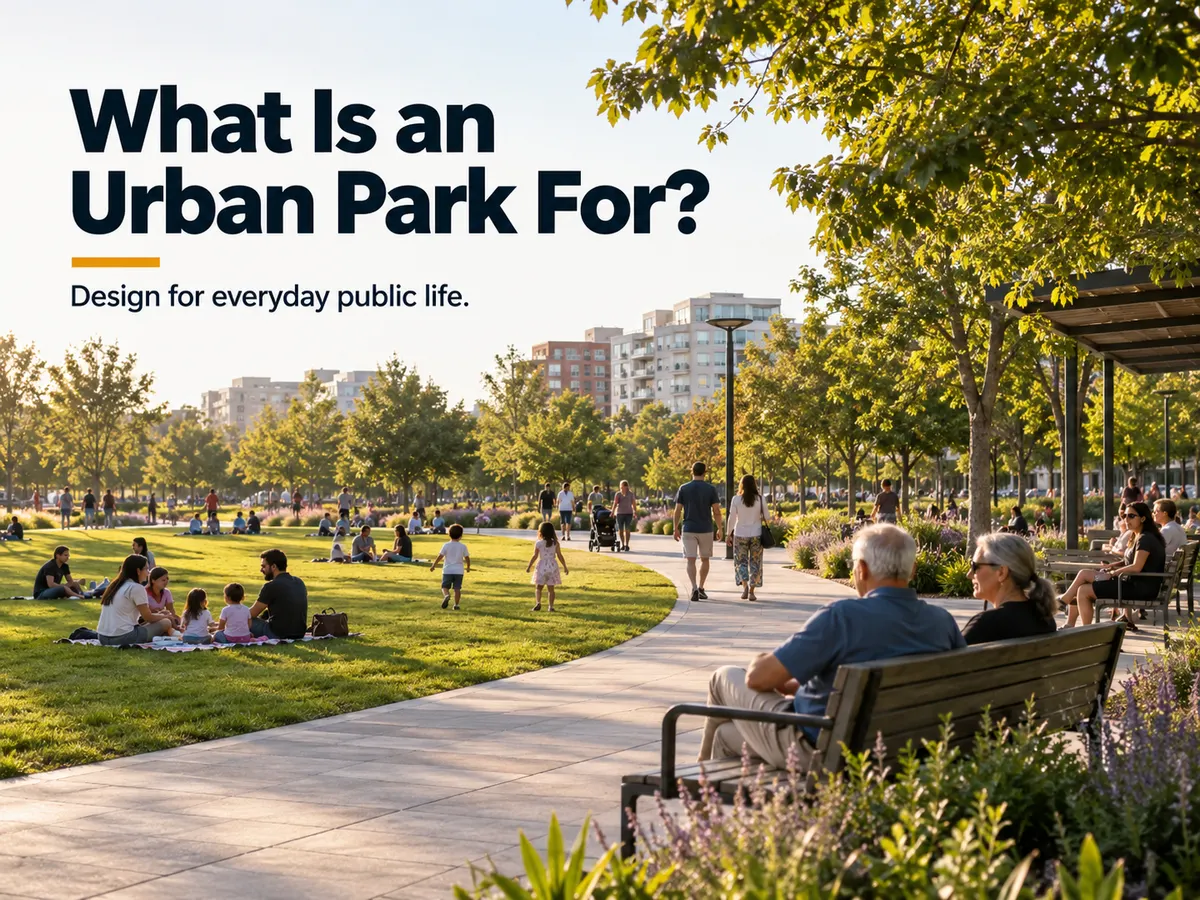
An urban park is for the everyday free time of the people who live within a short walk of it, and it belongs to them first of all.
That sounds obvious, but a great deal of what goes right or wrong with parks follows from that sentence. A park is not mainly for its opening day or for the photograph taken from above on that day. It is for the retired neighbor who walks there every morning, the mother who needs a shaded bench beside the swings, the teenagers who need somewhere to be after school, and the family that comes out after dinner on a July night because the flat is too hot to sit in. When a park works, those people use it without giving it a thought. When it does not, it turns into scenery glanced at from the pavement, and its main activity becomes the irrigation schedule.
Free entry makes the park a room the whole city shares
In plain terms, an urban park is a public open space inside a city, usually green and free to enter, where people are meant to spend time rather than just pass through. It can be a small neighborhood park with a playground and a few benches, a long promenade by the sea, a city forest at the edge of the built area, or one of the large parks that many cities have opened in recent decades on former railway yards, industrial sites or harbours given back to the city through waterfront development.
What they share is their role as outdoor rooms the city holds in common, built for recreation and leisure close to home. People go there to rest, play, meet, move, sit in the sun, watch their children, read, eat or do nothing in particular, and they can spend a whole afternoon without paying, without being anyone’s customer and without needing a reason. Very few places in a city allow that, which is why the question of what a park is for turns quickly into a question of which people, at which hours, doing what.
A wide road can put a close park very far away
Hardly anyone schedules a visit to their local park; whether they go depends mostly on how near it is, and nearness is a large part of what makes cities livable. I keep returning to this because it overturns the instinct to judge parks by size. A large park across the city makes a fine Sunday outing, while a modest one at the end of the street, with good shade and something going on, changes an ordinary weekday, which is roughly what studies of green space and health find as well. The two do different jobs, and in daily life the second does far more.
Distance is not only meters on a map. A park beyond a wide road without a safe crossing is far away for a child or an older person, however close it looks. A park reachable only by car is far away for a family without one. When I look at a park, one of my first questions is how people actually arrive: on foot or by bus, from which side, crossing what. UN-Habitat’s site-specific assessment guidelines study a public space together with everything within a five-minute walk of it, about 400 meters, and I think that is the right instinct, because the walk to a park is already part of the park.
Retirees own the park before the shops open
Spend a whole day in a busy park and you see several parks one after another, each with its own users. The early morning belongs to retirees and walkers, the most loyal users a park will ever have, there every day and in every season. What they need is modest: a decent walking path, a few exercise machines, benches close enough together for conversation, and a kiosk that opens early enough for a first glass of tea. A park that serves them well has a core of regulars who notice everything, from a cracked paving stone to a light that went out overnight, and who will mention it to the gardener or the kiosk owner long before any complaint reaches an office.
Shade over the swings decides the early afternoon
Around midday and into the early afternoon, the park belongs to parents and small children. Here shade over the playground becomes the most important feature, followed closely by benches placed where a parent can see the child, a clean toilet and a drinking fountain. In a hot summer, anywhere from the Mediterranean to the Gulf, a playground in full sun is simply unused between noon and four, however good its equipment, and a few well placed trees or a shade sail can double the hours it actually works.
Teenagers defend the parks that make room for them
After school, the teenagers arrive. They want a basketball hoop, a skating area, a corner where they can sit together with some music without being moved on. They are often treated as a problem in parks, and I think that is a mistake. A park that gives teenagers a place of their own tends to be a park they look after, and one that gives them nothing tends to be one where they leave their mark in less welcome ways.
What works for them is rarely complicated. A hoop with a proper surface under it, a few low walls to sit on near the court rather than at the far end of the park, a light that stays on until the court empties, and, in the better cases, a small tournament every few weeks run with the youth center, where the teenagers themselves draw up the fixtures. Parents notice the difference too, because a corner that belongs visibly to young people, in full view of the path, feels safer to them than a dark edge of the park where nobody quite knows who is there.
Evening crowds follow the lighting
In the evening, especially in summer, the park belongs to families and couples and to the gentler side of the night time economy, and the deciding factor is light. If the lighting works and is spread evenly, if benches have an open view, if the kiosk is still serving and there is now and then something to watch, the park stays full late into the night, and a park full on a summer evening does more for a city brand than any poster could. If the lights are patchy, it empties at dusk, and women and older people are the first to stop coming. A park designed around only one of these groups ends up crowded for two hours and empty for twelve.
The weekly calendar fills a park that planting alone cannot
Two parks of similar size, location and greenery can lead very different lives, and the planting rarely explains why. What usually explains it is whether anything happens there regularly, in other words in its public space programming. A sports instructor from the municipality who leads exercise on the lawn on fixed mornings gives the walkers a reason to come at the same hour even in winter. A children’s art class from the cultural center that moves out to the shaded grass in spring keeps families in the park until lunch. A monthly producers’ market, with cheese, honey and vegetables from nearby villages, draws people from neighborhoods further away, and so does a small food festival that comes back to the same lawn every autumn. An outdoor film one evening a week keeps the park busy after dark. Not every hour needs a program, though; a bench in the shade where someone reads or does nothing at all is a perfectly good use of a park, and the calendar works best when it leaves those quiet corners alone.
A park is for whatever happens in it regularly, and the parks that fill up are the ones where the neighborhood knows what happens on which day.
Events organized by people like me fit into this picture only when they repeat. A single huge concert, run like a mega event in miniature, brings a crowd, a lot of noise and often a lawn that needs weeks to recover, and then it is forgotten. A monthly evening concert or a spring festival that returns every year builds a habit, and that habit is the only event legacy a park really needs. A concert of two hours can hold part of a park for several days once the build and the removal are counted, so that whole period belongs in the booking decision. The organizers who get invited back treat the park as somebody else’s living room and settle a few things with the park team before anything is signed:
- the build and removal days as well as the show day, and which paths and play areas stay open throughout
- vehicle routes, and ground protection under the stage and the trucks
- where power, toilets and bins go, and who empties them
- the condition the lawn is handed back in, walked through together the morning after
A café contract can keep the park open late
Most larger parks in most cities have a café or a kiosk, and it is the least discussed part of how a park works. A good park café is where people ask where the toilet is, what is on today, where to take a lost child. It is often the only staffed point in the park after office hours, and its owner has a direct interest in a full park. When the contract is written with the park’s life in mind, things line up: opening early for the walkers, staying open late on film nights, keeping the toilets clean and lit, staying open at least on winter weekends. These are small clauses, yet in the parks I have seen work well they make the café a partner rather than a tenant, which is placemaking in its most practical form, written into a lease. When the contract sets only the rent, the café keeps its own hours and the park’s evenings suffer.
The guard’s logbook knows who the park is really for
Counting is the simplest habit a park can have, and the one most often skipped. In well run parks somebody keeps a record of how busy the place is: sometimes a line the guard writes in the gate logbook, sometimes the café’s receipt count and the car park occupancy, sometimes a short survey at the café once a season. Over a year, those notes answer what no design drawing can: who comes at what hour, from which neighborhoods, how weekdays differ from weekends, what the market Saturday changes, who is still there on a January morning. They show whether the teenagers turn up in the late afternoon and need more room, whether a neighborhood two streets away never appears because the crossing is dangerous, whether winter mornings are busier than anyone expected. Without them, every decision about next year is a guess, however well meant. The WHO’s brief for action on urban green spaces gives monitoring and evaluation a section of its own next to planning and design, and I wish more park budgets did the same, since a new feature has to be looked after for its whole working life and not only on the day it is unveiled.
So, does anyone keep that kind of notebook in the park nearest to your home, and has anybody ever read it?