Contents
- The budget is organized around things, not hours
- Why do programs get cut first when money runs short?
- A new park arrives with a building budget and nothing for its first year
- Who pays when every program has to pay for itself?
- Sponsors prefer a summer festival to a Tuesday class
- A program line that shows hours, not just money
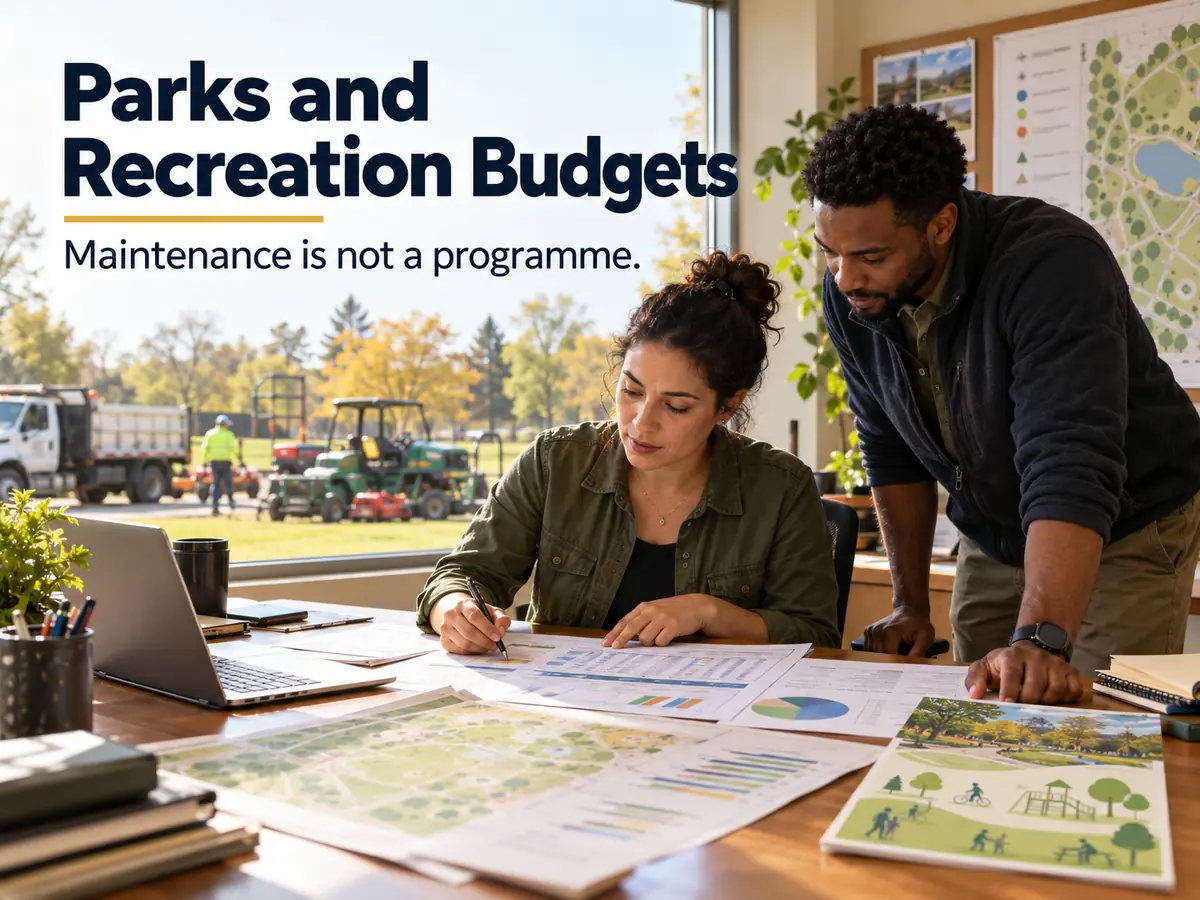
A common assumption about any parks and recreation budget is that a bigger one means more for people to do. Quite often it does not. A parks and recreation budget pays for two different things: the upkeep of land, buildings and equipment on one side, and on the other the programs, staff hours and activities that give people a reason to use all of it. The two grow by different rules. Upkeep grows almost by itself with every new lawn, pool and playground. Programs grow only when somebody argues for them, and in a tight year they are the first lines to shrink, because on paper they look optional.
So a budget can rise steadily while the number of things happening in the parks stays flat or even falls. Nobody plans that. It comes from habits in the way budgets are laid out, contracts are written and results are reported, and most of those habits are shared just as much by the private side of the field, the consultancies, contractors, sponsors and event companies, as by anyone who looks after public land.
The budget is organized around things, not hours
Open the spending side of almost any parks and recreation budget and read the line items. Grass cutting, tree care, irrigation, path repairs, playground inspection, lighting energy, vehicle fuel, cleaning contracts, new planting. Every one of them is a noun with a quantity attached: square meters, units, kilowatt hours, visits per week. You can price it, put it out to tender and check whether it was done.
The program side rarely looks like that. It tends to appear as a single line called activities or events, or it disappears entirely inside salaries. The instructor’s fee sits in one place, the heating of the hall in another, the printing of the season leaflet somewhere else, and the hours of the staff member who organizes the whole thing are mixed in with the hours they spend on everything else. Nobody can say what a weekly walking group, a children’s swimming course or a Saturday sports morning actually costs, and so nobody can say what it would cost to run twice as many.
An event budget works by the opposite discipline. In our business a program has a price per day, per person and per hour, because a client will not sign anything else. I think recreation could borrow that habit without losing anything, and it would change the conversation far more than a bigger total would.
The reason the program is so hard to see is that it is mostly people. In the United States, where the National Recreation and Park Association gathers data from agencies every year, the 2026 Agency Performance Review reports that 45 percent of agency personnel work in operations and maintenance and 32 percent in programming, and that personnel services take 54 percent of operating spending. Read the other way round, a program is mainly paid staff hours, and staff hours are exactly the line that is hardest to defend once it has been folded into a general salary figure.
Why do programs get cut first when money runs short?
Maintenance has three things programs lack. It has contracts, so cutting it means renegotiating with a supplier. It has safety obligations, since a broken swing or a loose railing has to be fixed whatever the year looks like. And its failure is visible: an uncut lawn, a dark path or an overflowing bin produces complaints within days.
A program that never starts produces no complaints at all. Nobody phones to say that one of the autumn youth recreation programs did not appear this year, because the teenagers never knew it might have. Absence is silent, and silent lines are the easy ones to remove.
I want to be fair to the maintenance side here, because it is not the villain of the story. A dirty toilet or a broken bench empties a park faster than the lack of any program, and a well-kept place is the precondition for everything else. The trouble starts when maintenance is treated as if it were the whole service, and when the budget conversation each year begins with the fixed costs and gives the program whatever is left.
There is a second effect that I find more worrying. When a program is cut, attendance at the remaining ones usually falls too, because the regulars who came for one activity often stayed for another. A year later the attendance figures look weaker, and the weaker figures are then read as proof that the programs were not really needed. The cut justifies itself in hindsight. Programs that depend on seasonal instructors and temporary staff are especially exposed, since a person who was not called back in spring has usually found other work by autumn, and with them goes the relationship with the group they used to lead.
A new park arrives with a building budget and nothing for its first year
Every new park, sports field or community building comes with a construction budget, a design, a contractor and an opening date. What it rarely comes with is a costed plan for its first year of recreation programming: who will run activities there, for how many hours a week, with what equipment and at what cost.
This is not a problem of any single office. It is built into the way projects are commissioned across the field. The design firm is paid to deliver drawings, the contractor to deliver the object, the project manager to deliver it on time. Nobody in that chain is paid to think about a Tuesday afternoon in the second year, and so nobody does. The new facility is handed over, its upkeep joins the maintenance line, and the program budget, which did not grow, is now spread across one more place.
Do that for a decade and you get a familiar pattern: more acres, more buildings, the same number of program staff, and a growing list of repairs that keep getting postponed. The NRPA figures put a number on the last part, too, with the typical agency carrying an estimated one million dollars of deferred maintenance, and the same review notes that 63 percent of improvement spending goes to renovation rather than new development. Deferred repairs are a quiet debt, and quiet debts tend to be paid later out of whatever line can be squeezed, which is usually the program.
A simple change in habit would help a great deal. If every brief for a new urban park or facility had to include a first-year operating plan, with program hours, partners and a realistic cost next to the maintenance estimate, the decision to build would be made with both halves in view. Some projects would turn out smaller, some would gain a storage room or a staff office they would otherwise have lacked, and almost all of them would open with something already planned for the week after the ribbon.
Who pays when every program has to pay for itself?
Fees are a normal part of recreation, and I have no quarrel with them in principle. The same NRPA review finds that 80 percent of park and recreation programming is fee-based and that the typical agency recovers 26 percent of its operating spending from non-tax revenue. A modest fee keeps people committed, reduces the number who sign up and never come, and lets popular courses expand.
The problem lies in how cost recovery targets are applied. When each program is expected to cover its own costs, the programmer is pushed, quite rationally, towards the people who can pay: adults with a car and a free evening, children from families who already do several activities, groups who would probably have found a private alternative anyway. The free drop-in hour at the park, the open session at the sports hall for whoever turns up, the program in the neighbourhood where few people have money to spare, all of these start to look like losses.
What gets lost is the reason the service exists in the first place. The case for recreation for communities rests largely on the people who would not otherwise take part, and a pricing rule that slowly filters them out is working against its own purpose, even when every individual decision makes sense.
An honest budget separates programs into at least two kinds. Some are expected to recover most of their costs, and should. Others are there to reach people who would not come at full price, and their cost is the point, not a failure. Saying so openly in the budget and in the city’s leisure policy, with a figure attached, protects the second kind from being judged by the rules of the first.
Sponsors prefer a summer festival to a Tuesday class
Our own industry carries part of the blame here, and I would rather say it plainly. When companies want to support recreation, they usually want something with a stage, a date and a photograph. A summer festival in the park gets a logo on a banner, a crowd and a press release. A weekly class in recreation for older adults, which might change more lives over a year, has nothing to put on a banner and nobody to photograph on a grey morning in February.
Event companies, my own field included, reinforce the habit because one-off events are easier to sell, produce, invoice and report. A festival has a clear budget, a clear delivery and a clear end. A season of weekly programs needs continuity, local partners and someone who keeps turning up, which is less attractive to anyone billing by the project.
The result is that the one program line people get excited about in a budget discussion is often the event line. I have nothing against community events, and the good ones bind a neighbourhood together for years. But when a single weekend absorbs more than a year of regular activity would cost, the budget is telling you what is easy to fund, not what the park needs.
Sponsorship could work differently, and some of it already does. A company can support a season rather than a day: a year of free swimming lessons, a running group that meets every week, a winter program in a sports hall. The visibility is smaller and slower, but it lasts longer, and I suspect the people who benefit remember the name behind it far better than anyone remembers a logo on a festival stage.
A program line that shows hours, not just money
What would a parks and recreation budget look like if it took programs as seriously as grass? It can stay simple. What it needs is a separate program section with its own figures, written in the units programs actually use: hours of activity per week, number of regular sessions, partners involved, staff time assigned, and the cost per program hour next to the cost per square meter of upkeep.
Once those figures sit side by side, very different questions become possible. How many program hours does each park get? Which neighbourhoods have plenty of maintenance and almost no activity? What would it cost to add one more weekly session in the place that has none? Much of good recreation management comes down to asking those questions every year and defending the answers when the totals are tight.
It also helps to report results in the same terms. A maintenance report usually lists what was done: lawns cut, trees planted, repairs completed. A program report could list the same kind of thing, honestly: hours delivered, sessions that ran, regulars who stayed through the season, places that had nothing. That is close to what public space programming asks for on the ground, and putting it into the budget gives it a home that survives a change of staff.
Separating the lines does not mean taking money away from maintenance. It means refusing to let the maintenance line stand in for the whole service, and making the program visible enough that cutting it becomes a decision someone has to explain.
If you ask me, a modestly kept park with one reliable weekly program for its neighbours is worth more than a spotless one where nothing has been organized for years.