Contents
A city is livable when its ordinary day is easy. People can get to work and back without losing hours, afford a home within reach of their job, find a doctor, a school and a shop close by, feel safe walking home after dark and still have the time, energy and places to enjoy their free time. What makes cities livable is less about landmarks or rankings than about how much of each day is left over for living once the necessary things are done.
The same qualities happen to be what visitors feel within a day or two. A city that is hard on its residents is rarely a pleasure to visit for long, and a city that works for its own residents usually needs much less effort to welcome guests.
Liveability indexes describe a comfortable posting
Most public conversations about livable cities start with a ranking. The best known is probably the EIU Global Liveability Index, which rates cities on more than 30 indicators across five categories: stability, healthcare, culture and environment, education and infrastructure. It is careful work and it is useful for what it does, which is to compare living conditions across very different places on a common scale.
My reservation is with how the rest of us use such lists. Read the categories closely and they describe the conditions for a comfortable life with a good income: is it stable, are the hospitals good, are there international schools, do the roads and the internet work, is there culture to enjoy. Those things matter, yet they tell us little about how long a nurse spends on the bus, whether a young couple can rent near their work, or whether a retired man has a bench and a friend within walking distance. A city can do very well on an index and still be hard work for half its residents.
The gap is easier to see side by side.
| What a liveability ranking tends to look at | What an ordinary resident’s day asks |
|---|---|
| Stability and safety at city level | Whether the walk home from the stop feels safe |
| Quality of hospitals | Whether a doctor can be seen nearby without a long wait |
| Schools, including international ones | Whether the children can get to school on their own |
| Roads, transport, internet | How many hours a day go into getting around |
| Culture and environment | Whether there is a park, a pitch or a library within a short walk |
That does not make the rankings wrong. It means they answer a different question from the one a resident asks, and when tourism and investment marketing repeat a city’s rank as proof that life there is good, they are borrowing a conclusion the index was never built to give.
How long is the ordinary day?
Time is what a city takes from its residents first, and rankings capture it least of all. Two people with the same job and the same salary can live very different lives if one spends twenty minutes getting to work and the other spends an hour and a half each way. The second person has lost three hours a day, and those hours come straight out of free time, family time and sleep.
Proximity, to my mind, is the core of livability. A neighbourhood where the grocer, the pharmacy, the school, the health centre, a park and a bus stop are all within a short walk gives its residents back time that no amount of new infrastructure elsewhere can replace. Mixed neighbourhoods, where people live, work, shop and spend their evenings in roughly the same area, tend to be calmer and more sociable than districts where every trip requires a car.
The development industry has not always helped. For decades, large housing projects have been built far from jobs and services because land was cheaper there, and large office and retail complexes have been built far from homes because that suited the developer’s model. Each project might make sense on its own spreadsheet. Together they produce cities where everyone travels a long way every day, and the cost is paid in people’s evenings.
Can you afford to live near your own life?
Housing is where livability becomes most uncomfortable to talk about. A city that becomes attractive draws people and money, prices rise, and the people who keep the city running, from teachers and bus drivers to hotel staff and cooks, are pushed further out. They then commute back in every day to serve a centre they can no longer afford to live in.
Tourism plays a part in this, and our industry should be honest about it. The conversion of whole apartment blocks into short-term rentals, often by investors rather than residents letting a spare room, takes homes out of the market in exactly the neighbourhoods visitors like most. The arrival of remote workers can push the same way, and cities that court digital nomads are learning that newcomers on foreign salaries can change a local rental market faster than a new hotel does.
I don’t think the answer is to close the door on visitors or newcomers. A city that nobody wants to visit or move to has a different and worse problem. The question is whether the people who already live there can still find a home within reach of their life, and whether the industry that profits from the city’s appeal accepts some responsibility for that.
Free time needs somewhere to go nearby
Once the necessary parts of the day are done, a livable city gives people somewhere good to spend what is left. That is the part most often left out of the livability discussion, and it is the part I care about most. A city can have excellent hospitals and fast internet and still have no night time economy worth the name, leaving its residents with nothing to do in the evening but go home.
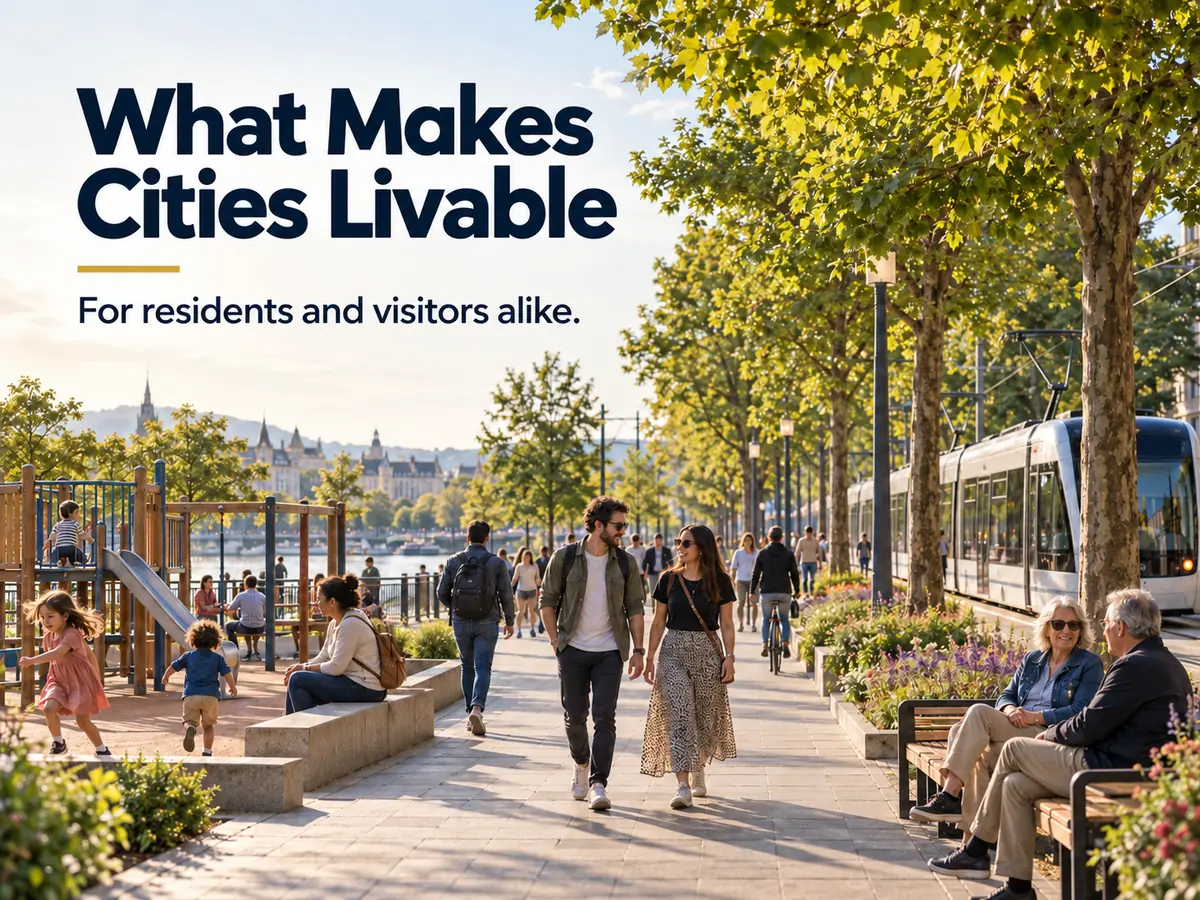
What matters here is not a famous park across the city but the ordinary places close to home: a small green space with shade and benches, a pitch the neighbourhood can book, a library with evening hours, a community recreation center with a weekly program, a promenade or a riverbank that is pleasant to walk. The question of why recreation matters is really a question about these everyday places, because they are where people meet neighbours, keep moving and feel part of where they live.
The quality of an urban park is a good example. A large, well-designed park helps, and the evidence on green space and health agrees, but a resident uses the one they can reach in ten minutes on foot. Most of the city’s recreation happens within that radius, which is why I would rather see many modest, well-kept places spread across a city than one spectacular project that most people visit twice a year. The same applies on the city’s edge. Easy access to the hills, the coast or the forest, by public transport and not only by car, turns outdoor recreation from a weekend expedition into an ordinary part of life.
Is the city kind at both ends of life?
A useful test of livability is to look at the city through the eyes of a child and an older person. Both depend more than the rest of us on walking, on public transport, on short distances and on places to rest. Both notice immediately when a pavement is broken, a crossing is too wide, a bench is missing or a public toilet is locked.
The WHO’s work on age-friendly practices describes environments that help older people meet their basic needs, learn and make decisions, be mobile, build and keep relationships and contribute to their community. I find that list a better description of a livable city than most rankings, because every item on it depends on the ordinary street. Mobility means a pavement without obstacles and a bus that kneels. Relationships mean a bench, a tea house, a club or a market within reach. Contribution means somewhere to go and something to take part in.
Children need much the same. A city where children can walk to school, play outside near home and go to a park without being driven is a city that works for their parents too, and usually for everyone else.
Visitors notice the same things, only faster
A visitor has no commute and no rent to pay, yet within a couple of days they experience most of what makes a city livable. They walk the streets residents walk, use the same transport, sit in the same parks and squares, eat in the same neighbourhoods and judge the same evenings. If the transport is confusing, the pavements are hard to walk and the evenings are empty, they feel it just as residents do, only without the patience that comes from having no choice.
For the same reason, I am wary of the habit of planning visitor experiences as a separate layer on top of the city. A clean, walkable, well-connected city with lively neighbourhoods is already most of a good visit. A city brand built on images that the ordinary street does not match lasts only until the first visitors arrive and tell their friends what they actually found.
There is a limit, of course. When visitors become so many that residents can no longer use their own streets, squares and transport comfortably, tourism itself starts to make the city less livable, and overtourism is a livability problem before it is a tourism problem. The places that handle it best tend to be those that treated quality of life tourism as a question about residents and kept measuring it while visitor numbers grew, rather than only counting the arrivals.
Who gets to say a city is livable?
Rankings, consultants and marketing campaigns all have opinions about which cities are livable. The people with the best information are the residents, and they are asked least often. A short, regular survey of how long people spend travelling, whether they can find housing near work, whether they feel safe at night, how often they use a park or a sports facility and whether they would recommend their neighbourhood to a friend would tell a city more about its livability than any league table.
Event organizers, hotels, agencies and tour operators could do more with this than they do. We work with cities every day and see them from the inside, through the eyes of visitors and through the people we employ. When we plan a festival, a congress or a tourism product, asking what it does for the residents’ ordinary week, and not only for the visitors’ weekend, is a small change in habit with large effects over time. It is also the logic behind treating recreation as a foundation of destinations rather than a pleasant extra.
A visitor who wants to know whether a city is livable needs no index at all, only a weekday spent like a resident: a bus across the city in the morning, lunch in a neighbourhood with no landmarks, an afternoon in a local park and an evening walk home from the last stop. The cities that pass that test are the ones where residents have enough time and enough good places left at the end of their own day, and that is where the welcome for visitors really comes from.