Contents
- Visits, tea and the long Sunday breakfast
- What does a free choice look like after a ten-hour day?
- The weekly series and the phone in the evening
- Why did the mall become the family weekend?
- Five-a-side pitches booked by the hour
- Free time comes in pieces of very different sizes
- Ramadan evenings move the whole clock
- Programs that start when people are free
A common belief, which I hear in planning meetings as often as in casual conversation, is that people have lost their leisure activities. Nobody reads anymore, the story goes, nobody plays an instrument, nobody walks in the hills, everyone just goes home and stares at a screen.
I don’t think that is true, at least not in the way it is usually meant. Leisure activities are whatever people choose to do once work, sleep and duties are out of the way, and people everywhere have plenty of them; they simply are not the ones on the brochure. Ask someone what they enjoy and you will hear about hiking, painting, travel and concerts. Watch what they do on an ordinary weekday and you will see family visits, tea with neighbors, the evening series, a walk by the water, a mall on Sunday and, for a great many men, football on a rented pitch. The second list does not cancel the first. It is what the first list looks like after it meets a working day, a commute, a budget and a neighborhood.
Visits, tea and the long Sunday breakfast
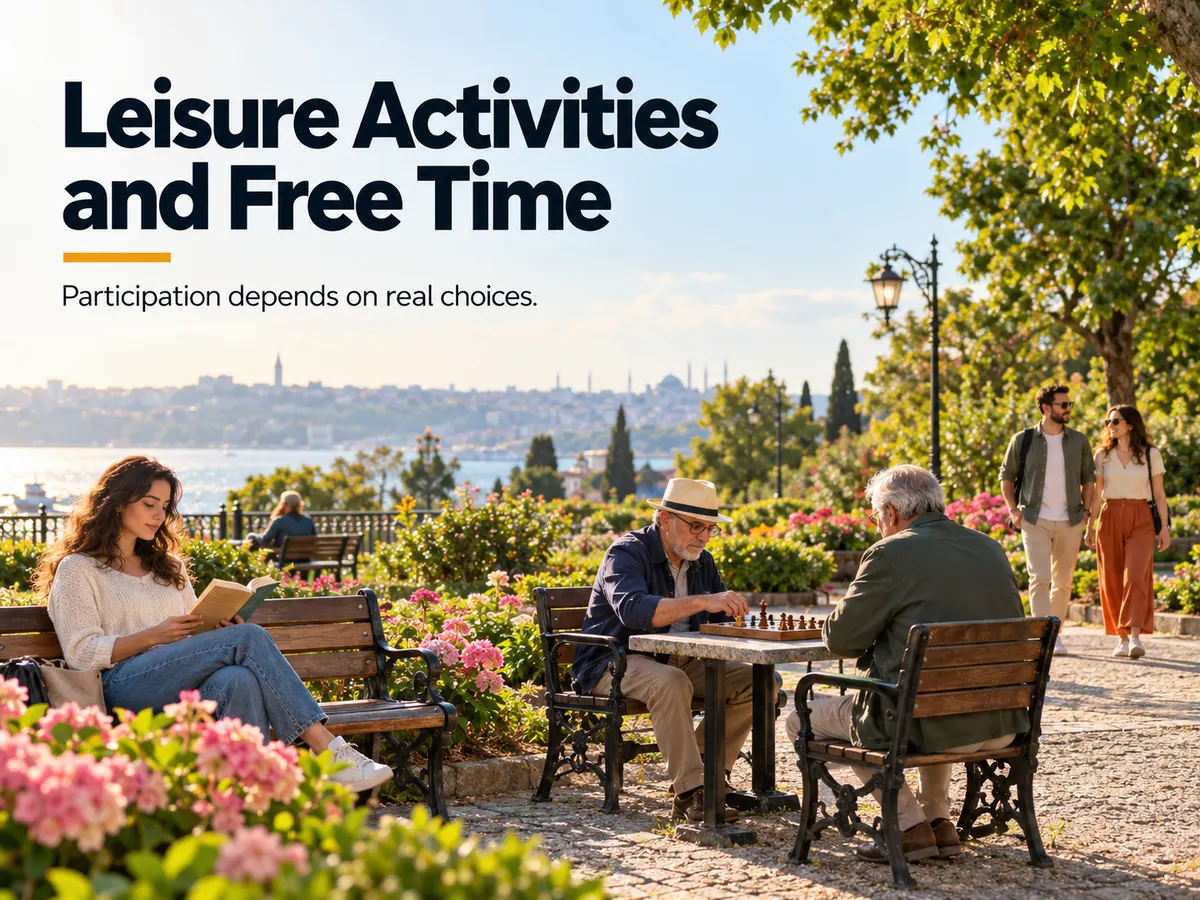
If I had to sum up everyday leisure in much of the world in one word, it would be company. A large share of free time is spent with other people, and much of it at home: weekend visits to relatives, long Sunday breakfasts or lunches, neighbors dropping in for tea or coffee, the round of visits during religious holidays, cousins gathering in a grandparent’s flat. Outside the home, the café, the park bench, the neighborhood coffeehouse and the walk along the water, which is about the most ordinary outdoor recreation there is, matter less as places than as somewhere to meet people.
This is a strength, not something to be corrected. Where these habits are still strong, as they are in Türkiye where I live, around the Mediterranean, across the Middle East and in much of Latin America and Asia, the things other places work hard to encourage, like time with older relatives or knowing your neighbors, are simply part of ordinary life. It also explains something planners sometimes miss: an offer designed for individuals tends to struggle, while a program that a whole family or a group of friends can join together has a much better chance.
What does a free choice look like after a ten-hour day?
On paper the choice looks wide open, since anything counts that is done willingly after work, school, sleep, chores and family duties. Some activities are physical, some social, some creative, some simply restful, and most are a blend. The same walk can be exercise prescribed by a doctor, a commute, or leisure, depending only on whether you had to take it. Statisticians draw the category just as widely; the American Time Use Survey files socializing, television, reading, games, sports and simply relaxing under the same heading of leisure.
That freedom has edges, though. People choose from what is available at the hour they are free, at a price they can pay, within a distance they are willing to travel and, very often, with someone to go along. A pottery course that ends at six is not an option for someone who leaves the office at six. A choir rehearsal across the city is not an option for a mother with nobody to watch the children. When people say they would like to do more of the things they love, I believe them; what stands in the way is usually distance, the clock and the effort of starting something alone.
Let’s say a class lasts forty-five minutes and the bus takes twenty each way. The real commitment is then closer to an hour and a half, before anyone has changed clothes or found someone to sit with the children, and when such a class is half empty I would look at that full figure long before concluding that nobody in the neighborhood is interested.
The weekly series and the phone in the evening
Television holds a particular place in a great many evenings. In plenty of countries the weekly series or the nightly soap is a shared event in the household, and the night it airs gets planned around. Add the phone, and a large part of free time after dinner happens on a screen.
It is easy to be dismissive about this, and my field has no shortage of dismissive remarks. I think they miss the point. A screen is close, costs nothing at the moment of use, is available at any hour and needs no transport, booking or change of clothes. After a long day and a longer commute, that is an extremely hard offer to beat, and any alternative has to be honest about how much effort it asks for. The alternatives that do win evenings back tend to be the ones that remove effort rather than add enthusiasm: a course in the building next door, a walking group that starts at the apartment block’s gate and loops through the nearest urban park, a film night where the neighbors already are.
Why did the mall become the family weekend?
For many urban families, the weekend answer to “where shall we go?” is the shopping mall, and I say that without irony. The mall offers in one place what is genuinely hard to find elsewhere: shelter from heat and rain, clean toilets, a food court that pleases everyone, a play area, cinemas, security at the door, parking. In many cities the cinemas themselves are inside malls, so even a film night tends to start there.
What the mall cannot give is time free from spending. A family can walk for an hour without buying anything, but every corner is built to change that, and for a family on a tight budget the afternoon slowly becomes window shopping. Brands and agencies know the mall weekend well, which is why so many activations happen there: a sampling corner, a children’s workshop, a small stage staffed for the weekend by a hostess agency. Some are thoughtful. Many are interruptions in a place people came to rest, and I would like more of them to be designed as though the visitor’s free time had value.
Five-a-side pitches booked by the hour
One leisure activity explains the whole subject better than any theory I know. It is five-a-side football on a small artificial-turf pitch rented by the hour, the kind found in neighborhoods from Europe to Latin America and the Middle East and often open late into the night as part of the local night time economy. A group of friends calls, books an hour, splits the price, plays, then sits for another half hour at the little café by the pitch. Nobody needs a membership, a coach or a season ticket.
What people do with their free time follows what is near, affordable and open at the hour they are actually free, far more than it follows the list of things they say they enjoy.
Football is popular everywhere, but it became a weekly habit for so many men largely because someone made it easy to book an hour after work, round the corner, with friends built in. The obvious gap is who gets the turf. The evening slots belong almost entirely to men; a quiet afternoon slot for children or a regular evening hour for women’s groups would use the same pitch and the same café for people who now have no equivalent at all.
Free time comes in pieces of very different sizes
Free time is not one block of hours that everyone holds in the same way, and the differences between people are less about taste than about the shape of their hours. Roughly, in most of the cities I know, it looks like this:
| Whose free time | When it tends to come | What tends to fit |
|---|---|---|
| Working parents | An hour after the children sleep, a Saturday morning, a few days of leave | Short, close to home, something the family can join together |
| Retirees | Long mornings and quiet afternoons, with fewer reasons to leave the house | A regular daytime meeting with company built in |
| University students | Irregular, and gone during exams | Drop-in formats with no term-long commitment |
| Shift workers | While everyone else is at work | Facilities open at off-peak hours |
| Seasonal tourism staff | Almost none from spring to autumn, plenty after the hotels close | Winter courses, leagues and programs |
| People caring for children or older relatives, very often women | In fragments, seldom a clean evening | Daytime slots, childcare alongside, nothing that needs a fixed three-hour block |
The last row is the one most offers miss, because a program that assumes a free evening from seven to ten never reaches someone whose evening is spent getting children to bed.
Seen like this, the useful question is never only what people like. It is whose free time, at which hour, and in what size of piece.
Ramadan evenings move the whole clock
Few things show the point better than Ramadan in cities with large Muslim populations. During that month the daily rhythm shifts: evenings fill with iftar gatherings, and after the meal the city comes out late, to the squares, the seaside, the historic quarters and the evening markets. Organizers who move their programs to the hours after the evening meal, whether a concert or a small food festival in a historic square, get crowds that a daytime program would never see, and those who keep the usual timetable wonder where everyone went. Nothing about people’s interests changed in that month. Only the clock did.
Programs that start when people are free
Organizers, people working in recreation management, hotels and brands all make leisure offers, whether or not they call them that, and the hour is half of the design. A cultural center that wants working adults in its courses has to think about evenings and weekends, even if it means shorter weekday mornings and a different staff rota. A city festival that wants families has to think about when children get tired and how far the bus stop is, not only about the headline act, and if it hopes to leave any legacy in people’s weekly habits, about what stays in the neighborhood once the stage comes down. A hotel that wants guests to try its activities has to place them at the hours guests are actually by the pool, rather than the hours that suit the animation team. And a brand in a mall has to accept that people came to rest, and build something that adds to that rest instead of breaking into it.
Persuading people to want different things is not, to my mind, the answer. They already want them. What helps is moving a few of those things closer, to the right hour, at a price that makes nobody hesitate, in a form that friends and families can join together. A newcomer also needs answers that regulars take for granted, such as whether it is fine to come alone, what to bring and whether a beginner will be lost on the first evening.
Rest belongs on that list too, and not as the poor relation. The Universal Declaration of Human Rights gives rest and leisure a line of its own in Article 24, and my own industry forgets it easily, filling every free half hour of a congress with networking and every corner of a festival with something to buy. Quiet seating where nobody has to order anything is a leisure offer as well.
Which of the things you say you enjoy would you take up every week, and what exactly keeps it from starting near your door?