Contents
- Without the race or the match, nobody would have travelled
- Spectators come for two hours and stay for days
- Away fans mostly travel home the same night
- Mass participation events have grown their own calendar
- The amateur arrives a day early and brings the family
- Winter football camps were built by hotels
- The same climate could host more than football
- Traditional sports draw crowds that nobody packages
- The temporary team behind each championship
Sports tourism is usually imagined as fans flying to a big match: a final abroad, a derby, a world championship, a weekend of flags and chanting in a foreign city. That picture is real, but it is the smallest and least reliable part of the business.
Sports tourism is any trip people make mainly because of sport, to watch it, to take part in it, to train for it or to visit the places where it lives, and the larger and steadier share of it is made up of people who travel to take part rather than to watch, and of teams who travel to train. Amateur runners, cyclists, triathletes, youth football squads with their parents, golfers, and every winter whole squads of professional football teams on resort hotel pitches around the Mediterranean. These visitors book earlier, stay longer and come back more often than most spectators ever will.
Most destinations hold several of these types at once without treating them as one business: a winter training season, a participation calendar, a mountain for skiing, a coast for water sports, and often a traditional sport with a devoted crowd that outsiders have never heard of. Seen from the event side, where I work, each type needs something different from hotels, agencies and organizers.
Without the race or the match, nobody would have travelled
The definition people in the field use is broad on purpose. UN Tourism’s own description of sports tourism speaks of visitors who watch or take part in sporting events, and planners in practice stretch it to anyone travelling outside their usual surroundings for sport. Even so, a beach holiday where you happen to play volleyball does not really count. The trip you would never have made without the race, the match or the camp does.
That “would never have made” is the useful test, because it shows whether sport is the product or just an extra. A hotel with tennis courts sells a holiday with tennis; a hotel that organizes a tennis week with coaches, a tournament and court bookings sells sports tourism, and the difference shows immediately in who arrives, when and for how long.
Of all the types of tourism, this is one the industry usually divides three ways, into watching, doing and visiting. From what I see on the event side, I would add training as a fourth part, since in warm-weather resort regions it has grown into an economy of its own. Put side by side, the four ask surprisingly different things of the same hotel:
| Who travels | Typical trip | What decides whether they come back |
|---|---|---|
| Spectators | A final, a tournament, a race weekend | The days around the match: hotels, transport, the city itself |
| Participants | A marathon, a triathlon, a youth tournament | Early breakfasts, quiet rooms, a program for the family |
| Teams in training | A winter or pre-season camp | Pitch quality and a schedule that never slips |
| Visitors to sporting places and traditions | A stadium, a museum, a traditional festival | Someone who explains what they are watching |
Spectators come for two hours and stay for days
International spectators are the most visible sports tourists. They come for a final, a tournament, a Formula 1 weekend, a basketball Final Four.
For them the match is a few hours and the trip is several days. Most of that time is spent in the city, eating, walking, shopping and hunting for a screen showing the other games, and whether the fan goes home with a good story depends far more on those days than on the score. That part of the trip belongs less to the stadium than to the hotels, the guides and, where a city has one, its destination management organization.
International tournaments also carry a much bigger operation than people expect. Teams, referees and officials need their own hotels, media need another set, there are fan zones, airport and match day transfers, accreditation, hostesses and guides for the delegations. Most of this is run by a temporary team assembled for the event and dissolved afterwards.
Away fans mostly travel home the same night
Domestic away fans are a different case altogether. A large share of them travel by coach, watch the match and head back the same night. By the strict definition they are day visitors rather than tourists, because they never spend a night.
They still fill roadside restaurants and the streets around the stadium, but the hotels barely see them. I don’t think this is anybody’s failure; it is simply the way away travel works in most football countries, shaped by distances, budgets and the habit of going together in a group. It does mean that a city hoping a big match will fill its hotels should first look at where the fans are coming from, and how far they would have to drive home.
Mass participation events have grown their own calendar
The fastest growing part of sports tourism is participation: marathons and half marathons, trail races, triathlons, cycling events, open water swims, amateur tournaments, youth championships, golf weeks.
The big city marathons are the obvious examples, and the strongest of them sell a route people want to run as much as a distance: a famous bridge, a historic center, a finish in front of a landmark. Trail races have turned mountain valleys and national park edges into weekend destinations. Warm coasts host triathlons and open water swims, golf resorts build their busiest weeks in the cooler months, and in late spring many coastal hotels fill with youth football teams playing tournaments on the same pitches the professionals used a few months earlier.
What these events share is a fixed weekend that participants plan months ahead, often with a training schedule built backwards from it. For hotels that is a gift: bookings arrive early, cancellations are rare, and the dates usually fall outside high summer.
The amateur arrives a day early and brings the family
In sports tourism the person you most need to understand is rarely the champion; it is the amateur who pays to take part, brings a family, and comes back next year if the weekend worked.
That amateur behaves nothing like a spectator. They arrive a day early to collect their race kit. They want a quiet room and an early breakfast. They often bring a partner or children who are not racing and need something to do. They stay an extra night to recover, some of them in a thermal hotel that quietly turns the race weekend into a small dose of wellness tourism, eat well afterwards and post photos for a week. Get those details right and many of them return, which a one time spectator rarely does.
What I keep seeing is that the race itself is planned with great care while everything around it is left to luck. The finish line is excellent, but the hotel breakfast opens too late for an early start, the families have no program at all, and nobody has told the shops along the route that a few thousand hungry runners will pass by around lunchtime. These are cheap things to fix, and they are the things participants mention when they decide whether to sign up again.
Winter football camps were built by hotels
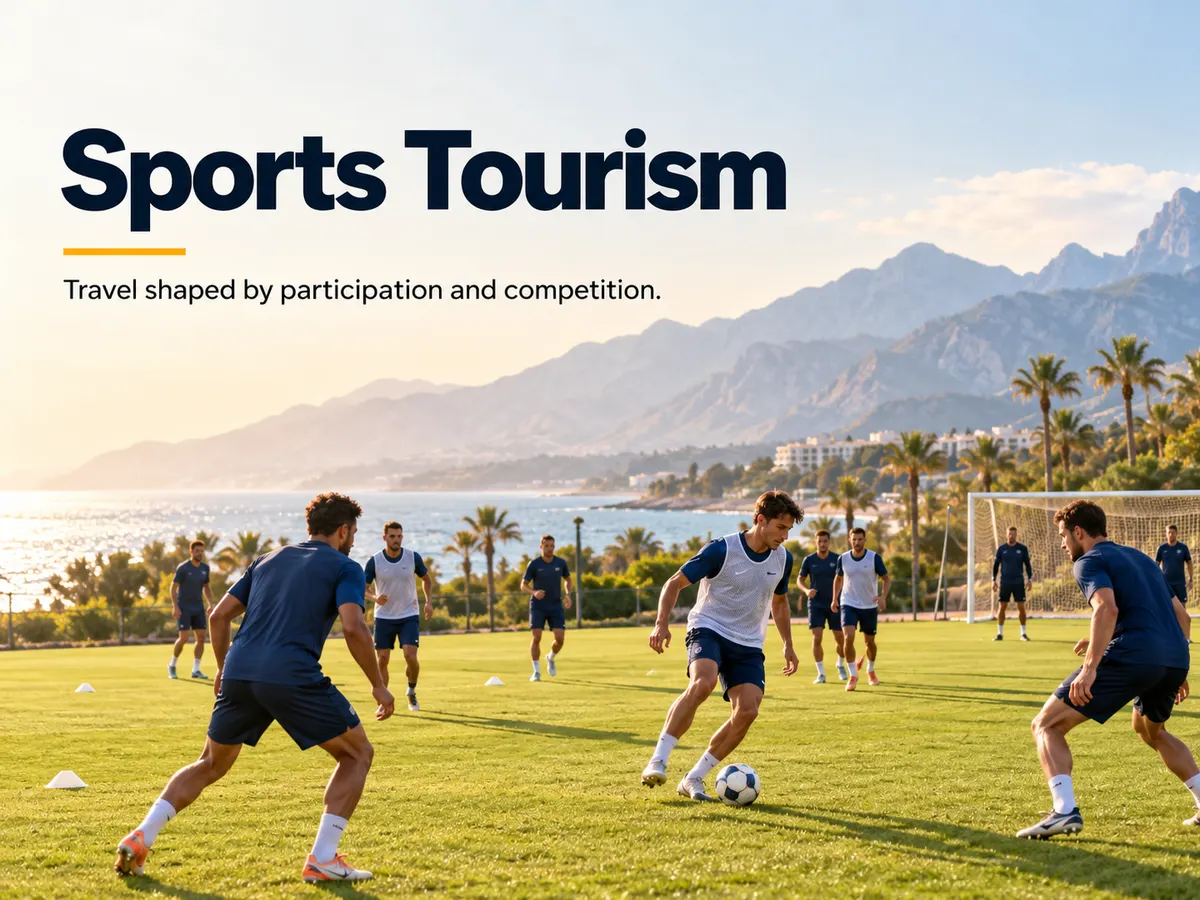
Every January the resort hotel zones on warm coasts, in southern Spain, Portugal’s Algarve, Cyprus and the Antalya coast among others, fill with football teams from northern and central Europe. They come for the winter break because the grass is green and the air is mild while their home pitches are frozen. With them come coaching staff, physiotherapists, journalists, agents and, for some clubs, groups of supporters who fly in for the friendly matches.
This economy grew from the industry itself rather than from a plan on someone’s desk. Hotels that stood empty in winter invested in professional grass pitches, changing rooms and lighting. Agencies appeared between clubs and hotels to arrange friendlies, referees, transfers and media. Over the years it became one of the clearest examples anywhere of a tourism product that fills the off season and spends well, because a club travels with a full delegation, full board and a real budget, and every friendly match is news back in the team’s home country.
What a club buys, though, is the training schedule, and the hotel is only the frame around it. A missed session because the pitch was double booked or the bus came late hurts the trip far more than a lovely room can repair, which is why the hotels that keep the same clubs for years treat the coaching plan as the real contract.
The same climate could host more than football
The camp economy is also fragile in ways people in the business know well. Hotels compete on price for the same clubs, margins shrink year after year, and the destination competitiveness the region built slowly is spent a little each season. Demand leans on a handful of source markets, so a difficult season in one of them is felt immediately. And the product is still mostly football, while athletics, cycling, swimming, tennis and triathlon have winter training needs of their own and the same weather would suit them. Some of those camps already exist, but few are organized with anything like football’s routine.
Summer offers a mirror image. In July the southern coasts are too hot for serious training, and clubs go to higher ground instead; the Alpine valleys of Austria and Switzerland have hosted summer pre-season camps for decades. Winter on the coast and summer in the mountains is a perfectly sensible year for any region that has both, and the hotels and agencies that learn to sell both will carry the camp economy into its next stage.
Traditional sports draw crowds that nobody packages
The quietest type of sports tourism is visiting places and traditions connected with sport. It works a little like faith tourism, in that people travel for what a place means to them more than for what happens there on a given day, and it has a form I came to know closely as Secretary General of the Marmara Traditional Sports Federation in Türkiye.
Traditional sports draw large, devoted audiences in many countries. Scotland’s Highland games, Basque rural sports, Swiss wrestling festivals, Mongolian Naadam and the oil wrestling and mounted archery I worked with all have crowds that come back every year, often from far away, because the event is part of who they are.
What these events rarely have is a tourism product around them. Visitors come, watch and leave. Few packages combine the event with accommodation, a guided explanation of the tradition, a regional meal, or a visit to the clubs and families who train for it. The audience is there already; tour operators and DMCs have done very little with it. That strikes me as one of the most natural openings in sports tourism anywhere, because a festival with centuries behind it is already cultural tourism waiting for someone to treat it that way, and no other place can offer that particular one.
The temporary team behind each championship
Behind most sports events, in almost any country, stands a team that exists for a few months only: a federation with a small permanent staff, an organization company, a DMC for hotels and transfers, a hostess agency sending daily staff, students called in from universities, local security and medical crews. It comes together before the event and scatters the week after.
That is normal for events everywhere. The loss is in what the team knew. The person who kept the transfer schedule, the one at the accreditation desk, the hotel coordinator who remembered which delegation wanted dinner early, all leave with the event, and the next championship begins with new people and an empty file. The large international organizations tend to handle this better because their standards demand training, shift plans and a proper handover. For the many medium sized events in between, a short note on who did what and how well, payment to the temporary team on the date promised, and a phone call to the good ones first next year would raise quality more than most budget increases. For my part, I would take a crew that already knows the venue over a bigger opening ceremony every time.