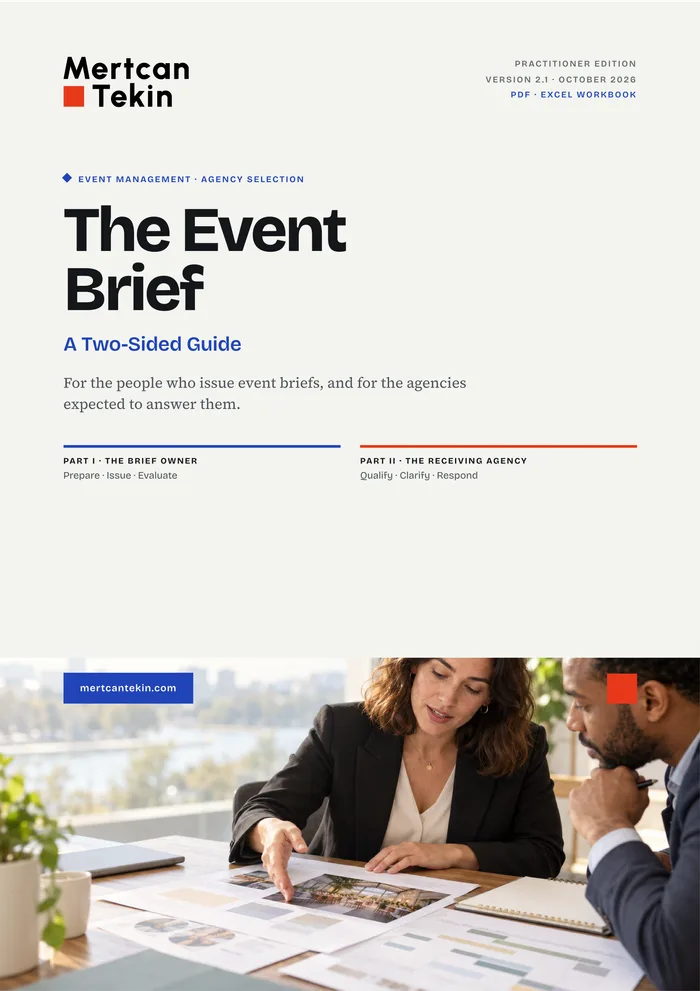
The Event Brief: A Two-Sided Guide
Eight parts to put in a brief, how agencies read each one, a scoring matrix, a selection timeline, and the intake, scope and bid discipline on the agency side.
What is inside
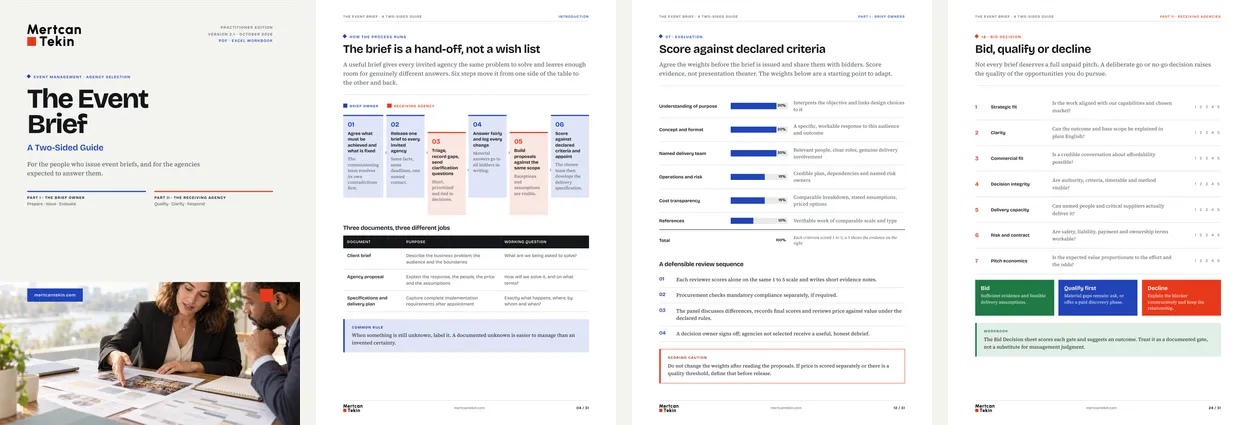
Part I · For brief owners
Five failures that cost the most, the eight parts of a brief with notes on how agencies read each one, weighted scoring, a workable timeline, an illustrative brief and a release checklist.
Part II · For receiving agencies
The first 48 hours, better questions for each part of the brief, a clarification log, scope status, feasibility, the commercial offer, a bid, qualify or decline gate and a submission checklist.
The workbook
Twelve sheets in two routes: Owner Brief, Budget, Scoring, Timeline and Roles; Agency Intake, Scope Register, Risk Register, Bid Decision and Response QA; a shared Clarifications log.
Why it is written for both sides of the table
Most writing about event briefs speaks to one side. The guide treats issuing a brief and answering one as the same conversation, because a weak brief and a careless intake usually fail together. It comes from work on both sides: requesting proposals and choosing suppliers for international forums, and writing proposals on the agency side.
The thinking behind it is in the article How to Brief an Event Agency So the Proposal Is Worth Reading.
Who the template is for
Part I is for the people who issue a brief: corporate event owners, association staff, public bodies and procurement teams who invite agencies to propose. Part II is for the agencies, DMCs and production companies who receive the brief and must decide whether and how to answer it.
Both parts use the same eight sections, so a brief owner can see how an agency reads each one and an agency can see what the owner is trying to decide.
How to use it, step by step
- Open Start Here and choose your route: brief owner, receiving agency, or both.
- As the owner, complete the eight parts in Owner Brief and use the completeness check before release. Enter a genuine budget range with the lines it includes in the Budget sheet.
- Agree the evaluation before release: set weights in Scoring, name the evaluators and the approver, and count the selection schedule back from the event date in Timeline.
- As the agency, log the request in Agency Intake, record every question in the shared Clarifications log, and run the seven gates in Bid Decision before committing a team.
- Keep scope and risk visible in the Scope Register and Risk Register, and run Response QA before you submit.
The workbook supports an accountable conversation between the two sides and does not replace one. Keep a dated version of the brief, the answers, the commercial baseline and the final approval, so the decision can be explained later.
Part II follows the agency through its first 48 hours with a brief: better questions for each part, a clarification log, scope status, feasibility, the commercial offer, a bid, qualify or decline gate and a submission checklist. Each part of the brief has notes on how agencies read it, which helps owners see where proposals drift.
Common mistakes it helps you avoid
- The budget is withheld. Share a genuine range so proposals are comparable.
- The objective is a list of adjectives. Describe an observable behavior or result.
- Nobody knows who decides. Name the evaluators, the approver and the weights.
- Too many bidders for too little time. Invite a shortlist proportionate to the event.
- Constraints arrive after appointment. State brand, access, approval, venue and safety rules up front.
The guide calls these the five failures that cost the most and suggests checking which of them appeared in the last comparable project before writing a new brief.
Questions about the template
Is the template free, and what do I receive?
Yes. Enter your work email, confirm the address from the email that follows, and the download page opens with the PDF guide and the Excel workbook. You will also receive new articles and templates about once a month, and you can unsubscribe at any time from any of those emails.
Where is the Excel workbook?
The Excel workbook is attached inside the PDF guide. Open the attachments panel, shown as a paperclip icon in Acrobat, Preview or Edge, and save it to your computer. If your reader has no attachments panel, the same file is offered separately on the download page after you confirm your email.
How long should an event brief be?
The guide says two to four pages of clear answers can be enough for a modest event, and that complexity should drive the level of detail. What matters is that every invited agency receives the same problem, the same constraints, a real budget range and a clear account of how proposals will be scored.
Should the brief include a budget?
Yes. The guide treats a withheld budget as one of the five most costly failures, because agencies then guess and the proposals cannot be compared. The Budget sheet records a range, the lines it includes, the contingency and the cost per guest, so every agency prices the same scope.
Is this template a procurement contract?
No. The guide is a practitioner framework and does not replace a legal contract, a procurement regulation or an event specifications guide. Apply your own safety, tax and purchasing rules, and keep a dated version of the brief, the answers, the commercial baseline and the final approval.