The Event Safety Plan Checklist
Who owns which part of safety, the twelve sections of a working plan, a risk register that decides something, movement and evacuation for people who need help, medical cover, weather decisions, build and break, command on the day, briefings, incident records and testing the plan.
What is inside
Foundations
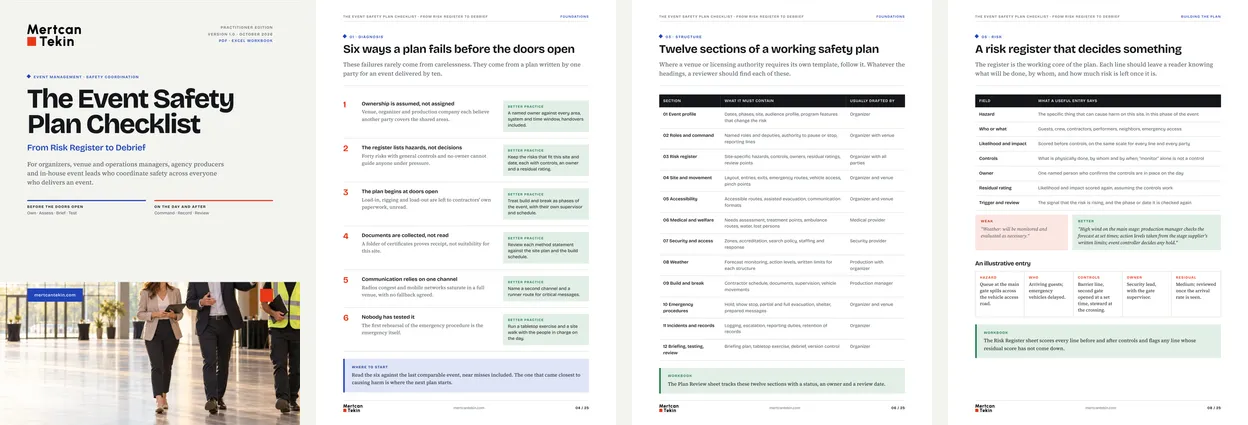
Six ways a plan fails before opening, ownership across organizer, venue and contractors, the twelve sections of a working plan and sizing the plan to the risk.
Building the plan and the day
Risk rating, site movement, evacuation for people who need help, medical cover, accreditation, weather, build and break, command structure, prepared messages, briefings and incident records.
The workbook
Eight sheets: Event Profile, Risk Register, Command and Contacts, Contractor Documents, Briefing Checklist, Incident Log, Plan Review and Start Here.
A planning framework, with the limits stated
Event safety plans are often written to be approved rather than used. This checklist is for the person who has to make one work across a venue, contractors and a temporary team: clear owners, decisions written in advance, and a plan that is tested before the doors open.
It is a planning and coordination framework, not legal, engineering or medical advice. Local law, licensing conditions, venue rules and qualified professionals come first, and the guide says so on its first page.
The thinking behind it is in the article What Goes Into an Event Safety Plan.
Who the template is for
The checklist is for event organizers and in house event leads who must assign ownership and assemble a safety plan, and for venue and operations managers who check an organizer's plan against the building and its own emergency procedures. Agencies, production companies and safety advisers can use the same structure to coordinate contractors and a temporary team.
It is a planning and coordination framework. Local law, licensing and permit conditions, the venue's rules and the judgment of competent safety professionals take precedence.
How to use it, step by step
- Complete Event Profile with dates, phases and key people. The sheet counts the features that raise the bar and suggests how deep the plan needs to be.
- Build the Risk Register: likelihood times impact before and after controls, with an owner for each decision and a flag where residual risk has not fallen.
- Name roles, deputies, channels and positions in Command and Contacts, and confirm who has the authority to stop the show.
- Track documents per contractor with due dates in Contractor Documents, and record briefing items by team in Briefing Checklist.
- On opening day, score the seven readiness gates in Plan Review with the people who own them, keep the Incident Log during the event, and hold a debrief that updates the register.
Yellow cells are inputs; ratings, statuses and totals are calculated. The workbook supports the people who own safety and does not replace them or the documents your venue and authorities require. Keep a dated version of the plan, the register and the briefings.
The guide follows the plan from foundations to the day: who owns what, how much plan the event needs, site and movement, accessibility, evacuation for people who need help, medical cover based on a needs assessment, security, weather and contractors, then command, incident recording, testing and a debrief that changes the next plan.
Common mistakes it helps you avoid
- Ownership is assumed, so nobody is named for an area, a phase or a system.
- The register lists hazards and records no decisions.
- The plan begins at doors open and ignores the build and the breakdown.
- Contractor documents are collected and never read.
- There is only one communication channel.
- Nobody has tested the plan, around a table or on foot.
The guide answers each of these with a page of practice, from rating risks consistently to testing the plan before the build.
Questions about the template
Is the template free, and what do I receive?
Yes. Enter your work email, confirm the address from the email that follows, and the download page opens with the PDF guide and the Excel workbook. You will also receive new articles and templates about once a month, and you can unsubscribe at any time from any of those emails.
Where is the Excel workbook?
The Excel workbook is attached inside the PDF guide. Open the attachments panel, shown as a paperclip icon in Acrobat, Preview or Edge, and save it to your computer. If your reader has no attachments panel, the same file is offered separately on the download page after you confirm your email.
Is this checklist legal or engineering advice?
No. It is a planning and coordination framework. Capacity and occupancy, temporary structures, electrical installations, fire safety and medical cover need sign off from people qualified to give it, under the rules that apply where the event takes place. Licensing and permit deadlines set by the authorities come first.
What are the seven readiness gates?
They are checks scored on opening day with the people who own them, starting with ownership, risk controls, site and routes, and contractor sign off. The guide treats a low score as a reason to fix, delay or reduce the event, and the Plan Review sheet suggests an outcome from the scores.
Does the template cover small events?
Yes. The Event Profile sheet counts the features of your event that raise the bar and suggests a plan depth, and the guide has a page on how much plan an event needs. A smaller event can use a shorter plan, but every area, phase and system still needs a named owner.