The Recreation Needs Assessment Kit
Setting the decision and the area, counting every provider's supply in usable hours, ranking demand evidence by how far it can be trusted, reaching the people who never come, observation counts in parks, barriers, gap analysis, scoring options and turning findings into a plan. Version 2.0 adds the fieldwork tools: commissioning brief, sampling, a coded resident survey, non-user intercepts, facility and access audits, park count sheets, demand scenarios, lifecycle cost and a one-page decision memo.
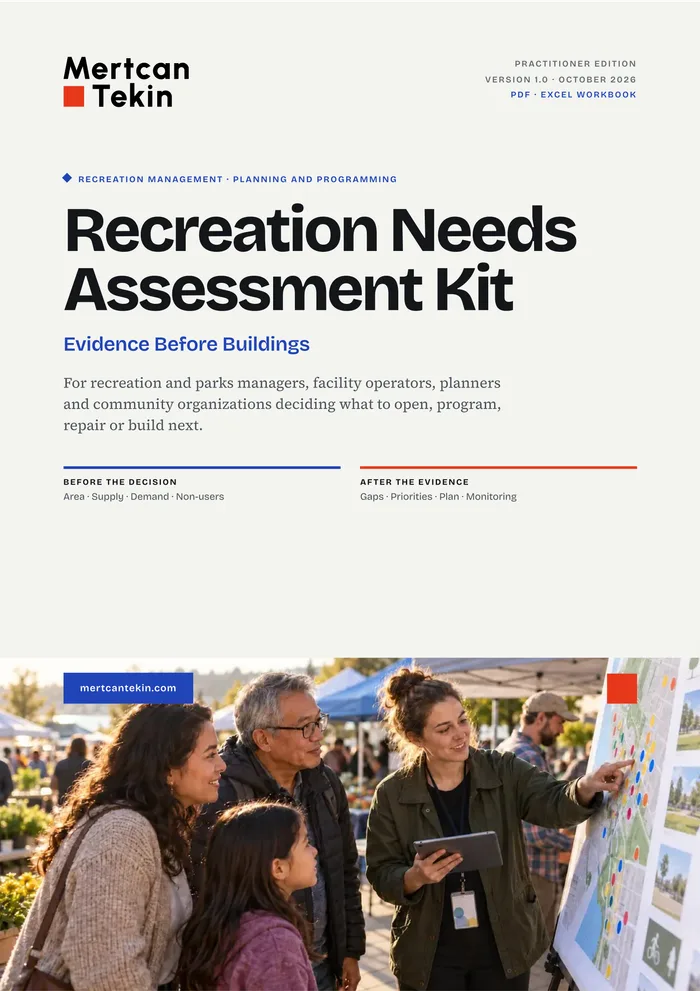
What is inside
Setting up and evidence
The decision and the area, the people the plan must serve, supply from every provider, usable hours, demand evidence, records you already hold, surveys, outreach to non-users and observation counts.
Analysis and the plan
Barriers sorted by who can remove them, supply against demand by zone, scoring options, the smallest response that closes the gap, an illustrative district assessment, the plan and monitoring.
Fieldwork tools
Commissioning brief and governance, sampling and quotas, a two-part resident questionnaire, non-user intercepts and focus groups, facility and access audits, park observation sheets, demand conversion and scenarios, scoring rubric, lifecycle cost, a twelve-week workplan, the decision memo and monitoring.
The workbook
Nineteen linked sheets, from settings, area profile, sampling and coded survey responses through supply, access, observation, demand model and gap analysis to scoring, lifecycle cost, action plan, QA sign-off, a worked example and a data dictionary.
Why evidence comes before buildings
A new hall or program decided before the evidence often serves the people who already come and misses the ones who never do. The kit gives recreation teams a method that counts supply honestly, reads demand with its limits stated, and looks for the residents who are absent.
It is written for parks and recreation managers, facility operators, planners and community organizations deciding what to open, program, repair or build next.
The thinking behind it is in the article Recreation Needs Assessment: Ask Before You Build.
Who the template is for
The kit is for recreation and parks managers, planners and community organizations deciding what to open, program, repair or build. It also suits consultants who run assessments for local authorities and boards who must approve the results.
It is a practitioner framework. Where national guidance, planning law or research ethics rules apply, they come first.
How to use it, step by step
- Commission the work with the one page brief: the decision to be informed, the decision owner, the study area and zones, the time horizon and the solutions the brief allows.
- Describe the people the plan must serve, with a profile that looks ten years ahead, and count every facility in the area, including those run by schools, clubs and private operators.
- Turn capacity into supply with usable hours, then rank the evidence of demand by how far it can be trusted: records you already hold, a survey about recent behavior, and outreach to people who do not use the service.
- Sort barriers by who can remove them, and set supply against demand zone by zone.
- Score the options, including operations, programs, partnerships and capital, then agree actions and sign off quality in the QA tab.
The workbook has 19 linked tabs, from the project dashboard and settings to the area profile, sampling, coded survey, outreach, supply, access, observation, evidence, barriers, demand modelling, gaps, scoring, cost, actions, QA sign off, an illustrative case and a data dictionary. Yellow cells are inputs and blue tinted cells hold calculations.
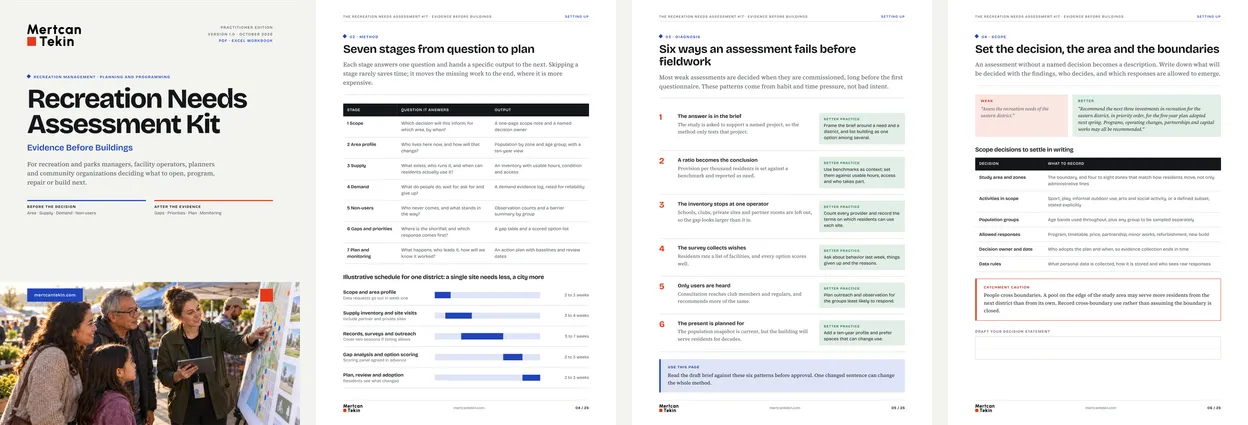
The kit follows seven stages from question to plan, and each stage answers one question. It gives particular attention to parks and open spaces, where most use is never booked, and sets out a simple observation protocol: zones that can be seen in one sweep, fixed time slots, repeat counts on several days and in at least two seasons.
Common mistakes it helps you avoid
- The answer is already written into the brief.
- A provision ratio becomes the conclusion.
- The inventory stops at one operator.
- The survey collects wishes. Ask what people did last week.
- Only current users are heard. Plan outreach to non users.
- The plan serves the present. Use a ten year population profile.
The guide calls these six ways an assessment fails before fieldwork begins, and the workbook includes an illustrative case and a data dictionary.
Questions about the template
Is the template free, and what do I receive?
Yes. Enter your work email, confirm the address from the email that follows, and the download page opens with the PDF guide and the Excel workbook. You will also receive new articles and templates about once a month, and you can unsubscribe at any time from any of those emails.
Where is the Excel workbook?
The Excel workbook is attached inside the PDF guide. Open the attachments panel, shown as a paperclip icon in Acrobat, Preview or Edge, and save it to your computer. If your reader has no attachments panel, the same file is offered separately on the download page after you confirm your email.
Does the template only lead to new buildings?
No. The commissioning brief asks which solutions are allowed, from hours, pricing and staffing to new courses and targeted sessions, shared use of school, private and club facilities, minor works, repairs and new building. The scoring tab then compares those options on the same evidence.
How do I reach people who do not use our services?
The kit recommends going where non users already are, through outreach at places they visit, and treating their answers as part of the evidence. The workbook has an outreach tab, and the barriers tab sorts what keeps people away by who can remove each barrier.
Can a small team use the kit?
Yes. The kit treats the records you already hold, such as bookings, courses, memberships and gate counts, as the most reliable evidence once a few weeks of preparation have gone into them. Each stage answers one question, so a small team can work through them in order.