Contents
For most of their history, B2B companies have rented other people’s stages. They book space at the sector’s trade fairs, buy a sponsorship at an association congress, pay for a session slot and a logo on the lanyard. The audience, the agenda, the date and the mood of the room belong to the organizer, and the company competes for attention with every other exhibitor in the hall.
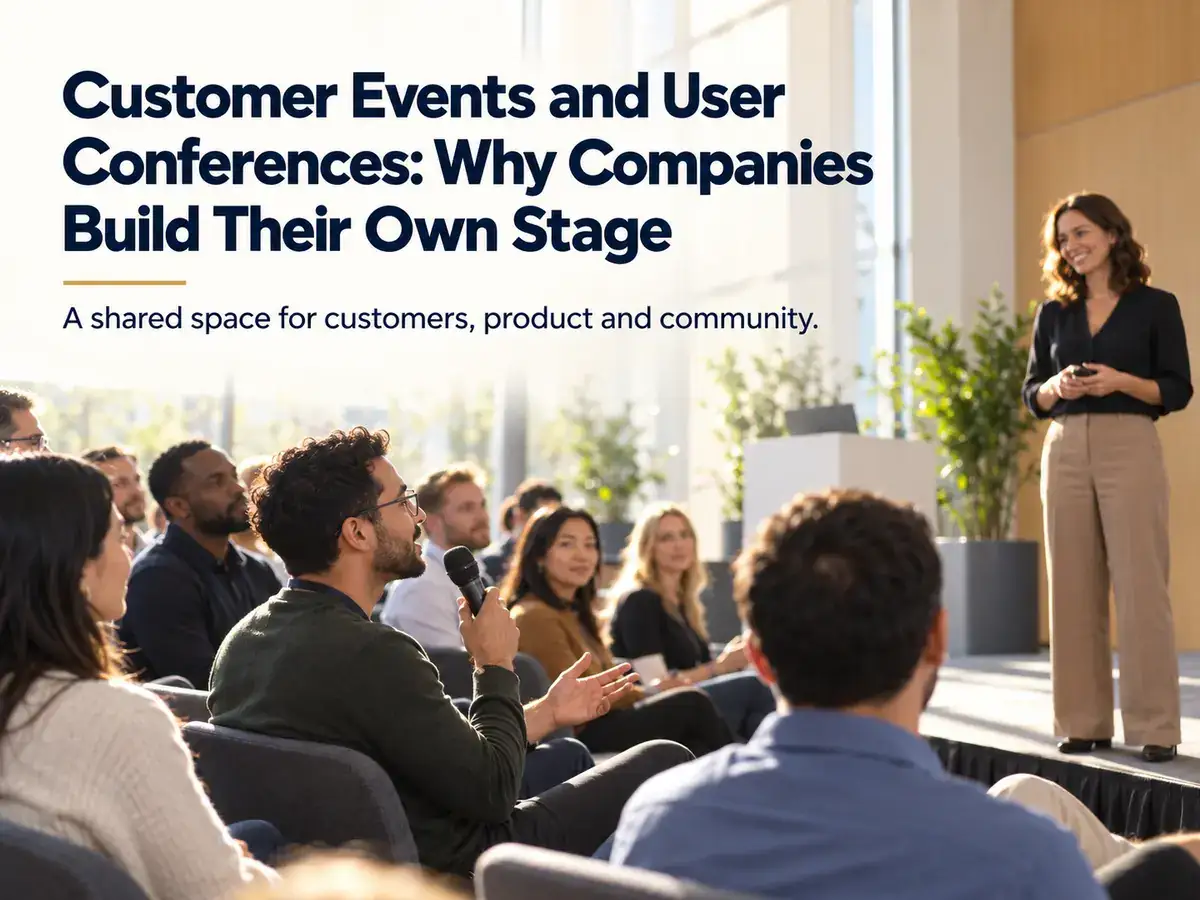
A user conference reverses that arrangement. It is an event a company organizes for the people who use its products, usually with partners and a share of invited prospects, to teach them, show where the product is going, hear what is not working and let customers learn from one another. The company owns the room. It decides who is invited, what is said from the stage and what happens in the corridors, and for a few days its customers are not passing visitors in a fair hall but guests who came specifically to spend time with it and with each other.
The reasons companies build their own stage are mostly commercial and quite sound. In businesses where revenue depends on renewals, upgrades and customers buying a second or third product, the existing customer base is worth more than any new contact a fair can bring, and a trade show is a poor place to look after it. Customers who understand the product well use more of it, stay longer and recommend it to peers; customers who feel heard about its weaknesses are more patient while they are fixed. A user conference is one of the few places where all of that can happen at once, in person, and where product, support, sales and leadership meet the same customers in the same week.
The price is that the company carries everything a fair organizer normally carries for it. It has to fill the room, produce several days of content worth the travel, look after hundreds of guests and live with the result in front of its own customers. From the organizer’s and agency side I have seen how differently companies approach this, and the ones that do well tend to understand early that they have taken on the job of an event organizer, not only that of an exhibitor with a bigger booth.
Customers come for each other more than for the keynote
The opening keynote gets the most preparation, the best stage and the largest share of the budget. Ask attendees a few weeks later what they valued, and many of them will talk about something else: a session where another customer showed how they solved a problem they share, a conversation over lunch with someone from a similar plant or department in another country, a workshop where they finally understood a feature they had paid for and never used.
Peer learning is the core of a good user conference, and it needs more design than it usually gets. Customer speakers are the most credible voices on the program, yet many of them have never presented to a large room and are understandably nervous about saying anything that sounds like a complaint or an endorsement. They need early invitations, help with structure, a rehearsal and permission to talk about what went wrong, because an honest account of a difficult implementation is worth more to the audience than a polished success story. A conference agenda built around customer stories, with company speakers in a supporting role, signals that the event is about the users and not about the host.
The corridors matter as much as the sessions. Customers in industrial and technical sectors often want to talk to their counterparts, engineer to engineer, operations manager to operations manager, and they will do it whether or not the program makes room for it. Planned networking by role or by industry, tables at lunch grouped around shared problems, and enough time between sessions for real conversations turn that instinct into something attendees remember.
Who is the conference really for: users, buyers or partners?
A user conference usually tries to serve several audiences in the same few days, and each of them wants something else. The people who use the product every day want depth: training, advanced sessions, direct access to the product team and the support engineers. The executives who make purchasing decisions want a view of where the company and the sector are heading, and a few conversations with peers and with the host’s leadership. Partners, integrators and resellers want the roadmap early, commercial updates and time with the customers they serve. Prospects, if sales has invited them, want to see whether existing customers are genuinely satisfied.
Each of these is reasonable, and one program can hold several of them, provided somebody decides which audience comes first. When nobody does, the program becomes a negotiation between internal teams, each defending its own sessions, and the attendee experiences the result as a crowded schedule without a centre. Setting that priority is a question of event strategy rather than of agenda design, and it is best answered before the venue is booked, since that choice changes the size of the event, the venue, the price of a ticket and who is sent the first invitation.
Inside the company, the same event looks different from every department. Product wants feedback, marketing wants content and announcements, sales wants meetings with key accounts and prospects, support wants to solve problems face to face, leadership wants a moment with the largest customers. Good event stakeholder management here means giving each team a clear and limited role and protecting the attendee from the sum of all requests, especially from sales teams who would like every customer conversation to end with a proposal.
The roadmap keynote is a promise customers will check
Most user conferences include some form of announcement: new products, new features, a roadmap for the coming year. These sessions draw the largest audiences and generate the most attention, and they carry a risk that a product launch for the general market does not. The audience of a user conference consists of people who will test every claim in their own operations and who will return next year remembering what was promised.
A roadmap presented with confidence and delivered late, or not at all, damages trust more than a modest roadmap delivered on time. I would encourage companies to keep announcements on stage to things they are prepared to stand behind, to separate clearly what is available now from what is planned, and to give the product team time after the keynote to answer detailed questions in smaller rooms. Customers who leave with an honest picture of what is coming, including what is not, tend to plan around it; customers who leave with a dazzling slide tend to come back with a list of grievances.
Industry content belongs on the program too, and it is where many user conferences become stronger than they expected. Sessions on regulation, safety, energy use or skills in the customers’ sector, given by people who hold a genuine view rather than by the host’s sales leadership, give senior attendees a reason to come that is unrelated to the product. They are also the most natural way for a company to earn thought leadership in its field, by putting useful ideas on its own stage instead of asking for a slot on someone else’s.
Why do some user conferences shrink after the third year?
The first edition of a user conference often benefits from novelty. Customers are curious, the company invests heavily and the program is fresh. By the third or fourth year a different pattern can appear: senior customers send junior colleagues, registrations depend on discounts, and the event is held together by the habit of holding it.
The usual causes are familiar. The format has not changed since the first year. The number of sales and partner sessions has crept up while the hands-on content has stayed the same. Customers who attended twice have already heard the basics and find nothing for advanced users. The cost of attending, including travel, hotel and time away from work, has grown faster than the value of the program. Leadership looks at the attendance figure and decides the answer is a bigger venue or a more famous speaker, when the problem is closer to the content.
A user conference keeps its best customers only while they leave it better at their own work, and once it starts to feel like a sales floor with a stage attached, they quietly send someone else.
Companies that keep their user conferences healthy tend to treat each edition as something to redesign rather than repeat. They listen closely to what long-standing customers say they missed, add advanced tracks and certification, rotate the format of the main days, and sometimes move from one large central event to smaller regional editions that are cheaper to attend and closer to customers’ own markets and languages. Some add an online layer for people who cannot travel, though a hybrid event for customers works best when the remote audience is given its own sessions rather than a camera pointed at the main stage. No single one of these choices fits every company, and the work of planning a conference of this kind starts again every year with the same question about what customers need now.
What does a good user conference leave behind in the support queue?
The effects show up later than the event report and in places marketing rarely looks: fewer basic support tickets from customers who attended training, faster adoption of features that were demonstrated, renewals that were less difficult than expected, and customer stories that sales teams keep using until the next edition. On the days themselves, the corner I watch most is the one where support and product engineers sit with customers and their laptops; at the conferences that work, it has a queue from the first coffee break until the doors close.