
Contents
ACI World reports that airports worldwide handled a record 9.8 billion passengers in 2025, based on data from 2,817 airports. International traffic grew 6.1% and domestic traffic 1.7%. In the first half of 2026, traffic reached about 4.7 billion, up only 0.6%, as Middle East airports saw passenger numbers fall 21%.
Airports moved more people in 2025 than in any year before. ACI World, the trade body for the world’s airports, reported on 23 September 2026 that airports handled a record 9.8 billion passengers in 2025 [1]. The same release says momentum has cooled in 2026, with traffic in the first half up just 0.6% [1]. For travel, venue and event planning, the two numbers describe one picture. The record describes last year, and the slowdown describes the year we are in.

What did ACI World report?
The figures come from ACI World’s 2026 Annual World Airport Traffic Report, which draws on data from 2,817 commercial airports [1]. ACI World says that dataset covers an estimated 97% of scheduled global passenger traffic, the largest it has used [1]. International passenger traffic grew 6.1% in 2025, well ahead of domestic growth of 1.7% [1]. Air cargo reached a record 131.2 million tonnes, up 3.3%, and aircraft movements rose 2.0% to 103.1 million [1].
Growth in 2025 was broad. Africa led with a 9.0% rise, followed by the Middle East at 6.5%, Asia Pacific at 5.1%, and Latin America and the Caribbean at 4.5% [1]. Europe grew 4.2%. North America was the exception, with traffic down 0.7%, which ACI World links to softer domestic demand [1]. The table under the chart below sets out the regional figures.
The first half of 2026 tells a different story. Global traffic reached about 4.7 billion passengers, up 0.6% on the first half of 2025 [1]. Growth continued in Africa, Europe, Latin America and the Caribbean, and Asia Pacific, while North America was largely flat [1]. The Middle East saw traffic fall 21%, which ACI World attributes to the impact of the escalating crisis and airspace disruption in the region [1]. These first half figures come from a report published in September and are not final.
Which airports were the busiest in 2025?
ACI World published its preliminary ranking of the busiest airports on 15 July 2026 [2]. Atlanta held first place with 106.3 million passengers, despite a fall of 1.6% [2]. Dubai was second with 95.2 million, up 3.1%, and Tokyo Haneda third with 91.7 million, up 6.7% [2]. Shanghai Pudong grew 10.7% and Guangzhou 9.5%, the fastest growth in the top ten [2].
The ten busiest airports in 2025
Unit: million passengers in 2025. Percentage after each name: change against 2024. Preliminary ACI World ranking.
| Region | 2025 change | Note |
|---|---|---|
| Africa | +9.0% | Fastest growth |
| Middle East | +6.5% | Fell 21% in H1 2026 |
| Asia Pacific | +5.1% | Two of the top ten are in China |
| Latin America and the Caribbean | +4.5% | |
| Europe | +4.2% | |
| North America | −0.7% | Flat in H1 2026 |
| World | 9.8 billion passengers | 2,817 airports in the dataset |
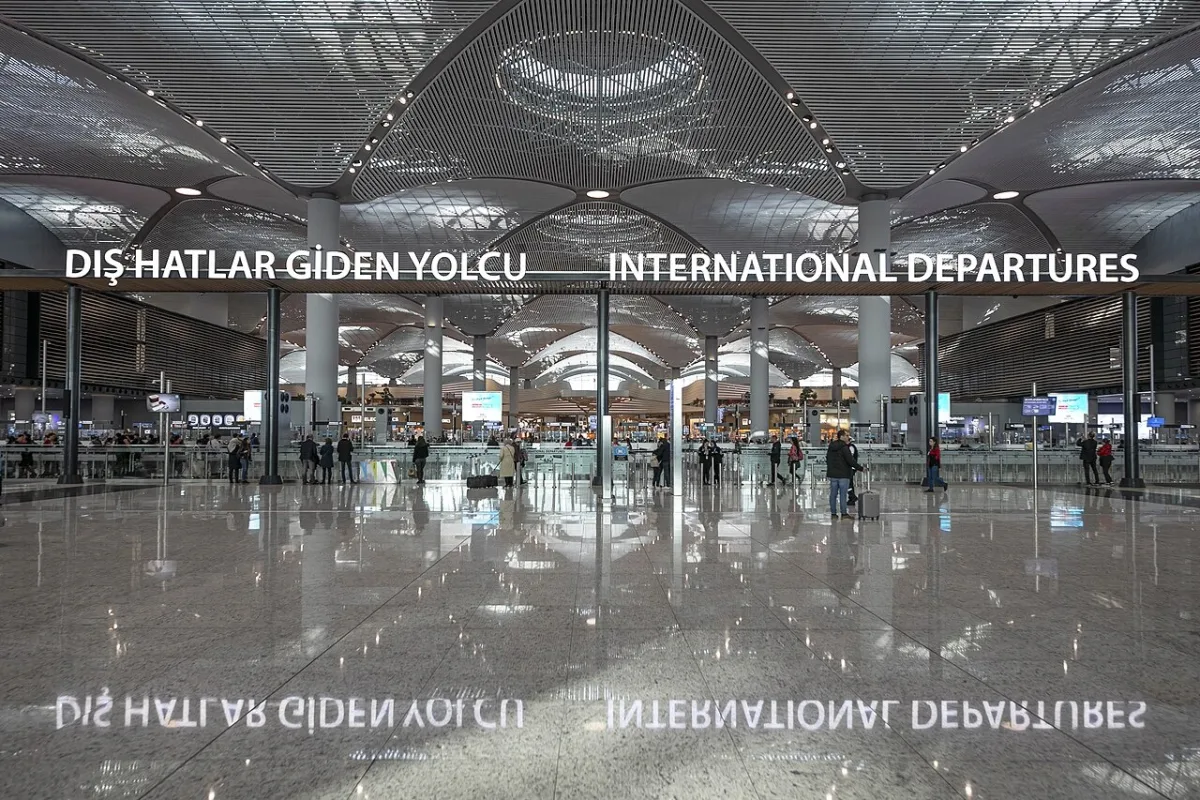
Istanbul Airport ranked eighth with 84.4 million passengers, up 5.5% [2]. ACI World notes that Istanbul’s 2025 total was 61.8% above 2019, when it ranked 28th [2]. The ranking also shows how close the field is. Fewer than four million passengers separate fourth place from tenth place, so small changes in growth can reorder the list [2]. The top 20 airports handled about 1.59 billion passengers, around 16% of the global total, according to ACI World [2].
The ranking also shows where growth came from. Kuala Lumpur was the biggest mover in the top 20, rising from 26th to 20th with 63.4 million passengers, up 11% [2]. Guangzhou, which topped the table in 2020 and fell to 57th in 2022, returned to ninth place [2]. Five of the top 20 airports are in the United States, and four of them are mainly domestic hubs, where domestic traffic makes up 80% to 95% of passengers [2]. In cargo, Istanbul ranked 18th with about 1.98 million tonnes, almost unchanged on 2024 [2].
ACI World says global traffic in 2025 was 3.7% higher than in 2024 and 6.5% higher than in 2019 [2]. That puts the 2025 record in context. Air travel has passed its pre pandemic level, but the growth rate is now closer to the long run trend than to the rebound years. A rate of 0.6% in the first half of 2026 is below even that trend [1]. Budgets for 2026 that assumed 2025 growth rates therefore rest on a faster pace than the first half figures show.

How do airline and tourism figures compare?
Airline data from IATA describe the same slowdown from a different angle. IATA reported that total passenger demand fell 0.8% in August 2026, measured in passenger kilometres, while demand outside the Middle East grew 0.6% [3]. In July, total demand had grown 0.2% [4]. Middle East carriers saw total demand fall 14.6% in August, deeper than the 10.0% fall in July [3][4].
European airports held up better through the summer. ACI EUROPE reported growth of 3.9% in July and 3.1% in August across its network [5]. Istanbul Airport was Europe’s busiest in August with 8.6 million passengers, up 3% [5]. In Türkiye, DHMİ counted 193.2 million passengers at all airports from January to September 2026, up 2.9% [6].
Tourism data line up with the airport figures. UN Tourism estimated about 690 million international arrivals in the first half of 2026, up 0.4%, with the Middle East down 22% [7]. Airport passengers and tourist arrivals are different measures, because one arrival can mean several airport passengers. Still, ACI World’s 21% fall and UN Tourism’s 22% fall for the Middle East point to the same weakness [1][7].
What does it mean for the sector?
For hotels, the shift from 2025 to 2026 is a shift in the growth rate, not in the level. Airports still handle close to record volumes, so demand in most gateway cities remains high [1]. What changes is the room for rate increases based on volume growth alone. For hotels that relied on rising arrivals, destination data by source market show where growth continues. A city served by a hub in a growing region faces a different year from one that depends on transfers through the Middle East.
For agencies and DMCs, the regional split matters most. Growth continued in Africa, Europe, Latin America and Asia Pacific in the first half of 2026 [1]. Programmes that route through Middle East hubs carry more risk than those using hubs in Europe or Asia. For agencies, routing changes in supplier contracts come into view before the winter season begins.
For airlines and airports, the report confirms a capacity question. ACI World’s Director General Justin Erbacci says that long term demand remains strong and more capacity will be needed [1]. In Istanbul, a new east and west runway opened on 18 September 2026, giving the airport six runways [8]. DHMİ says the runway should shorten taxi and holding times for domestic and eastbound flights [8].
For congress and event organizers, airport traffic is an early signal for delegate travel. A slow year means airlines may cut frequencies on weaker routes, which affects how delegates reach a venue. Guidance on how to plan a conference usually covers access, and air connectivity deserves a specific line in the venue assessment. For organizers, the relevant variable is whether the main source markets for their delegates are in growing or shrinking regions.
For destination management organizations, the ACI World ranking shows how much a hub can change a destination’s reach. Istanbul climbed from 28th to eighth in six years [2]. That rise depends on airport capacity, airline networks and demand together. A destination strategy that treats air access as a fixed input misses how quickly it can grow or shrink.

What is my reading of the figures?
My reading is that the 2025 record and the 2026 slowdown are both accurate and both partial. The record shows a recovered industry with broad growth in 2025, led by international traffic [1]. The slowdown shows that growth now depends heavily on one region’s stability. Without the Middle East, the first half of 2026 would look much closer to normal growth, though ACI World does not publish that calculation, so I do not quantify it [1].
My second point is about rankings. Annual rankings reward size, and the fastest movers in 2025 were in China and Türkiye [2]. A ranking change for Istanbul matters less to an event planner than the number of direct routes and the frequency on each. I would read the ranking as a sign of network depth rather than as a measure of quality or convenience.
My third point is about timing. ACI World’s report covers the operating year 2025 and the first half of 2026 [1]. The data that matter for 2027 planning, including the second half of 2026, are not in it yet. Monthly releases from IATA, ACI EUROPE and DHMİ fill that gap alongside the annual report [3][5][6]. This connects with the wider tourism trends for 2027.
What does this commentary cover?
What to watch next
| Indicator | What it shows | When to publish |
|---|---|---|
| ACI World full year 2026 estimate | Whether the 0.6% first half growth holds or slips | First half of 2027 |
| ACI EUROPE monthly traffic | European airports, where growth continued through August | Monthly |
| IATA monthly traffic | Airline side view of the Middle East decline | Monthly |
| DHMİ monthly statistics | Istanbul and Türkiye against the regional trend | Monthly, around the 10th |
| UN Tourism Barometer | Whether airport passengers and tourist arrivals move together | Next edition |
| Congress registration by delegate origin | Whether long haul attendance follows air traffic | Before each event |
The first signal is monthly traffic for the third quarter of 2026. ACI EUROPE showed European growth of 3.1% in August, while IATA showed a global fall of 0.8% in the same month [3][5]. If the gap between Europe and the global total persists, it will shape where events and incentive programmes can grow in 2027. The second signal is the Middle East, which fell 21% in the first half [1].
The third signal is capacity. ACI World argues that more airport capacity will be needed over the long run [1]. New infrastructure, such as Istanbul’s sixth runway, adds options for airlines to grow [8]. Whether airlines use that space depends on demand, which the next round of monthly figures will show.
Analysis result
ACI World reports that airports handled a record 9.8 billion passengers in 2025, with international traffic up 6.1% [1]. In the first half of 2026, traffic reached about 4.7 billion, up only 0.6%, and the Middle East fell 21% [1]. Atlanta remained the busiest airport in 2025, while Istanbul rose to eighth with 84.4 million passengers [2]. Airline, airport and tourism data agree that the weakness is concentrated in one region [1][3][7]. For the sector, the record supports confidence in long term demand, while the 2026 data support careful planning by region and route.
Does your event or destination plan for the 2025 growth rate or the 2026 one?
Frequently asked questions
How many passengers did airports handle in 2025? ACI World counted a record 9.8 billion passengers in 2025, based on data from 2,817 commercial airports [1].
How did traffic develop in the first half of 2026? Global airport traffic reached about 4.7 billion passengers in the first half of 2026, up 0.6% on the same period of 2025 [1].
Which region fell most in 2026? The Middle East saw the sharpest decline in the first half of 2026, with traffic down 21%, according to ACI World [1].
Which was the busiest airport in 2025? Atlanta remained the busiest airport with 106.3 million passengers, followed by Dubai and Tokyo Haneda, in ACI World’s preliminary ranking [2].
Where did Istanbul Airport rank? Istanbul ranked eighth in 2025 with 84.4 million passengers, up 5.5% on 2024. It ranked 28th in 2019 [2].
Sources
- ACI World, Global airport passenger traffic reaches record 9.8 billion in 2025, 23 September 2026
- ACI World, World’s busiest airports 2025 ranking, 15 July 2026
- IATA, Air passenger demand slips in August, Press Release No 46, 30 September 2026
- IATA, Air passenger demand grows in July, 31 August 2026
- ACI EUROPE, Passenger traffic strengthens over summer despite geopolitical and economic headwinds, 30 September 2026
- DHMİ, Havayolunda 9 ayda 193,1 milyon yolcu, 12 October 2026
- UN Tourism, International tourism holds steady with 0.4% growth in first half of 2026, September 2026
- DHMİ, İstanbul Havalimanı’nın ilk doğu batı pisti yarın açılıyor, 17 September 2026