Contents
- Scope and method
- How the supply was planned
- Beds announced by August 2025
- Delegation rates and the public platform
- The cruise ships
- How the timeline unfolded
- Public investment and what happens after
- Attendance
- Occupancy and prices during the conference
- The visitor’s time and the city
- Residents and the environment
- What the published record documents
- Analysis result
- Frequently asked questions
- Sources
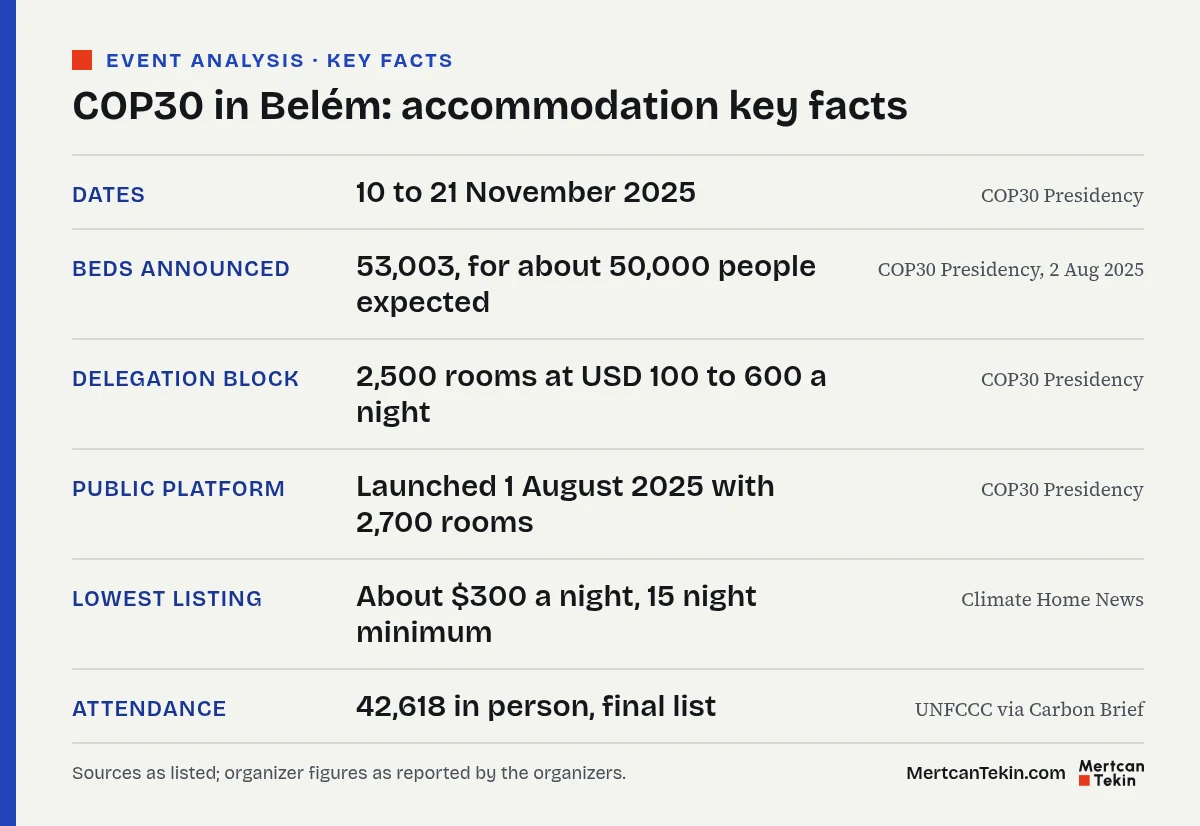
For COP30 in Belém, 10 to 21 November 2025, the presidency announced 53,003 beds: 14,547 in hotels, 22,452 on Airbnb, 10,004 in seasonal rentals and 6,000 on cruise ships. Delegations had a 2,500 room block at USD 100 to 600 a night. The federal transparency portal lists about R$4.2 billion of federal resources for 22 works. The Pará hotel association reported 83% final hotel occupancy, and the final UN list counted 42,618 people in person.
In early August 2025 a booking site for the UN climate conference opened in Belém, and visitors had to queue to enter it. Three months later the conference took place as scheduled, with delegates housed in hotels, private homes, a purpose built village and two cruise ships.
The short version of the record: Belém met COP30 with an accommodation mix in which private rentals outnumbered hotel beds, while public money went mainly into assets planned to stay in use, such as the Parque da Cidade and the Vila COP. The final UN list counted 42,618 people in person [3]. After the event, the Pará hotel association reported 83% hotel occupancy against the 95% it had expected, and the regional real estate council said about 45% of available rental homes were not let [8][9]. This is a situation report of what was published, by whom and on what scope.
Scope and method
I use the figures published by the COP30 presidency, the Brazilian federal and state governments, the UNFCCC through Carbon Brief, and press reports that name their source. Supply figures count beds or rooms at a stated date; attendance counts people; occupancy is a share of rooms sold over a period. Those are three different measures, so I keep them in separate tables and do not divide one by another. Organizer and government figures are labelled as such. The UNFCCC’s own accommodation reports, any post event study by the federal government and a visitor spending survey were not available to me.

How the supply was planned
In January 2025 the presidency said Belém expected about 50,000 participants and that the federal government was working to add more than 26,000 accommodations [4]. The plan listed about 4,500 beds on cruise ships, more than 1,000 rooms in new hotels, nearly 11,500 beds in seasonal rentals of homes and apartments, about 2,300 beds with the Armed Forces and space for more than 5,000 people in adapted schools. It also announced R$172 million from the federal tourism fund, Fungetur, to upgrade and expand hotels and tourist services [4]. At the time, the national secretary for the conference described rapid rental price rises as speculation that he expected to ease as supply grew [4].
| Type | Planned addition | Unit as stated |
|---|---|---|
| Cruise ships | About 4,500 | Beds |
| New hotels | More than 1,000 | Accommodations |
| Seasonal rentals of homes and apartments | Nearly 11,500 | Beds |
| Armed Forces | About 2,300 | Beds |
| Adapted schools | More than 5,000 | People |
| Total stated | More than 26,000 | Accommodations |
| Hotel upgrade funding (Fungetur) | R$172 million | Federal loan fund |
The Pará hotel association later put the city’s starting point at about 25,000 beds at the beginning of 2025, against estimated demand of 50,000 [8].
Beds announced by August 2025
On 2 August 2025 the presidency announced 53,003 beds. Airbnb listings accounted for 22,452, hotels in the capital and metropolitan region for 14,547, seasonal rentals through real estate agencies for 10,004 and cruise ships for 6,000 [1]. Most of the inventory was outside hotels.
Beds announced for COP30, by type
Unit: beds. Status at 2 August 2025. Total 53,003.
| Type | Beds |
|---|---|
| Airbnb | 22,452 |
| Hotels, capital and metropolitan region | 14,547 |
| Seasonal rentals through real estate agencies | 10,004 |
| Cruise ships | 6,000 |
| Total | 53,003 |
The presidency counts beds and the platform counts rooms, so they appear separately.
Delegation rates and the public platform
The COP30 Special Secretariat gave negotiators priority. In mid July 2025 it set aside 2,500 rooms for the 196 countries at fixed rates from USD 100 to 600 a night. Least Developed Countries and Small Island Developing States received 15 rooms per delegation at USD 100 to 200; other countries received 10 rooms at USD 220 to 600 [1].
The official public platform, run by Bnetwork, opened on 1 August 2025 with 2,700 rooms, first for delegations and from 2 August for the general public [1]. Climate Home News reported that the rooms were in apartments, holiday homes and private residences, that high traffic meant users had to queue, and that the cheapest listings it saw were about $300 a night with a 15 night minimum stay, while one three bedroom apartment was listed at up to $3,400 a night [2]. These are listings on one date, not prices paid.
| Item | Rule or price | Scope | Source |
|---|---|---|---|
| Delegation block | 2,500 rooms at fixed rates of USD 100 to 600 | All 196 countries, from mid July 2025 | COP30 Presidency |
| LDC and SIDS delegations | 15 rooms each, USD 100 to 200 | Per delegation | COP30 Presidency |
| Other delegations | 10 rooms each, USD 220 to 600 | Per delegation | COP30 Presidency |
| Public platform at launch | 2,700 rooms | Apartments, holiday homes, private residences | COP30 Presidency; Climate Home News |
| Lowest listing seen | About $300 a night, 15 night minimum | Platform, early August 2025 | Climate Home News |
| Highest listing cited | Up to $3,400 a night | Three bedroom apartment on the platform | Climate Home News |
| Cruise ships | 3,800 additional rooms; cheapest sold out | MSC Seaview and Costa Diadema, Port of Outeiro | Climate Home News |
The cruise ships
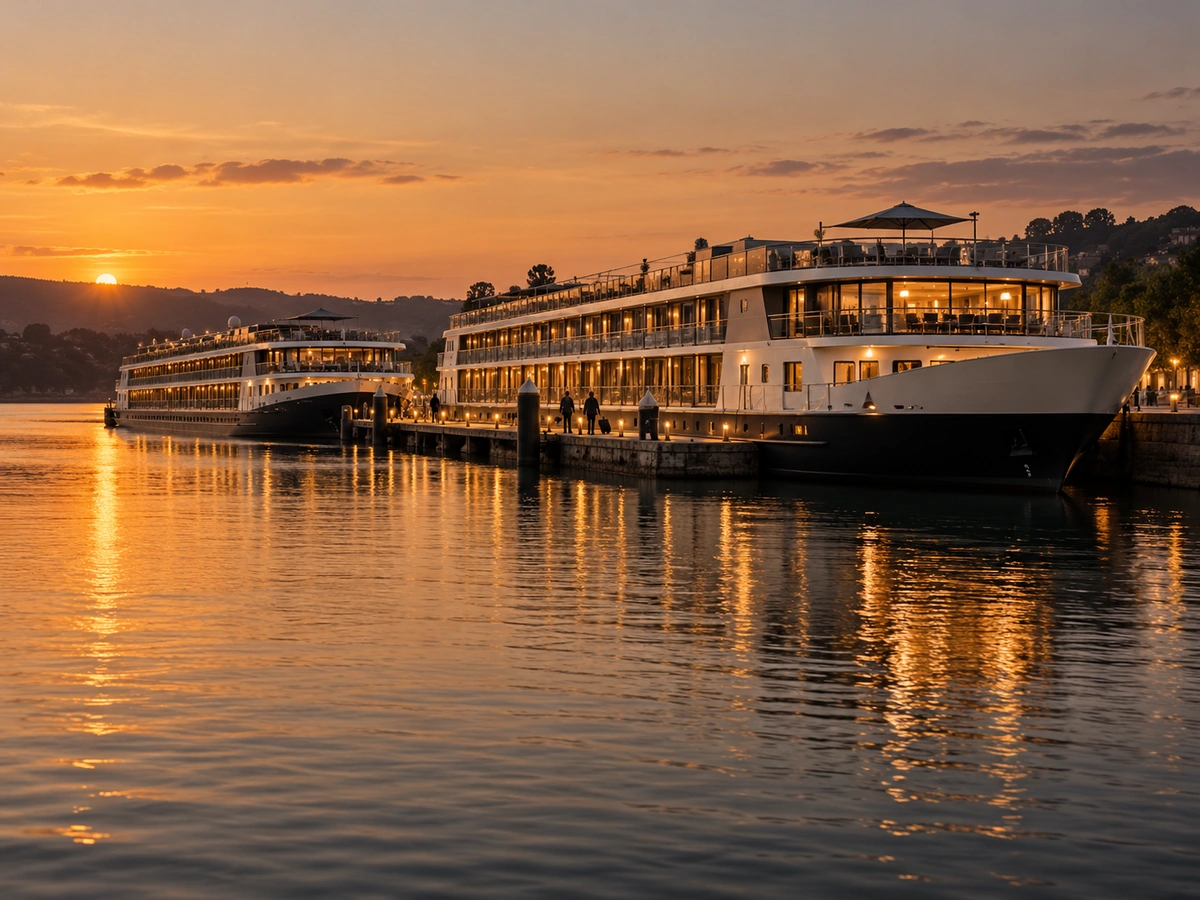
The presidency chartered MSC Seaview and Costa Diadema to dock at the Port of Outeiro, about 20 km from the venue, and counted 6,000 beds on board [1]. Climate Home News reported 3,800 additional rooms on the ships in early August and noted that the cheapest cabins had sold out [2]. Carbon Brief later reported that Brazil offered free cabins to delegations from low income countries [3]. The January plan had mentioned a new bridge to connect Outeiro with the conference sites in about 30 minutes [4].
How the timeline unfolded
Climate Home News reported that, at an emergency meeting in late July, a UN committee gave the Brazilian government until 11 August to present solutions on logistics, a deadline later moved to 14 August [2]. In September, UNFCCC Executive Secretary Simon Stiell recommended that UN agencies reduce the size of their delegations and make more use of virtual participation [8]. As the conference approached and supply grew, many hotels lowered their prices; one hotel that had taken the name Hotel COP 30 cut its double room rate from R$5,670 in August to R$900 during the event [8].
| Date | Step | Source |
|---|---|---|
| Mid July 2025 | 2,500 room delegation block announced | COP30 Presidency |
| Late July 2025 | UN committee emergency meeting sets an 11 August deadline | Climate Home News |
| 1 August 2025 | Official platform launched with 2,700 rooms | COP30 Presidency |
| 2 August 2025 | Platform opened to the general public; 53,003 beds announced | COP30 Presidency |
| 14 August 2025 | Revised committee deadline | Climate Home News |
| 10 to 21 November 2025 | COP30 held in Belém | COP30 Presidency |
| 10 November 2025 | 56,118 registered for on site participation (provisional) | UNFCCC via Carbon Brief |
| December 2025 | Final list: 42,618 in person, 2,550 online | UNFCCC via Carbon Brief |
Public investment and what happens after
The federal transparency portal for COP30, run by the Comptroller General, lists about R$4.2 billion of federal resources, from the federal budget, the development bank BNDES and Itaipu Binacional, for 22 works in tourism, sanitation and infrastructure [5]. That figure covers federal funding only. State projects, including the Parque da Cidade, sit outside it.

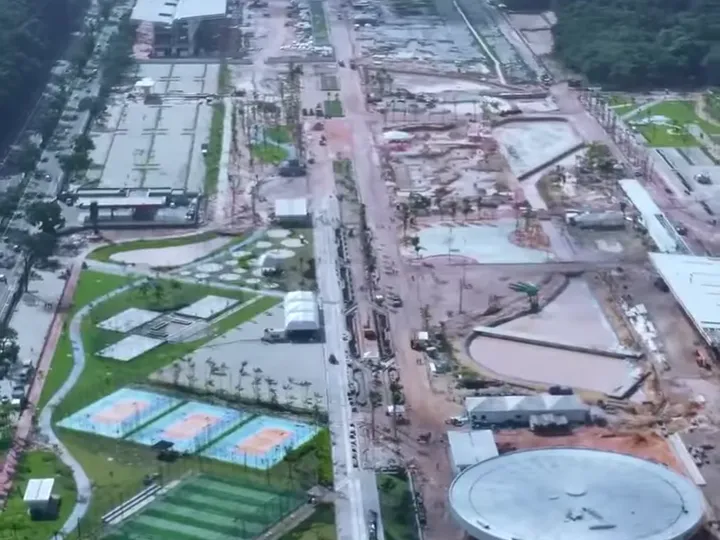
The Parque da Cidade was built on the site of a former small airport in the Sacramenta district. The state government opened its leisure area to the public on 27 June 2025, with 14 sport and recreation spaces including courts, a running track, a skatepark and cycle paths, more than 2,500 planted trees and two wetlands that treat wastewater for up to 2,800 users a day [6]. On its first evening it received 16,704 visitors. On 1 August it was handed to the UN to host the Blue and Green Zones, with the state describing it as a legacy of the conference [6].
The Vila COP, a 405 suite complex in the Marco district 300 metres from the park, opened on 3 November 2025 to house heads of state and delegations. It cost R$194.9 million, funded by Itaipu, and the federal government said units were rented at up to US$300 a night. After the conference it is to become a state administrative centre [7].
| Item | Funding as reported | Funder | Stated use after COP30 |
|---|---|---|---|
| 22 federal works in tourism, sanitation and infrastructure | About R$4.2 billion | Federal budget, BNDES, Itaipu (federal resources only) | Varies by work |
| Parque da Cidade, Sacramenta | Not stated in the source used | Pará state government | Public park; opened to residents on 27 June 2025 |
| Vila COP, 405 suites, Marco | R$194.9 million | Itaipu Binacional | State administrative centre |
| Hotel upgrades | R$172 million | Fungetur, federal tourism fund | Hotel and tourist service capacity |
Attendance
The UNFCCC’s provisional list of 10 November 2025 counted 56,118 people registered for on site participation. Carbon Brief reports that the final list recorded 42,618 in person, including support staff, security and volunteers, plus 2,550 online [3]. The president of the Pará hotel association said that, in his estimate, there were at most 25,000 participants plus about 15,000 professionals such as journalists, volunteers and activists [8]. That is an industry estimate with different categories from the UN list.

Occupancy and prices during the conference
O Globo, as reported by Hotelier News, gave final hotel occupancy of 83% according to the Pará hotel association, which had expected 95% [8]. The association’s president said revenue rose significantly and offset the lower occupancy. A listing survey for 10 to 21 November found single rooms in Belém priced between R$28,700 and R$85,000 for the stay, with an average daily rate of R$7,431.77 before taxes [8]. Folha de S.Paulo reported that the Pará real estate council estimated about 45% of the rental properties offered were not let [9].
| Measure | Reported value | Scope | Reported by |
|---|---|---|---|
| Hotel occupancy | 83% (95% expected) | Member hotels, final tally | ABIH-PA via O Globo and Hotelier News |
| Rental properties not let | About 45% | Properties offered through agencies | Creci-PA via Folha |
| Listed single room price for the stay | R$28,700 to R$85,000 | Listing survey, not rates paid | O Globo via Hotelier News |
| Average listed daily rate | R$7,431.77 before taxes | Listing survey, not rates paid | O Globo via Hotelier News |
| People on site, final list | 42,618 (plus 2,550 online) | All registered categories | UNFCCC via Carbon Brief |
These are trade body figures on their own scopes: hotel occupancy covers member hotels over the conference, the rental estimate covers properties offered through agencies, and the price survey covers listings rather than rates paid.
The visitor’s time and the city
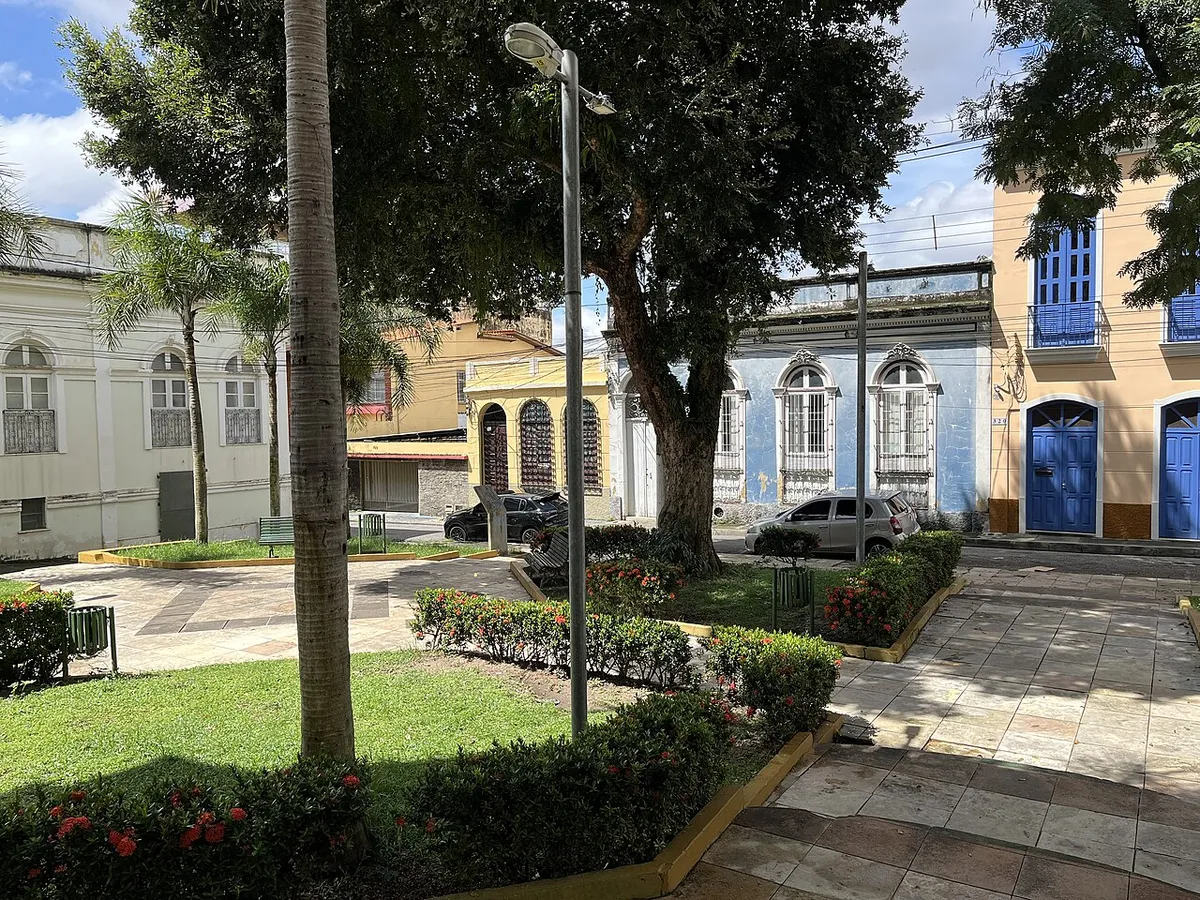
Folha’s closing review, based on interviews with experts and trade bodies, described an overall positive balance for the city [9]. Visitors spent time at the new Porto Futuro complex on Guajará Bay, the Museu das Amazônias, which reported more visitors and more foreign visitors, and the restored São Brás market. Parallel venues in historic buildings around Praça Frei Caetano Brandão hosted exhibitions and panels, and one of them is to stay open after the conference. The experts named transport, especially access to the Green Zone, as the main operational topic; a regional transport specialist suggested free buses for Green Zone visitors, as accredited Blue Zone participants had, and temporary shared bicycles along the cycle paths around the park [9]. A researcher in the same report tied long term value to promoting Belém regularly as a destination [9].
A delegate’s day at a climate conference is long and fixed by negotiation sessions, so the window for the city is usually early evening. Knowing which places visitors reached and what they spent would show how much of the conference crowd met Belém beyond the venue.
Residents and the environment
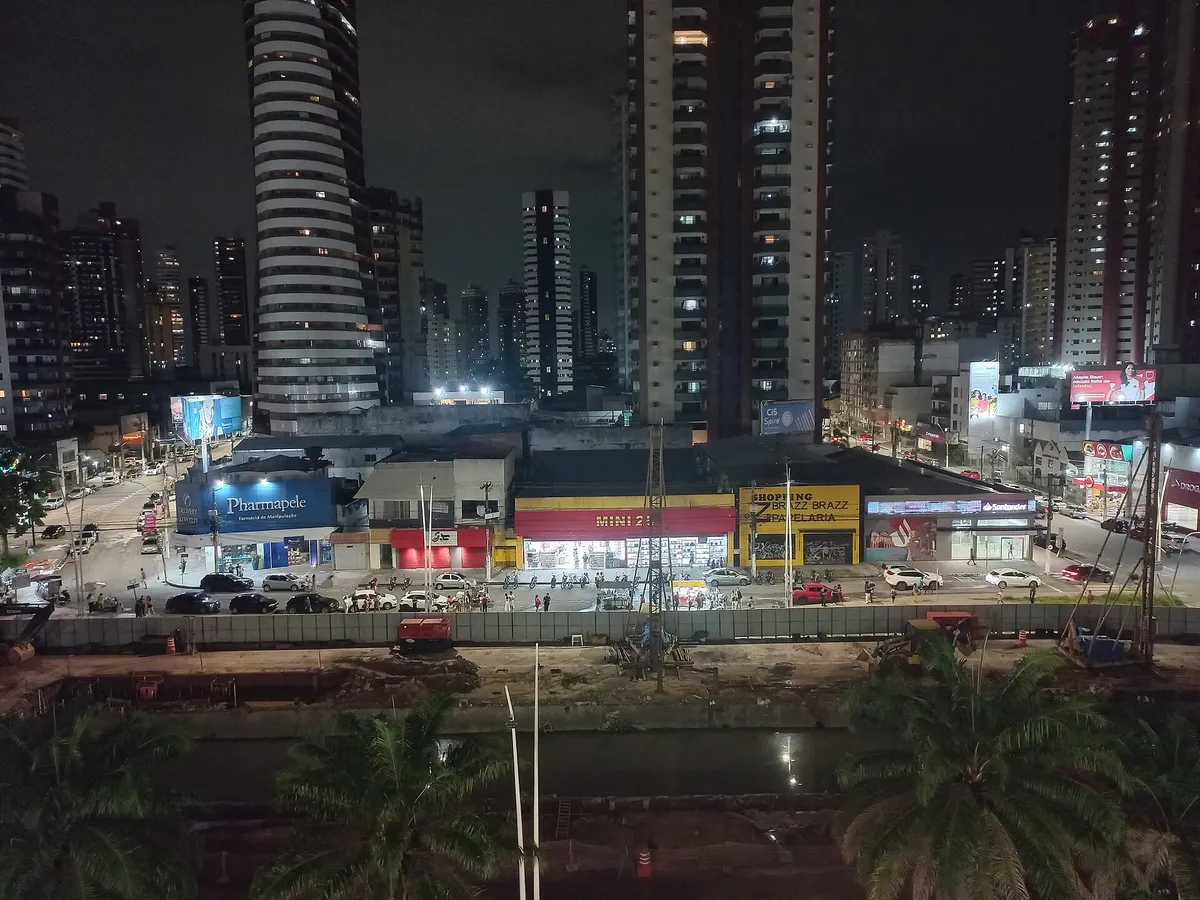
For residents, the most visible permanent asset is the park: a holiday programme that drew more than 8,400 online sign ups in July 2025, and sport spaces open before the conference [6]. The Vila COP has a stated civic use afterwards [7]. I found no published resident survey on the conference period, nor an environmental footprint for the event, so those dimensions remain undocumented here.
What the published record documents
Belém’s published record covers items that recur at any large conference: the inventory by type, with beds and rooms kept apart; delegation blocks with rates by country category, and when each channel opened and to whom; temporary assets, such as the ships, with their transport links and travel times, and shuttle coverage of the zones open to the public; and the post event use of permanent assets, as named for the park and the Vila COP, with their use a year later as the next data point. For a PCO or a convention bureau, the same items appear in any room block contract, and the mega events guide covers how they are set early.
| Indicator | What it shows | When to publish |
|---|---|---|
| Inventory by type | Beds and rooms by channel, kept apart | At each milestone before the event |
| Delegation block use | Rooms taken against rooms reserved, by country category | Within 3 months |
| Rates paid | Average rate actually paid, by accommodation type | Within 3 months |
| Occupancy by channel | Hotels, rentals and ships over the event period | Within 1 month |
| Transfer times | Door to door travel time from each accommodation zone | During the event |
| Visitor activity | Places visited and spending outside the venue | Visitor survey during the event |
| Post event use | Use of each permanent asset, such as visits to the park | 1 and 2 years after |
| Resident view and footprint | Resident survey and event carbon footprint with stated scope | Within 12 months |
Analysis result
On the published record, Belém met COP30 with an accommodation mix planned across hotels, private rentals, adapted schools, cruise ships and a public platform with rates by country category, and it published supply figures, rules and main public works as the plan developed [1][4][5]. Federal investment of R$4.2bn across 22 works, with state projects such as the Parque da Cidade and the Vila COP, leaves permanent assets with named civic uses [5][6][7]. After the event, the hotel association reported 83% occupancy against the 95% it had expected, the real estate council estimated about 45% of rental properties offered were not let, and the UN counted 42,618 participants on site [3][8][9]. In summary, the city expanded its capacity for one event and now holds a park, an administrative centre and a larger rental stock. The next useful data describe use: rates paid, delegation rooms taken and how the park and the Vila COP serve residents in their second year.
Frequently asked questions
How many beds did Belém have for COP30? The COP30 presidency announced 53,003 beds on 2 August 2025: 14,547 in hotels in the capital and metropolitan region, 22,452 on Airbnb, 10,004 in seasonal rentals through real estate agencies and 6,000 on cruise ships [1].
What rates applied to delegations? The presidency set aside 2,500 rooms at fixed rates of USD 100 to 600 a night. Least Developed Countries and Small Island Developing States had 15 rooms per delegation at USD 100 to 200; other countries had 10 rooms at USD 220 to 600 [1].
How much public money went into COP30? The federal transparency portal lists about R$4.2 billion of federal resources for 22 works [5]. State projects such as the Parque da Cidade are outside that total. The Vila COP cost R$194.9 million, funded by Itaipu [7].
How full were hotels during COP30? The Pará hotel association reported 83% final hotel occupancy against the 95% it expected, with revenue up, and the regional real estate council estimated that about 45% of rental properties offered were not let [8][9].
How many people attended COP30? The UNFCCC’s provisional list counted 56,118 people registered for on site participation on 10 November 2025. Carbon Brief reports that the final list recorded 42,618 in person and 2,550 online [3].
Sources
- COP30 Presidency, Belém already has 53,000 beds to host COP30 delegations, 2 August 2025 (archived copy)
- Climate Home News, Brazil launches COP30 accommodation platform after pressure from UN committee, 4 August 2025
- Carbon Brief, Analysis: Which countries have sent the most delegates to COP30?, updated 9 December 2025
- COP30 Presidency, Brasil amplia capacidade de hospedagem em Belém para a COP30, 16 January 2025 (archived copy)
- Controladoria Geral da União, Portal da Transparência: COP30
- Agência Pará, Governo do Pará abre ao público o Parque da Cidade, 27 June 2025
- g1 Pará, Vila COP é inaugurada em Belém para hospedar líderes mundiais, 3 November 2025
- Hotelier News, Ocupação hoteleira na COP30 fica abaixo do esperado, 25 November 2025
- Folha de S.Paulo, Belém na COP30 teve sobra de vagas, zona da cerveja e casas paralelas, 23 November 2025