Contents
- What does this analysis cover?
- What are the key facts?
- How does 2026 compare with forecasts and with 2019?
- What does the Fringe contribute to Edinburgh and Scotland?
- What worked well in 2026?
- Where are the weaknesses and risks?
- What the numbers show for destination professionals
- Indicators to track
- Analysis result
- Frequently asked questions
- Sources
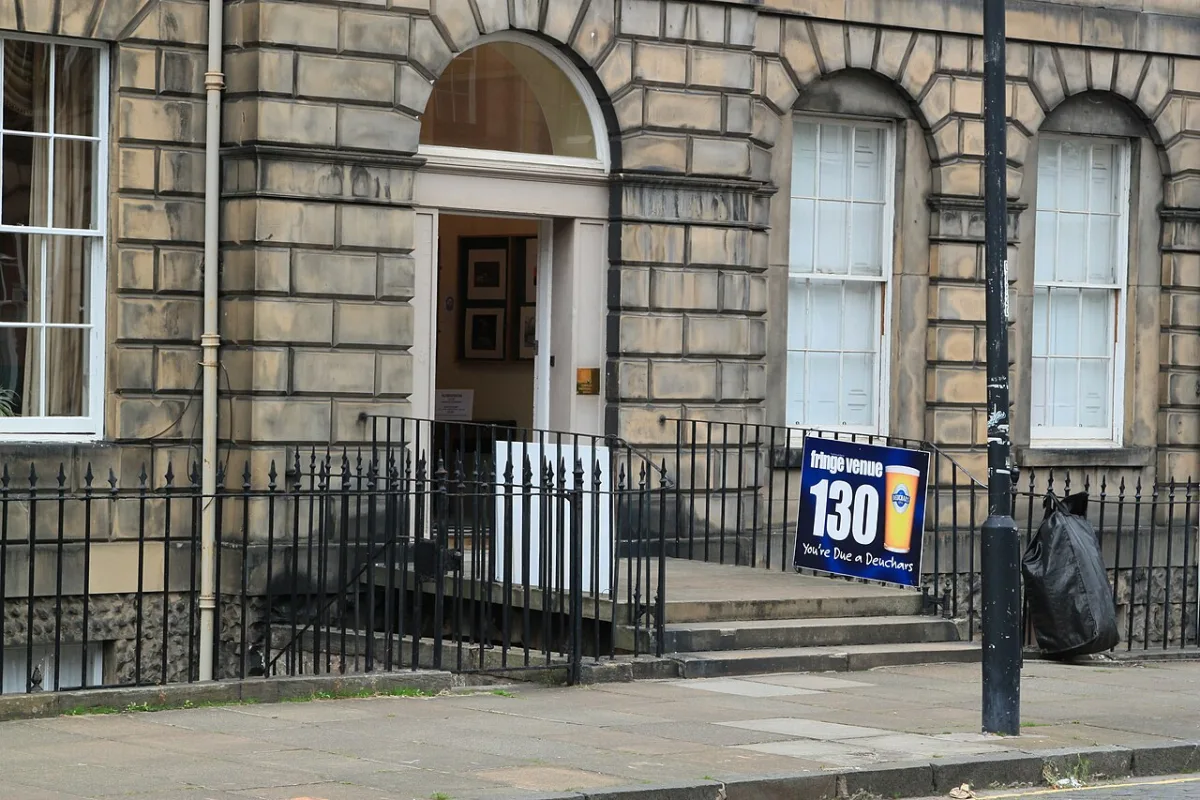
The Edinburgh Festival Fringe ran from 7 to 31 August 2026 and issued an estimated 2,805,395 tickets, 8% more than in 2025, according to the Fringe Society. It staged 4,232 shows in 306 venues. The total remains about 7% below 2019, and this was the first Fringe under Edinburgh’s 5% visitor levy.
On the last Saturday before the final week, queues formed outside basement rooms and church halls across the Old Town, and the box office logged more than 164,000 tickets in a single day. That figure, for 15 August 2026, was 1% above the previous peak of 17 August 2019 [1]. Two weeks later the Fringe Society closed the 79th edition with 2,805,395 tickets issued, 8% more than in 2025 [1][2]. Both numbers are real, and both need context before a city reads them as a recovery story.
The main point of this analysis is that the 2026 Fringe grew on 2025 but has not returned to its 2019 scale. The ticket total sits about 7% below the 3,012,490 tickets of 2019 and close to the 2018 level [3]. The growth came with more shows, more performances and more international companies, which suggests supply led the increase. This was also the first August under Edinburgh’s 5% visitor levy, so the festival now feeds a public revenue line as well as the private visitor economy [4].

What does this analysis cover?
What are the key facts?
According to the Fringe Society, the 2026 programme listed 4,232 shows from 77 countries, with 61,277 performances across 306 venues [1]. In 2025 the same organizer counted 3,893 shows, 53,942 performances and 301 venues [2]. Performances therefore rose by about 14%, faster than the 8% rise in tickets. The marketplace side also grew, with 1,864 accredited arts industry members from 63 countries and 1,091 accredited media, of whom 702 were reviewers [1]. The next Fringe, the 80th, runs from 6 to 30 August 2027 [1].
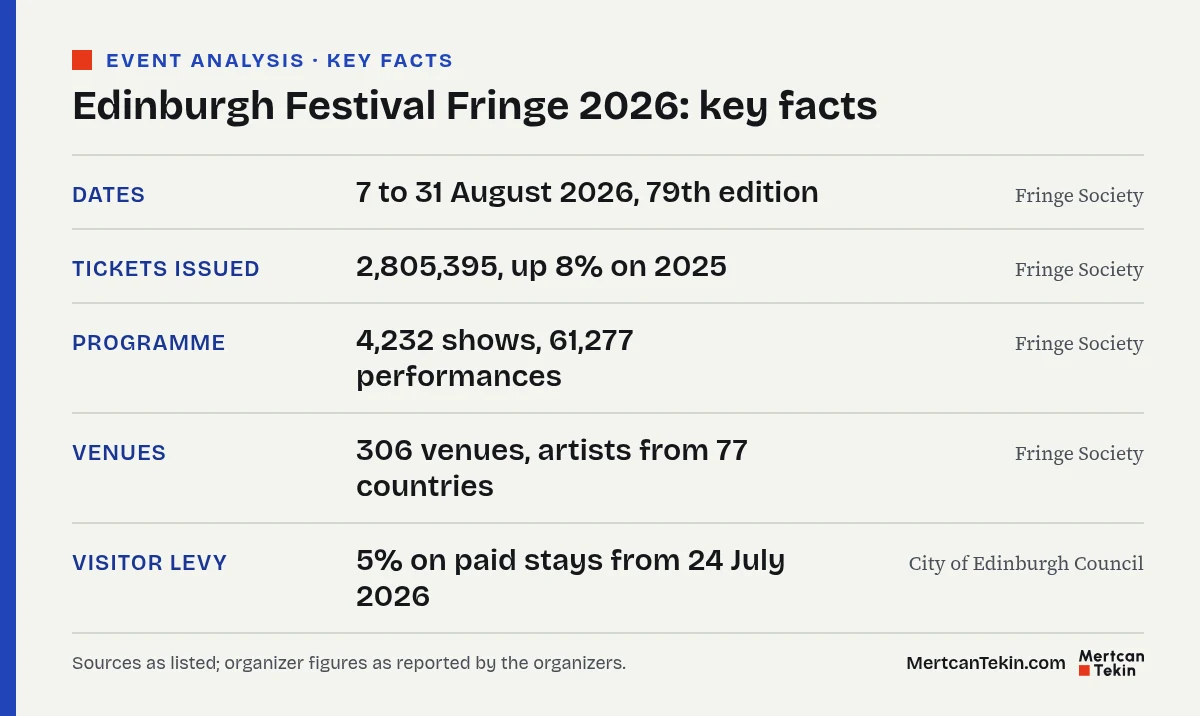
Tickets issued: 2026 against 2025 and the pre pandemic years
Unit: tickets issued, organizer count at the close of each festival. Free and non ticketed shows excluded. Light bars: pre pandemic years.
| Measure | 2019 | 2025 | 2026 |
|---|---|---|---|
| Tickets issued | 3,012,490 | 2,604,404 | 2,805,395 |
| Shows | Not in source | 3,893 | 4,232 |
| Performances | Not in source | 53,942 | 61,277 |
| Venues | Not in source | 301 | 306 |
| Accredited arts industry | 1,661 | 1,770 | 1,864 |
| Countries on stage | Not in source | 62 | 77 |
The count has two limits worth stating plainly. It covers issued tickets only, so free shows, street events and non ticketed work are outside it, and the Society says as much [1]. It also closes at 11:30 on the final day, with 12.5 hours of shows still to run, while the 2025 count closed at 10:00 [1][2]. The difference is small at this scale, but it means the comparison is close to like for like rather than exact.
How does 2026 compare with forecasts and with 2019?
The Fringe Society did not publish a ticket forecast for 2026, so there is no organizer target to test the result against. The useful benchmark is the trend. Festivals Edinburgh reported 2,696,864 tickets in 2017, 2,838,839 in 2018 and 3,012,490 in 2019 [3]. Against that series, 2026 sits slightly below 2018 and about 207,000 tickets short of the 2019 peak. My reading is that the festival has recovered most of its pre pandemic demand but has not resumed the growth path it was on before 2020.
The levy does have a forecast. The City of Edinburgh Council projects that the scheme could raise up to £50 million a year [4]. The Herald reported that about £5m had been raised since the levy started on 24 July, a figure based on council statements rather than audited receipts [5]. Since the council receives its first payments in October and November, a fair test of the annual projection can only come in 2027 [4]. A single festival month cannot be multiplied by twelve, because August is the city’s peak.
What does the Fringe contribute to Edinburgh and Scotland?
The most cited figures come from the BOP Consulting study for Festivals Edinburgh. It estimates that the eleven festivals together had a net economic impact of £407m in Edinburgh and £367m in Scotland in 2022, up from £280m and £313m in 2015 [6]. In real terms, BOP puts the Edinburgh figure at 119% of its 2015 level and the Scottish figure at 97% [6]. The model supported about 5,850 full time equivalent jobs in Edinburgh [6]. These are model estimates for all festivals, built on a 2022 programme that ran at about 75% of its pre pandemic size.
| Measure | 2015 | 2022 | Note |
|---|---|---|---|
| Net impact, Edinburgh | £280m | £407m | Up 19% in real terms |
| Net impact, Scotland | £313m | £367m | 97% of 2015 level in real terms |
| FTE jobs supported, Edinburgh | c.5,650 | c.5,850 | Rounded to nearest 50 |
| Average nights in Edinburgh | 3.9 | 4.6 | Staying audiences |
| Staying visitors from outside Scotland | 25% | 31% | Share of staying visitors |
| Accommodation share of net audience spend, Edinburgh | Not compared | 51% (c.£85m) | Food and drink 25%, shopping 19% |
For the visitor economy, the composition matters more than the total. BOP finds that 51% of net audience spending in Edinburgh went on accommodation, about £85m, with 25% on food and drink and 19% on shopping [6]. Staying audiences spent an average of 4.6 nights in the city, up from 3.9 in 2015, and the share of staying visitors from outside Scotland rose from 25% to 31% [6]. That is why August room rates and the levy are linked so closely. A festival whose main spending line is accommodation will be the largest single contributor to a tax on overnight stays, which is also why seasonality in tourism shapes the levy’s annual yield.

What worked well in 2026?
The first strength is breadth. Performances grew by about 7,300 on 2025 and 77 countries appeared on stage, against 62 the year before [1][2]. A broader programme gives audiences more choice across the day, which helps explain the single day record without a matching record in total tickets. It also supports the Fringe’s role as a market, since 1,864 accredited buyers and programmers came looking for work to tour [1].
The second strength is artist support. In its first year at 6 Infirmary Street, the permanent Fringe Central served an estimated 5,500 artists, and nearly 1,000 attended the Meet the Media session [1]. Access also improved, with 120 accessible venue spaces, 62% of shows wheelchair accessible and more than 37,000 tickets issued through the access scheme, against nearly 25,000 in 2025 [1][2]. Community schemes such as Fringe Days Out involved 41 schools, charities and groups [1]. These are organizer figures, but they describe services with clear counts rather than estimates.
The third strength is that the levy arrived with a published spending plan. The council lists more than £90m of programmes over three years, including culture, cleansing, public toilets and venues such as Leith Theatre [4]. That gives residents a way to see what the August peak pays for.
Where are the weaknesses and risks?
The clearest risk is cost for participants. The Scotsman reported that last minute city centre rooms often exceed £80 a night, and one performer said a company should have about £10,000 ready to bring a show [7]. Queen Margaret University housed around 640 performers in its Fringe Village from £350 a week, and its dean warned that rising prices could deter artists from taking the risk [7]. The Fringe Society’s own chief executive called affordability the issue on which all sides agree [1]. When the open access model depends on artists paying their own way, cost is the factor most likely to change who performs.
The second weakness is measurement. The headline count excludes free shows and street events, and there is no published split of tickets by resident and visitor audiences for 2026 [1]. The last full impact study uses 2022 data and covers all festivals together [6]. That leaves the city without a current, Fringe specific view of net visitor spending, just as it starts taxing that spending.
The third risk sits in the levy design. A 5% charge, capped at five nights, applies at the same rate all year [4]. That is simple to run, but August visitors already face the highest rates of the year, so the levy adds most in cash terms exactly when artists and audiences are most price sensitive. The Visitor Levy (Scotland) Act 2024 gives councils the power to design schemes, and the evidence from the first year will show whether a flat rate works for a festival city [8].

What the numbers show for destination professionals
My reading is that tickets are a capacity measure, not an impact measure. More performances in a similar number of venues will raise tickets even if visitor nights stay flat, so a rising ticket count does not prove more visitors. For hotels and agencies, the useful questions are nights, origin and spend per stay, which is where BOP places half of the festival’s local value [6]. For destination data teams, the levy now offers a monthly revenue series that can be read against ticket and occupancy data.
For organizers in other cities, the Edinburgh case shows the trade off inside an open access festival. Growth in shows brings choice and market value, but it also brings more companies competing for the same rooms and audiences. A visitor flow plan that only counts tickets will miss that pressure. The levy may help if part of it supports artist housing or venue costs, but the published programmes focus mainly on city operations and culture in general [4]. For congress and meeting planners, the main factor is timing. A conference placed in Edinburgh in August competes with festival audiences for every room, and the levy now adds a fixed share to that bill, so in the shoulder months business events face less competition for rooms.
Indicators to track
| Indicator | What it shows | When to publish |
|---|---|---|
| Tickets by audience origin | Resident, rest of Scotland, rest of UK and international shares | Within 3 months |
| Levy receipts by month | How much August adds against the rest of the year | Quarterly from the first receipts |
| Artist cost index | Venue hire, accommodation and marketing per show | Before registration opens |
| August room rate premium | Hotel and short let rates against a non festival month | Within 3 months |
| Free and non ticketed attendance | Audiences the ticket count leaves out | With the annual review |
| Updated impact study | Net impact on a basis comparable to 2015 and 2022 | Before the 80th edition review |
These six indicators would let the city compare the 2027 anniversary edition with 2026 on a consistent basis. The most valuable is tickets by audience origin, because it separates resident demand from visitor demand. The second is a simple artist cost index, published before registration opens, so companies can plan.
Analysis result
The 2026 Fringe grew by 8% on 2025, set a single day record and widened its programme, while its ticket total stayed about 7% below 2019 [1][3]. It was also the first Fringe in the levy era, which turns August demand into a public revenue line for the first time [4]. The economic case rests on a 2022 model for all festivals, so the 2026 contribution remains an estimate until new data arrive [6]. The pressure point is cost, for artists first and for audiences second [7]. A festival that anyone can join stays open only as long as anyone can afford the room.
How would this change your plans for the next twelve months?
Frequently asked questions
How many tickets did the Edinburgh Fringe issue in 2026? The Fringe Society estimated 2,805,395 tickets as of 11:30 on 31 August 2026, the last day. The count excludes free and non ticketed shows [1].
Was 2026 a record year for the Fringe? Not for total tickets. The 2019 Fringe issued 3,012,490 tickets [3]. The 2026 record was for a single day, with more than 164,000 tickets on 15 August [1].
How does the Edinburgh visitor levy work? It adds 5% to the cost of paid overnight accommodation in the city, capped at five consecutive nights, and has applied to stays from 24 July 2026 [4].
What is the economic impact of the Edinburgh festivals? BOP Consulting estimated a net impact of £407m in Edinburgh and £367m in Scotland for 2022, across all eleven major festivals. It is a model estimate, not a measured result for the Fringe alone [6].
When is the next Edinburgh Fringe? The 80th anniversary Fringe runs from 6 to 30 August 2027, according to the Fringe Society [1].
Sources
- Edinburgh Festival Fringe Society, Fringe 2026 concludes with its 80th anniversary firmly in sight, 31 August 2026
- Edinburgh Festival Fringe Society, Edinburgh Festival Fringe 2025 comes to a close, 25 August 2025
- Festivals Edinburgh, Festivals 2019: Summary of Activity, March 2020
- City of Edinburgh Council, Edinburgh visitor levy comes into effect, July 2026
- The Herald, Edinburgh tourist tax takes £5m since July, 2026
- BOP Consulting for Festivals Edinburgh, Edinburgh Festivals Impact Study, June 2023
- The Scotsman, University warns Fringe must be kept affordable, 20 August 2026
- Visitor Levy (Scotland) Act 2024, legislation.gov.uk