
Contents
- Scope and method
- What the public approved
- Three studies, three scopes
- Turnover and value added
- What visitors spent and where they stayed
- Four accounts, kept apart
- The visitor’s time budget
- Mobility against targets
- Residents, accessibility and volunteers
- The environment
- Media reach
- What the Basel record shows for mid sized hosts
- Analysis result
- Frequently asked questions
- Sources
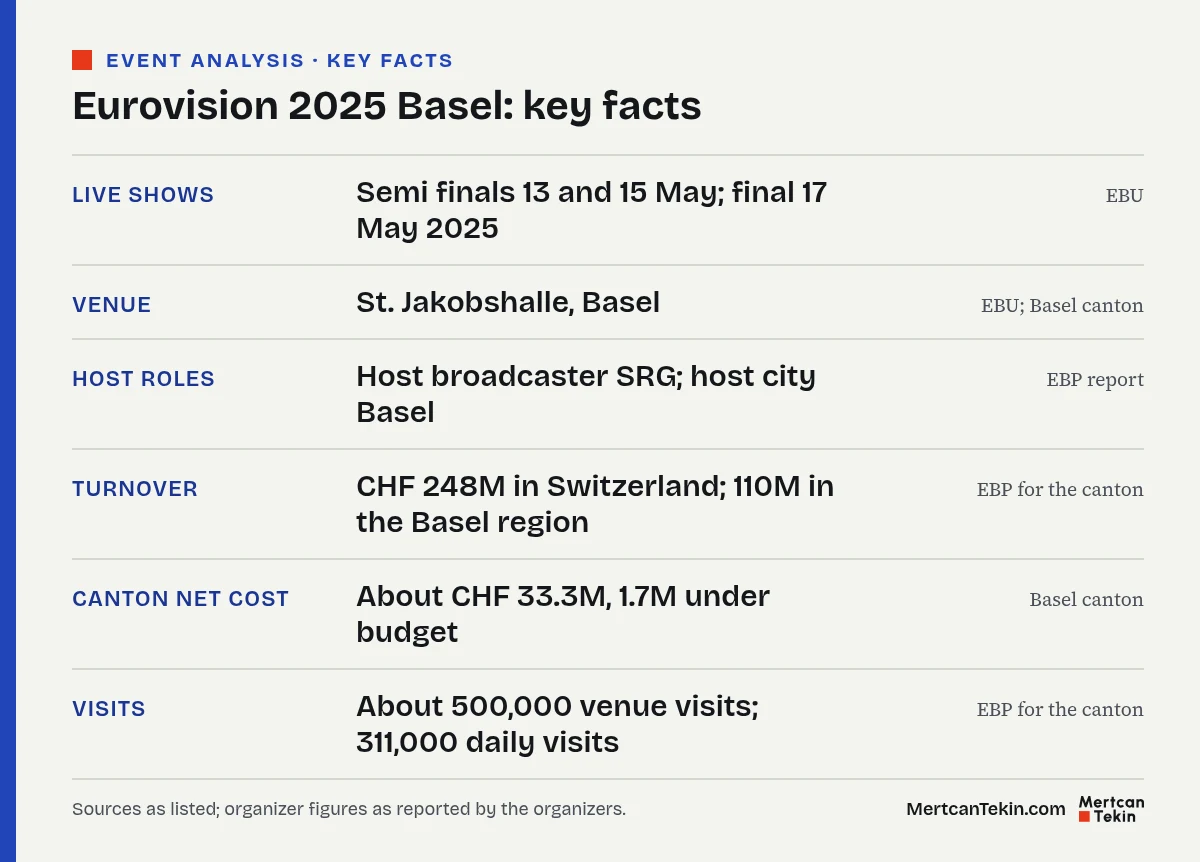
Basel City’s net spending on Eurovision 2025 was about CHF 33.3 million, CHF 1.7 million under the CHF 34.964 million credit that voters approved with 66.57% in November 2024. The EBP report for the canton estimates CHF 115 million of gross value added and CHF 248 million of turnover in Switzerland, 176,000 overnight stays and CHF 44.1 million of visitor spending. Displacement is not netted out, and the ZHAW study for SRG SSR uses a different scope.
Basel had about eight months to prepare a Eurovision Song Contest, and the canton wrote down most of what it planned to measure before the first rehearsal. That is the main reason its record can be read closely. The spending was put to a public vote with an itemised budget, the targets for mobility, waste and regional purchasing were set in advance, and an independent consultancy reported against them six months after the final.
The headline pair is the canton’s net cost of about CHF 33.3 million and gross value added of CHF 115 million in Switzerland [1][2]. They are two different measures, one a public outlay and the other a modelled economic effect, so I read them side by side rather than as a ratio. Three separate studies published figures on the contest, each on its own scope, and much of the confusion around Eurovision numbers comes from mixing them.
Scope and method
The core source is the impact and sustainability report that EBP Schweiz AG prepared for the canton of Basel City [2]. Volunteers surveyed 2,129 visitors aged 16 and over across seven event days, and 651 of them completed an online follow up. Economic effects come from a regional input output model, which estimates direct and indirect effects from survey spending and purchase data. The canton co organised the event and commissioned the study, so these are host city figures and are labelled that way in the charts.
Two other sets of figures exist. The EBU published early host city data eleven days after the final [7], and the host broadcaster SRG SSR published a value added study by the Zurich University of Applied Sciences (ZHAW) in December 2025 [8]. Neither replaces the EBP report; they measure different things.


What the public approved
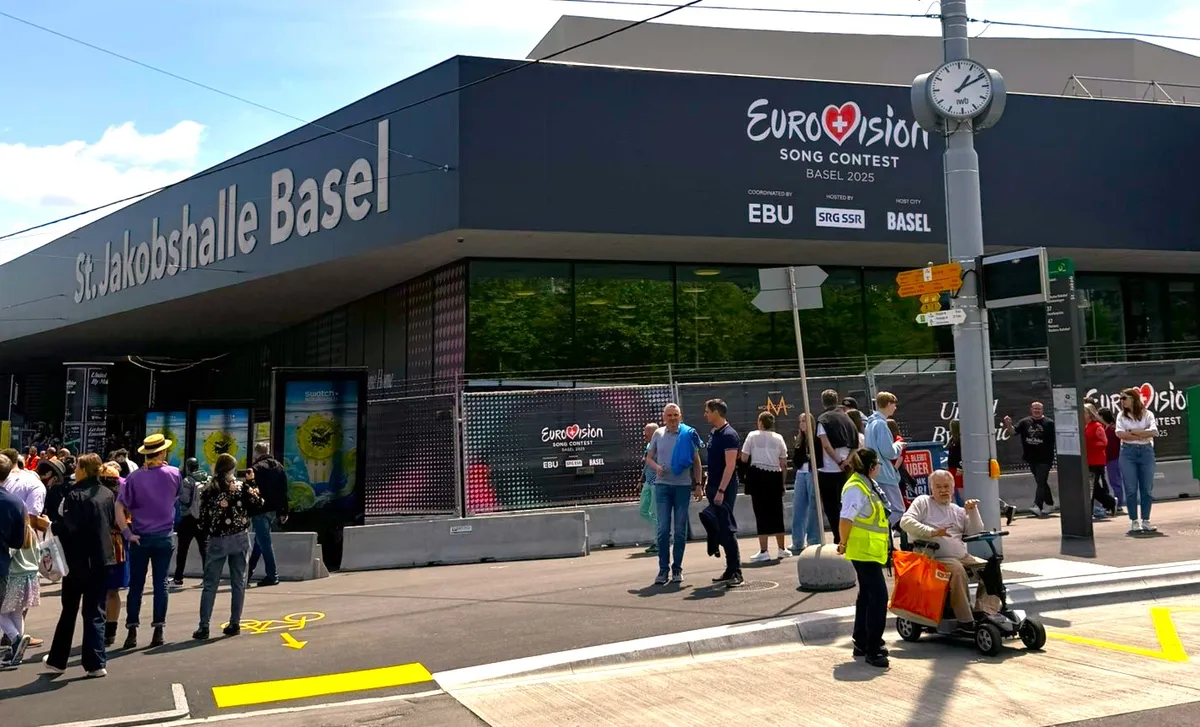
The EBU and SRG SSR chose Basel over Geneva on 30 August 2024 [3][5]. The live shows took place at St. Jakobshalle, with semi finals on 13 and 15 May 2025 and the final on 17 May, and 37 countries took part [4]. A week later the cantonal government asked parliament for net spending of CHF 34.964 million, and the finance committee backed it unanimously, 13 votes to none [5]. The proposal itemised the main blocks: infrastructure and lost income around St. Jakob, security and rescue including cyber security, accommodation and welcome actions, transport and public transport, side events, and project organisation and communication.
What the approved credit covered
Unit: CHF million, net. Proposal of September 2024, total CHF 34.964M. The final net cost was about CHF 33.3M.
| Item | CHF million |
|---|---|
| St. Jakob infrastructure and lost income | 14.592 |
| Security, rescue and cyber security | 7.875 |
| Accommodation and welcome actions | 5.07 |
| Transport and public transport | 2.0 |
| Side events | 0.915 |
| Project organisation and communication | 0.8 |
| Other items (remainder) | 3.712 |
| Total net credit approved | 34.964 |
| Final net cost reported | About 33.3 |

The spending decision then went to a cantonal vote on 24 November 2024. It passed with 38,186 votes in favour, 66.57%, against 19,172 [6]. For an event of this kind, a vote on an itemised credit is unusual and gives the later report a clear baseline.
After the contest the canton reported net spending of about CHF 33.3 million, CHF 1.7 million below the approved budget, and attributed the difference mainly to higher sponsorship and ticket income [1]. The report adds that 61% of the inputs bought by the host city came from firms in the Basel region [2].
Three studies, three scopes
The figures that circulate most often come from different studies, and they do not contradict each other once their scopes are clear.
| Study | Published by, date | Main figures | Scope |
|---|---|---|---|
| Early host city data | EBU, 28 May 2025 | 500,000+ at activities; 50,000 nights; 95% hotel occupancy late in the week | Early estimate during event week |
| Impact and sustainability report | EBP for Kanton Basel-Stadt, 20 November 2025 | CHF 248M turnover; CHF 115M value added; 176,000 overnight stays; 311,000 daily visits | Input output model and survey of 2,129 visitors; displacement not netted |
| Value added study | ZHAW for SRG SSR, 4 December 2025 | CHF 91.2M economic value; CHF 57.6M remained in Switzerland | Method not detailed in the release |
| Resident survey | SRG SSR, 4 December 2025 | 72% to 81% positive on five statements | Sample and dates not stated in the release |
The EBU’s early count of 50,000 nights of accommodation and the EBP total of 176,000 overnight stays are the clearest example [2][7]. The first was an early host city estimate published in May; the second is a model of all stays generated by the event, including participants, visitors staying with friends and 41,500 stays outside Switzerland. Likewise, ZHAW’s CHF 91.2 million of economic value and EBP’s CHF 115 million of value added are not two estimates of the same quantity [2][8]. The SRG release does not set out ZHAW’s method in detail, so I report its figures as published and do not compare them line by line.
Turnover and value added
EBP estimates CHF 248 million of turnover in Switzerland, CHF 110 million of it in the Basel region. Gross value added reached CHF 115 million, CHF 53 million in the Basel region and CHF 62 million in the rest of the country. The work volume equalled 950 full time equivalents, 470 in the region, and public levies and taxes came to CHF 11.5 million [2].
Turnover and value added
Two different measures, each shown for Switzerland and for the Basel region within it. Gross figures, direct plus indirect.
| Measure | Switzerland | Basel region | Rest of Switzerland |
|---|---|---|---|
| Turnover | 248 | 110 | Not stated separately |
| Gross value added | 115 | 53 | 62 |
| Work volume (FTE) | 950 | 470 | 480 |
Turnover counts every franc that changed hands, including inputs bought from other firms, so it is the largest and least comparable number. Value added is the better measure of what the economy gained. Both are gross: the report states that tourist displacement is not netted out, meaning regular visitors who would have used the same hotel rooms in May are not subtracted. Work volume in full time equivalents is also not the same as new jobs.
What visitors spent and where they stayed
Visitors spent CHF 44.1 million, tickets excluded. Daily spending ranged from CHF 296 for hotel guests to CHF 44 for local residents [2].
Spending per person per day
Unit: CHF per person per day, tickets excluded. From the visitor survey.
| Visitor group | CHF |
|---|---|
| Hotel guests | 296 |
| Other paid accommodation | 183 |
| Staying with friends or relatives | 116 |
| Day visitors | 71 |
| Local residents | 44 |
| All overnight guests (average) | 208 |
The event generated 176,000 overnight stays, 68% of them in the canton and region of Basel. Other paid accommodation such as bed and breakfasts and short term rentals took the largest share. Hotel occupancy was 85% at the start of contest week and 95% in the second half, against a usual May average of about 60% [2][7].
Overnight stays generated
Unit: overnight stays, total 176,000, including 41,500 outside Switzerland.
| Group | Overnight stays |
|---|---|
| Visitors in other paid accommodation | 58,900 |
| Visitors in hotels | 46,500 |
| Event participants, mainly in hotels | 41,700 |
| Visitors staying with friends or relatives | 28,900 |
| Total | 176,000 |
A pricing charter asked hotels and restaurants to commit to fair prices. It signed up 46 of 56 hotels in Basel City and 162 of 350 restaurants, against targets of 75% of accommodation providers and 150 restaurants [2]. The restaurant target was met and the hotel share was 82%.
Four accounts, kept apart
A single return on investment figure would hide more than it shows. I keep four accounts separate.
| Account | What it measures | Basel figure | Status |
|---|---|---|---|
| Organiser | Budget of SRG SSR and the EBU for the contest | Not in the sources used | Not published here |
| Public spending | Net cost to the canton of Basel City | About CHF 33.3M | Reported by the canton |
| Economic impact | Gross value added, direct and indirect | CHF 115M in Switzerland, CHF 53M in the region | Modelled, displacement not netted |
| Social cost benefit | Welfare gains against full public cost, including congestion and resident value | None | Not produced |
The organiser’s account belongs to SRG SSR and the EBU, and their budgets for the contest were not part of the sources I used. The public account is the canton’s net CHF 33.3 million. The economic impact account is the EBP model. A social cost benefit account, which would weigh welfare effects such as congestion, noise and the value residents placed on the event against the full public cost, was not produced.
The visitor’s time budget
Most people who came to Basel never entered the arena. The EBU’s early data counted about 100,000 visitors at the shows in St. Jakobshalle and Arena plus, more than 100,000 at the opening ceremony and about 343,000 at the city venues: 190,000 at the Eurovision Village, 135,000 at Eurovision Square and 18,000 at the EuroClub [7]. These are visits, so one person entering three sites counts three times. EBP’s 311,000 daily visits across seven days, one person per day, is closer to a count of people [2].
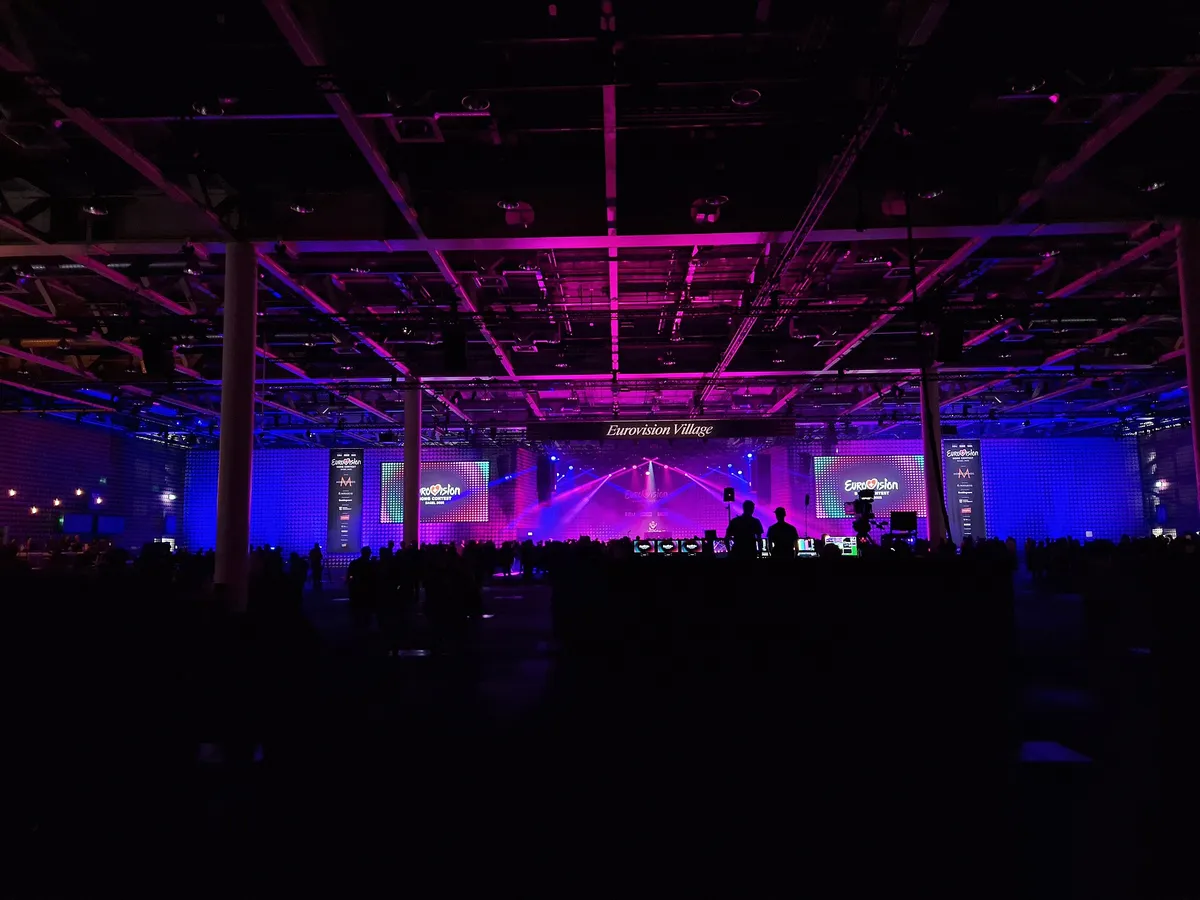

For destination planning this is the useful split. The free public programme in the Messe, Barfüsserplatz and St. Jakob Park carried the city’s share of the week, and it is where residents and day visitors spent their time. Tickets for the three venues included free public transport across the regional fare network, and a CHF 20 voucher covered part of the train journey to Basel within Switzerland [2].
Mobility against targets
Mobility had explicit targets, and the report answers them. 63% of ticket holders travelled to Basel by public transport, on foot or by bike, against a target of 50%; within Basel the share was 89%, against 75%. Across all surveyed visitors the shares were 78% and 91% [2].
Public transport and slow modes
Unit: share of visitors. Two survey groups shown separately. Vertical marks show the targets.
| Group and trip | Share | Target |
|---|---|---|
| Ticket holders, to Basel | 63% | 50% |
| Ticket holders, within Basel | 89% | 75% |
| All visitors, to Basel | 78% | Not stated |
| All visitors, within Basel | 91% | Not stated |
Residents, accessibility and volunteers
SRG SSR published a survey of Basel residents in which 72% said the contest benefited many groups of people, 81% that it had a positive effect on the local economy, 79% that it raised Basel’s image in Europe, 72% that it raised its profile within Switzerland and 71% that it gave a strong sense of community [8]. The release does not give the sample size or the fieldwork dates, so these are broadcaster figures without a published method.
On accessibility, the host city worked with Pro Infirmis and the Behindertenforum on a barrier free concept. At Arena plus, 27 of 77 wheelchair tickets were sold, against a target of selling 95%; the report reads this as demand below the available quota. 45% of surveyed visitors named the barrier free public transport stops as an accessibility measure they noticed [2]. Among volunteers, 84% said they would take part again [2].
The environment
Two indicators need careful reading. Waste was 439 g per visit against a target of at most 300 g, which the report describes as above target. Visitor travel and the overnight stays it triggered produced 14,858 tonnes of CO₂ equivalent, reported separately from the 1,487 tonnes attributed to the event itself, of which 1,066 tonnes came from film and television production. Of the 107 million kilometres travelled, 57 million were by air [2]. Keeping visitor travel separate is correct, because it is the part a host city can influence only through ticketing and transport offers.
Media reach
The contest reached 166 million people across 37 public service media markets, and the final had a 47.7% viewing share, the highest since 2004 [7]. EBP also counted about 313,000 mentions of Basel in connection with the contest between June 2024 and May 2025, which it converts into about 314 billion potential media contacts and itself calls a theoretical upper bound [2]. The viewer figure is the one to quote.
What the Basel record shows for mid sized hosts
The Basel record rests on a few elements: a credit put to a clear decision with an itemised budget, so the final cost can be read against it; measurable targets set before the event for mobility, waste and regional purchasing, with published sample sizes, model and effects left out; transport bundled into the ticket; a pricing charter with hotels and restaurants with a sign up target stated in advance; and a resident survey published with its method, so the social side of the record carries the same weight as the economic side. For a city weighing a bid, these items fit any event impact assessment and any plan to use events for city branding.
| Indicator | What it shows | When to publish |
|---|---|---|
| Net cost against credit | Final public cost line by line against the approved budget | Within 6 months |
| Value added net of displacement | Gain after subtracting regular tourism pushed out | Within 6 months |
| Hotel and rental occupancy | Event week against the same weeks a year earlier | Within 1 month |
| Visitor time split | Ticketed venues against free public sites, in people per day | Within 3 months |
| Mobility shares | Public transport, walking and cycling against targets | Within 3 months |
| Accessibility use | Wheelchair tickets sold and access services used | Within 3 months |
| Resident survey with method | Sample, dates and questions published with results | Within 6 months |
| Repeat visits | Return visitors and May overnight stays in the following two years | 1 and 2 years after |
Analysis result
On the sources used, Basel delivered Eurovision 2025 within its approved public credit, with a final net cost of about CHF 33.3M against CHF 34.964M approved [1][5]. EBP’s model puts turnover at CHF 248M and value added at CHF 115M, with 176,000 overnight stays, but it does not net out displacement, and a separate ZHAW estimate for SRG SSR reaches a lower CHF 91.2M on a different scope [2][8]. Mobility and accessibility measures were largely delivered, while waste per visit came in above its target and visitor travel produced most of the emissions [2]. The balanced conclusion is that Basel ran a well documented, budget disciplined contest with clear gross economic activity and high media reach [7], and that its net economic effect and its social balance remain open because displacement and a fully published resident survey are missing. That makes Basel a useful benchmark for mid sized hosts, provided its gross figures are read as gross.
Frequently asked questions
What did Eurovision 2025 cost the canton of Basel City? Net spending was about CHF 33.3 million, CHF 1.7 million below the CHF 34.964 million net credit, mainly because sponsorship and ticket income were higher than planned [1][5].
Did Basel voters approve the spending? Yes. In the cantonal vote of 24 November 2024 the spending decision passed with 38,186 votes in favour, 66.57%, against 19,172 [6].
Why do the overnight stay figures differ? The EBU’s early host city data in May 2025 gave 50,000 nights. EBP’s later model counts 176,000 overnight stays generated by the event, including participants, visitors staying with friends and stays outside Switzerland [2][7].
How did visitors travel? 78% of all surveyed visitors reached Basel by public transport, on foot or by bike, and 91% used these modes within Basel. Among ticket holders the shares were 63% and 89%, above targets of 50% and 75% [2].
Who wrote the study? EBP Schweiz AG prepared the impact and sustainability report for the canton of Basel City, published on 20 November 2025. A separate value added study by ZHAW was published by SRG SSR in December 2025 [2][8].
Sources
- Kanton Basel-Stadt, Basel zieht positive Bilanz zum Eurovision Song Contest, 20 November 2025
- EBP Schweiz AG for Kanton Basel-Stadt, Eurovision Song Contest 2025 Basel: impact and sustainability report (PDF, German)
- EBU, Basel will host Eurovision Song Contest 2025
- EBU, Eurovision Song Contest Basel 2025
- Grosser Rat Basel-Stadt, Finanzkommission stimmt Ausgaben für den ESC 2025 in Basel einstimmig zu, 6 September 2024
- Kanton Basel-Stadt, Schlussresultat der kantonalen Abstimmung vom 24. November 2024
- EBU, Vital statistics: Eurovision 2025’s record breaking reach, 28 May 2025
- EBU newsroom, SSR SRG reveals positive impact of hosting Eurovision Song Contest 2025, 4 December 2025