
Contents
- Scope and method
- What is the Las Vegas Grand Prix?
- What does the race bring Southern Nevada?
- What are the strengths of the event?
- Where do the numbers and operations get challenged?
- Forecast versus result
- Expert commentary
- Public cost and social benefit
- Residents and the city
- Destination management and recreation
- What an impact study leaves out
- Analysis result
- Frequently asked questions
- Sources
A study by Applied Analysis, commissioned by Formula 1, estimated US$934 million of economic activity in Southern Nevada from the 2024 race, including US$336 million of net visitor spending after displacement. Economists quoted by LVSportsBiz argued such totals reflect gross spending, noting hotel occupancy fell on some race nights in 2023 [1][2].
Every large event now arrives with a number attached. For the 2024 Las Vegas Grand Prix the number was US$934 million, published in a study by the consultancy Applied Analysis that Formula 1 commissioned [1]. Three economists later told LVSportsBiz that the figure counted spending without subtracting what the race displaced [2]. Both sides have a point, and the gap between them shows how much any impact study depends on its method.
My reading: the study is more careful than its headline. It reports a net visitor figure of US$336 million after an adjustment for displacement, and it keeps fiscal effects to direct taxes only [1]. The headline adds operations spending and multipliers on top, and it leaves out costs that fall on residents and businesses in the closure zone. The US$336 million therefore leaves two questions open: how displacement was estimated, and what the missing costs amount to.
Scope and method
This analysis uses the Applied Analysis study for 2024, LVSportsBiz reporting of the economists’ critique and of resident disruption, the Las Vegas Review Journal on public sponsorship, Nevada Newsmakers and Sports Business Journal on the 2025 race, the Las Vegas Sun and Formula 1’s own extension announcement. Impact figures are model estimates commissioned by the promoter. Hotel data for 2023 are an economist’s analysis reported by the press, not a published paper.

What is the Las Vegas Grand Prix?
Organizer, circuit and timing
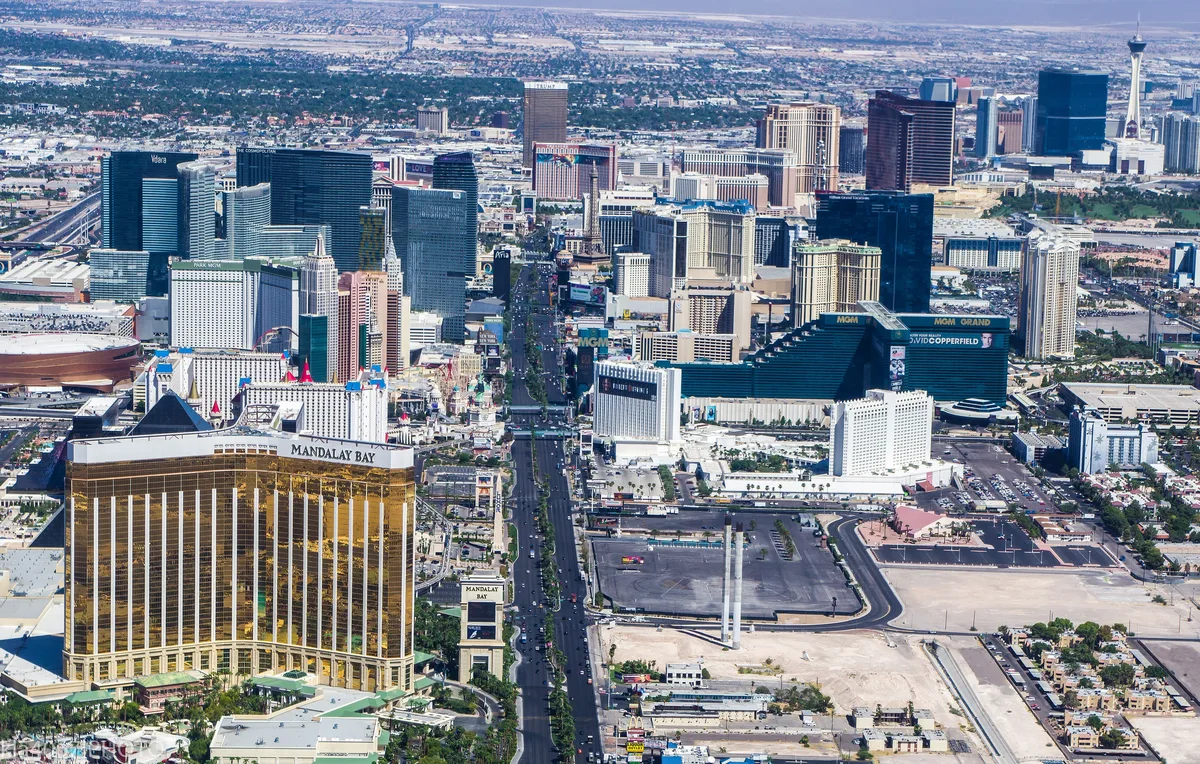
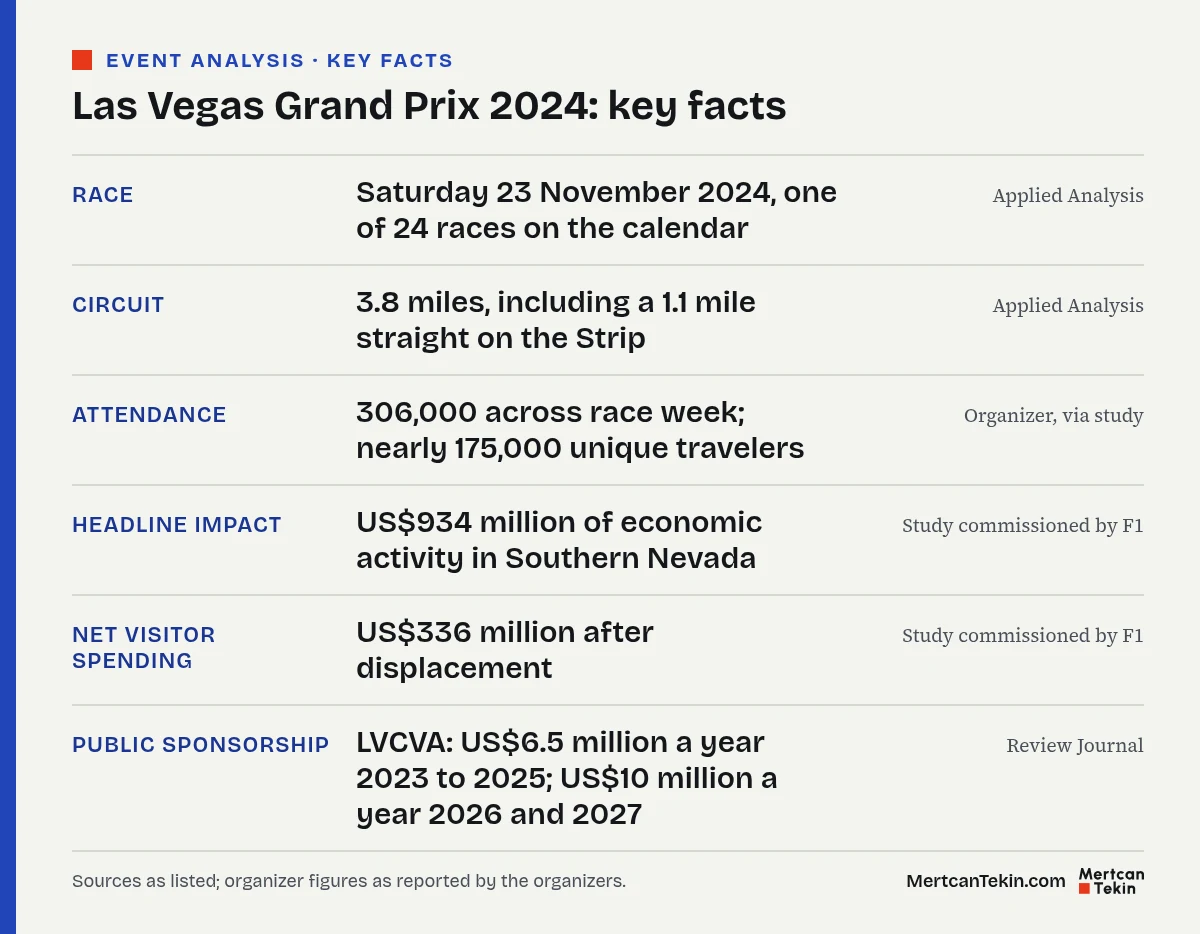
The race runs on a 3.8 mile street circuit that includes a 1.1 mile straight on the Strip; the 2024 race was held on Saturday 23 November [1]. It is promoted by Las Vegas Grand Prix Inc., part of Formula 1, whose parent Liberty Media spent about US$500 million before the 2023 race on land, a three storey pit building and the Grand Prix Plaza [4]. The race sits on the weekend before Thanksgiving, a period LVSportsBiz describes as traditionally slow for hotels [3]. In June 2026 Formula 1 announced a ten year extension through 2037 [8].
Who commissioned the impact study
Formula 1 engaged Applied Analysis to build an event specific model, based on more than 5,000 attendee surveys commissioned by Formula 1 and completed in the days after race weekend [1]. The study is clear about who paid for it. LVSportsBiz notes that Applied Analysis also consults for the Las Vegas Convention and Visitors Authority (LVCVA), which sponsors the race [2]. That does not make the numbers wrong; it means reading them with the method open.
What does the race bring Southern Nevada?
The 934 million dollar figure
The headline combines two blocks [1]. Operations and event hosting: about US$213 million of direct spending kept in the local economy, or US$378 million with indirect and induced effects. Visitors: US$336 million of net spending after accounting for displaced visitors and businesses, or US$556 million with ripple effects. Visitors who travelled for the race stayed 3.7 nights on average and spent more than US$2,400 each outside the race itself [1]. The study puts state and local taxes at US$45 million, counting only direct effects to avoid double counting [1].
What sits inside the headline number
Unit: US$ million, 2024. Dark bars are direct spending; light bars add indirect (supplier) and induced (employee spending) effects.
| Component | Direct | Total with ripple | Jobs | Wages |
|---|---|---|---|---|
| Operations and event hosting | $213M | $378M | 2,025 | $146M |
| Net visitor spending | $336M | $556M | 2,477 | $138M |
| Combined | $549M | $934M | 4,502 | $284M |
Visitor counts reported by F1
The study reports race week attendance of 306,000, including spectators, hospitality guests, team personnel and media, and converts that into nearly 175,000 unique travelers [1]. Attendance counts each day separately, so the unique traveler figure is the more useful one for tourism planning. MGM Resorts’ chief executive said in 2025 that the race draws "around 150,000 visitors" who would not otherwise have come that week [6].
What are the strengths of the event?
A night race in a strong hotel market
LVCVA’s chief executive Steve Hill said the race "fills about half" of the city’s 150,000 hotel rooms, and that the city needs other programming in race week too [5]. In 2025 that week also had two Raiders games, an NHL game and a college football game, with almost 180,000 fans across the four [5]. MGM reported 98% occupancy on its Strip properties for the 2025 race [6].
Global broadcast exposure
The study claims television viewership of over 56.1 million and about 33,700 media stories in race week [1]. Nevada Newsmakers reported ESPN’s US audience at 905,000 in 2024 and 1.5 million in 2025, helped by an earlier start [5]. The two numbers measure different things: a global cumulative reach claim and an average US audience. They are not interchangeable.
Changes between editions
The 2025 race sold out for the third year running, after average ticket prices fell by about 30% and the start moved two hours earlier [6]. Hill said everyone involved "took the lessons of the first two" races, and that room rates in 2025 were "stable and moving up" towards race day, unlike year two [5][6]. Setup was planned with two crews working towards each other to shorten closures by about three weeks [4].


Where do the numbers and operations get challenged?
Gross versus net
Victor Matheson of the College of the Holy Cross put the critique simply: impact statements are "pretty good about adding up the stuff that does happen" but "terrible about addressing the things that don’t happen" [2]. JC Bradbury of Kennesaw State University said decades of research find the net effect of mega events "quite small", sometimes negative [2]. The study’s net visitor figure answers part of this. What remains open is how displacement was estimated: the study says it "contemplates displaced visitor and business spending" but does not publish the inputs [1].
Displacement of regular visitors
Frank Stephenson of Berry College analysed hotel data for the 2023 race over a ten day window [2]. His results show that fewer rooms were rented, at much higher rates, so revenue rose while visitor numbers fell.
| Measure | Effect |
|---|---|
| Hotel occupancy rate | Down 8 to 18 percentage points per night |
| Rooms rented | Down 12,000 to 30,000 per night |
| Room rates | Up more than $250 a night on race night and the two nights before; up about $100 on the third night before and the night after |
| Hotel revenue | Up about $70 million over the ten day window; some nights down considerably |
That pattern is the core of the displacement debate: the city may earn more from fewer people, and the spending of the guests who stayed away is lost to restaurants and shows that the race guests do not use. The data cover 2023, the first edition. Hill has said demand for the first race will be higher than for any later one, so 2023 is not a fair proxy for every year [5]. No comparable series for 2024 or 2025 appeared in the sources used.
Street closures and local businesses
LVSportsBiz reported that four businesses filed lawsuits against Formula 1 and Clark County over lost revenue [2]. Its publisher described commutes for Strip workers stretching from 20 minutes to 45 to 60 minutes during works that ran from early September to Christmas in 2025 [3]. The Review Journal reported about four months of traffic impacts in 2024 [4]. These costs are real and absent from the US$934 million.
One race, several numbers
Unit: US$ million. Figures of different types: a regulatory threshold, a net component, a gross total and a recalled year one estimate.
Forecast versus result
Three kinds of forward figure exist for this race, and none is a forecast in the strict sense. The first is regulatory: LVCVA certified that the 2025 race would generate at least US$250 million, a condition for advertising on public roads during the event [4]. The second is expectation: after the 2025 race Hill said it would "track around" the US$1 billion mark of the first two races, and later that it should beat 2024 [5][6]. The third is a recalled baseline: Hill put year one at about US$1.5 billion [5].
The results side is thin. Formula 1 states US$3.2 billion of cumulative impact for 2023 to 2025 and US$43 million of state and local taxes for 2025 [8], but no published 2025 study was among the sources I could open, so the yearly split behind the cumulative figure cannot be checked here. What can be compared is the tax line: US$45 million in 2024 and US$43 million in 2025, both on the promoter’s side of the ledger [1][8].
Expert commentary
The economists quoted by LVSportsBiz make a method point, not a moral one. Matheson: "it’s pretty easy to get a big number when you do all of the adding and multiplying but none of the subtracting" [2]. Stephenson’s hotel series shows what subtraction looks like in practice. Marta Soligo of UNLV, director of tourism research at the UNLV Office of Economic Development, adds a market reading: Formula 1 tourism is niche, so many race visitors would not otherwise come, yet "I don’t think they have one event that can solve such issues" in a year when Las Vegas had 2.5 million fewer visitors from January to September and international arrivals fell 13.5% [7].
From the industry side, Hornbuckle’s estimate of about 150,000 visitors who would not have come that week is the closest public figure to an additionality measure [6]. It comes from a hotel operator and is not a survey result, but it sits near the study’s 175,000 unique travelers [1]; the difference between the two is the displaced and the would have come anyway.
Public cost and social benefit
The public money is modest next to the private investment, but it is public. LVCVA, funded mainly by hotel room taxes, paid US$6.5 million a year for 2023 to 2025 and approved US$10 million a year for 2026 and 2027, including tickets and a transport programme for Strip employees [4]. Social benefits claimed by the promoter include more than US$2 million in foundation giving [8]. Tax receipts and public spending belong in one account, social claims in another.
| Account | Figure | Source type |
|---|---|---|
| LVCVA sponsorship 2023 to 2025 | $6.5 million a year | Public agency funded mainly by room taxes [4] |
| LVCVA sponsorship 2026 and 2027 | $10 million a year, incl. $2.5 million for tickets and a Strip worker transport programme | Public agency [4] |
| Private investment by Liberty Media | $500 million for land, pit building and Grand Prix Plaza | Reported [4] |
| State and local taxes, 2024 | $45 million (direct only) | Commissioned study [1] |
| State and local taxes, 2025 | $43 million | Promoter [8] |
| Business losses and commuter time | Not quantified | Claimed in lawsuits and by critics [2] |
| Foundation giving, 2023 to 2025 | More than $2 million | Promoter [8] |
Residents and the city
The race asks most of the people who work on the Strip and the businesses inside the circuit. Marta Soligo of UNLV said the race will boost tourism data in race week, but its effect will not be long term [7]. For residents, the fair test is not the headline but closure days, commute times and whether the worker transport programme reduces them. The 2025 changes, free tickets for teachers, Girl Scouts selling cookies at the event and lower prices aimed at drawing locals, show the promoter treating residents as an audience as well as a cost [3]. The environmental footprint of the event and its setup has not been reported in the sources used.
Destination management and recreation
For destination managers the race is a calendar tool. Hill frames it with the National Finals Rodeo in December: events that fill weeks which used to be slow [5]. That is a seasonality strategy, and it works only if the rest of the city keeps running: Hill’s own words are that "you need alternative programing" around the circuit [5]. For recreation, the cost is access: months of works around the Strip [3] mean that access depends on a published closure calendar with alternative routes.
What an impact study leaves out
Four items decide how far such a figure can be read: the direct net figure before multipliers, the displacement method with its inputs, hotel data by night against a baseline, and an estimate of costs in the closure zone. Who commissioned the study, and whether anyone reviewed it independently, also shape how the figure is read.
| Indicator | What it shows | When to publish |
|---|---|---|
| Displacement method | How displaced visitors and business losses were estimated, with inputs | With the report |
| Gross and net | Direct net spending shown before multipliers | With the report |
| Hotel data | Occupancy, rooms sold and rate by night against a baseline year | Within 1 month |
| Closure cost | Business revenue change in the closure zone against a control area | Within 6 months |
| Commuter time | Change in travel times for workers during setup and teardown | During works |
| Survey base | Number of surveys, timing and response profile | With the report |
| Independence | Who commissioned and who reviewed the study | With the report |
| Public return | Taxes against public sponsorship and service costs | Each year |
Analysis result
On the sources used, the 2024 Las Vegas Grand Prix produced US$934 million of economic activity by the estimate of a study commissioned by Formula 1, of which US$336 million was net visitor spending after displacement [1]. Economists argue that such totals overstate net gains, and 2023 hotel data showed fewer rooms rented at higher rates [2]. Public sponsorship is US$10 million a year from 2026 [4]. The race is now fixed in the calendar through 2037 [8]; the missing piece is an open, reviewed measure of its costs to residents and businesses.
Frequently asked questions
Who produced the 934 million dollar estimate? Applied Analysis, in a study commissioned by Formula 1 [1].
What do critics argue? That the total adds up spending without subtracting losses from disruption and displaced visitors, so it overstates net gains [2].
Did hotel occupancy rise in 2023? Data cited by economist Frank Stephenson showed occupancy fell 8 to 18 points per night, with about 70 million dollars more hotel revenue over ten days [2].
How many attended in 2024? The study reported race week attendance of 306,000, including nearly 175,000 unique travelers [1].
How long is the circuit? 3.8 miles, including a 1.1 mile straight on the Las Vegas Strip [1].
Sources
- Applied Analysis, 2024 Las Vegas Grand Prix Economic Impact Analysis (PDF)
- LVSportsBiz, Economists question F1 race economics in Las Vegas, 5 March 2025, updated 13 March 2025
- LVSportsBiz, F1 Las Vegas: annual glittery spectacle or Clark County’s four month headache, 23 November 2025
- Las Vegas Review Journal, Las Vegas Grand Prix extended through 2027 via $20M LVCVA sponsorship deal, 12 August 2025
- Nevada Newsmakers, 2025 Las Vegas Grand Prix should beat financial impact of 2024, 10 December 2025
- Sports Business Journal, Las Vegas GP delivers sellout, eases city’s tourism dip, 24 November 2025
- Las Vegas Sun, Grand Prix glows as Las Vegas weathers international visitor slump, 16 November 2025
- Formula 1, Explained: why the Las Vegas Grand Prix has earned a 10 year extension, June 2026