Contents
- Scope and method
- What is Maha Kumbh and what happened in 2025?
- What did the festival mean for Prayagraj and the region?
- What worked?
- Where did safety break down?
- What the record shows for mass gatherings
- Residents and environment
- What is the reading for crowd planners?
- Analysis result
- Frequently asked questions
- Sources
Local administrators estimated 663 million visits to Maha Kumbh 2025 in Prayagraj over 45 days, according to a Reuters analysis. The figure counts ritual bathing visits to the ghats, not distinct people, and Reuters could not determine how many individuals attended. It was built from AI assisted cameras and extrapolation [1].
Every crowd number is a model. At most events the model is simple: tickets scanned at a gate. At Maha Kumbh 2025 in Prayagraj there were no gates for most of the site, and the model had to estimate visits across a riverbank where people arrived by train, road and air for 45 days [1]. The result, 663 million bathing visits, is the largest figure any event analyst is likely to meet [1].
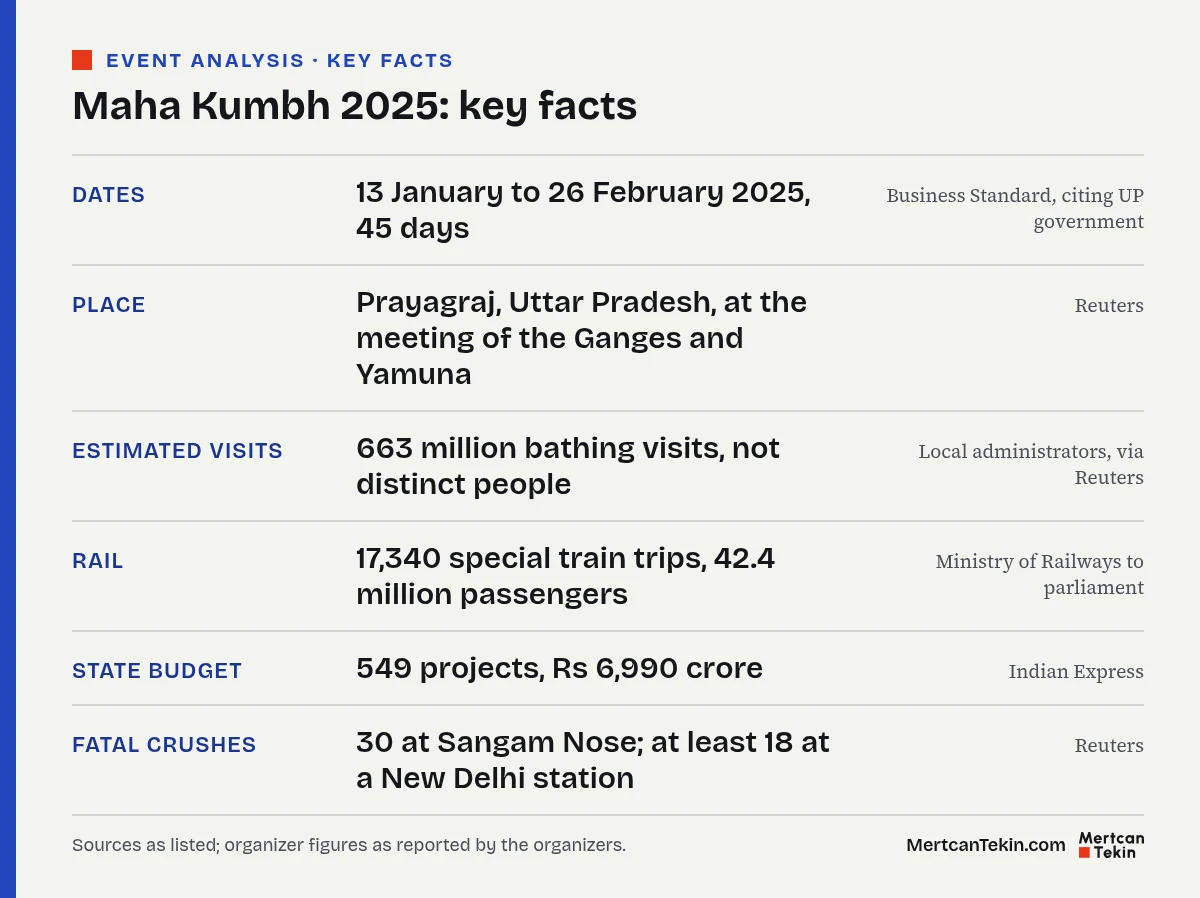
My conclusion first. The figure is a reasonable estimate of visits and a poor guide to people, and the authorities did not publish an uncertainty range [1]. The operations worked at a scale few event planners will ever face: tens of millions of rail passengers, thousands of sanitation workers and a temporary city of tents [2][3][6]. Yet the two deadliest incidents happened at a bathing point and at a railway station hundreds of kilometres away [1]. The record shows that, at a mass gathering, transport nodes are part of the venue.
Scope and method
This analysis uses Reuters’ visual analysis of the crowd estimate, official releases from India’s Press Information Bureau (PIB) and the Ministry of Railways, and Indian national media for budgets, inquiries and water quality. Visit totals are government or administrator estimates. Budget and economic effect figures are government figures or forecasts; I found no published measurement of the economic effect after the event. I make no comment on religious practice and do not assign blame for the incidents.

What is Maha Kumbh and what happened in 2025?
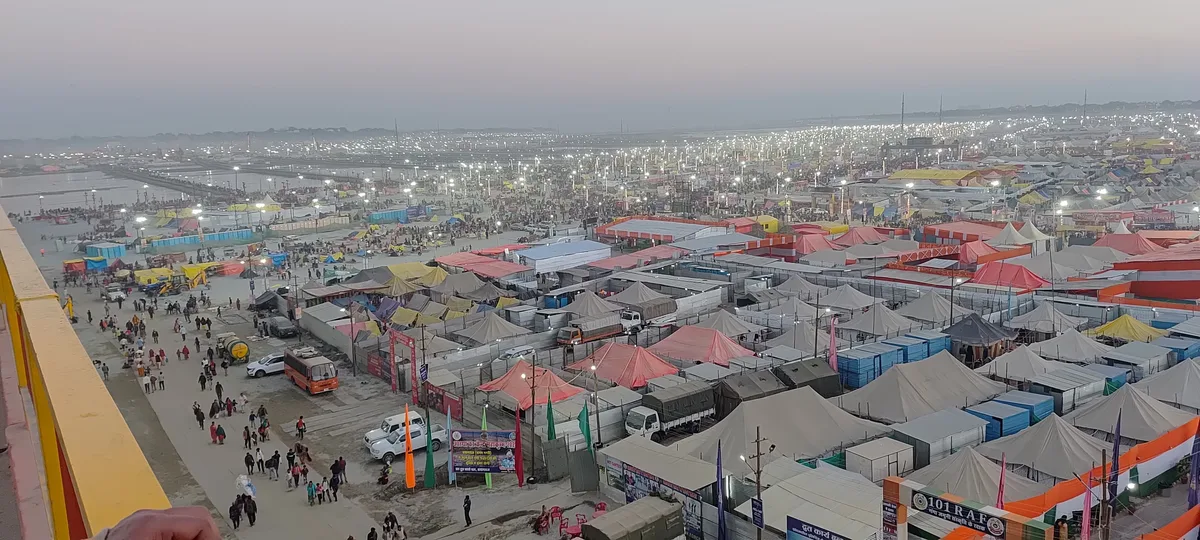
The Kumbh is held every three years, rotating between four locations; the 2025 edition in Prayagraj carried the maha prefix, which draws the largest gathering [1]. It ran from 13 January to 26 February 2025, hosted by the government of Uttar Pradesh [5]. The Mela grounds were spread over about 4,000 acres of riverbank, organised in 25 sectors [6].
How was the 663 million figure built?
A festival officer told Reuters that AI assisted cameras at selected locations near the ghats monitored crowd density, and the data were extrapolated across the riverbank [1]. The model used three variables: site measurements, human density, and transaction time measured from a random sample with facial recognition [1]. It assumed every visitor took a dip [1]. Anyone who stayed several days and bathed several times was counted more than once, and Reuters could not determine how many distinct people attended [1].
The estimate also moved. At the start, the state government expected about 400 million visits; a central government summary cited an expected 450 million [2][5]. On the closing day the state reported 650 million, and the Reuters figure from local administrators is 663 million [1][5].
Forecast against result
Unit: million estimated bathing visits. These are model estimates of visits, not counts of distinct people.
| Estimate | Million visits | When | Source |
|---|---|---|---|
| UP government estimate at the start | 400 | January 2025 | Business Standard |
| Expected turnout in government summary | 450 | Before the festival | PIB |
| UP government closing figure | 650 | 26 February 2025 | Business Standard |
| Local administrators | 663 | Over 45 days | Reuters |
What did the festival mean for Prayagraj and the region?
Rail, air and road volumes
The railways carried the largest measured share. The Ministry of Railways told parliament that special services made 17,340 train trips and served 42.4 million passengers [3]. The minister’s own figures a day after the close were 17,152 trains including 7,667 specials, against 13,000 originally planned [4]. The local airport handled about half a million passengers during the festival period; road traveller numbers were not available [1].
One festival, more rail demand than a national holiday season
Units differ by group: million passengers and thousand train trips. Special services only.
| Event | Train trips | Passengers served |
|---|---|---|
| Maha Kumbh 2025 | 17,340 | 42.4 million |
| Summer vacation 2024 | 12,919 | 18 million |
| Durga Pooja, Deepawali, Chhath 2024 | 7,990 | 11 million |
| Holi 2024 | 604 | 0.86 million |
The rail comparison puts the scale in context. One 45 day festival used more special train trips and more than twice the passengers of the 2024 summer holiday season across the network [3].
Public spending and the regional economy
The state launched 549 projects for the Mela at a budget of Rs 6,990 crore, against 700 projects and more than Rs 3,700 crore for the 2019 Kumbh [6]. The railways reported Rs 5,000 crore of work in the Kumbh area over three years [4]. On the benefit side, Mela officials estimated revenues of Rs 25,000 crore and the state estimated an effect of about Rs 2 lakh crore on its economy [5][6]. These are forecasts. I found no measurement after the event that tests them.
| Account | Figure | Type | Source |
|---|---|---|---|
| State projects for the Mela | Rs 6,990 crore, 549 projects | Budget | Indian Express |
| Same, Kumbh 2019 | Rs 3,700 crore, 700 projects | Budget | Indian Express |
| Railway works in the Kumbh area | Rs 5,000 crore over three years | Reported spending | The Hindu, Railway Ministry |
| Revenue expected by Mela officials | Rs 25,000 crore | Estimate before the event | Indian Express |
| Economic effect on the state economy | About Rs 2 lakh crore | Government estimate, not measured | Business Standard; Indian Express |
| Measured economic effect after the event | not published in the sources |
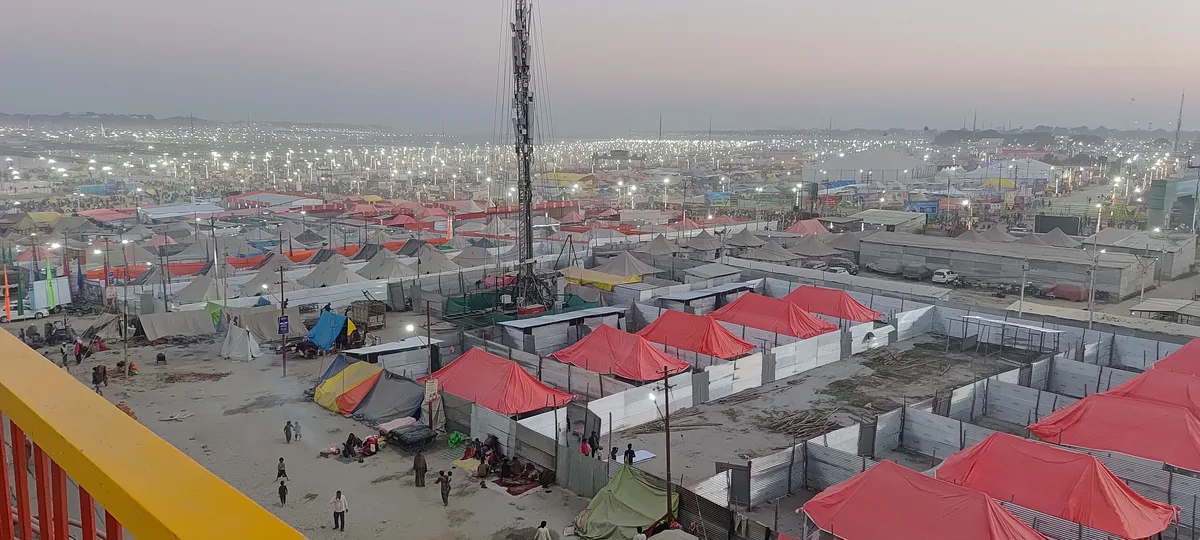
The regional tourism office reported 100 registered homestays against 15 a year earlier, more than 7,000 vendors in the city and a team of 1,000 guides [6]. The government set up 1.6 lakh tents, 2,200 of them luxury tents, alongside 218 hotels and 204 guest houses in the city [6]. Many of these assets are temporary by design, which makes the question of what residents keep a question about roads, stations and the trained workforce, not about tents.
Accommodation across budgets
The price range shows how wide the visitor mix was. State tourism tents ranged from Rs 1,500 a night for a dormitory bed to Rs 35,000 for the top category, transparent domes on the riverbank cost Rs 61,000 a night with meals, and new hotels near the site charged Rs 10,000 to Rs 25,000 [6]. At the other end, some ascetics who received free land told the Indian Express that the cost of firewood, carpets and basic tent materials was running down their savings [6]. Several premium sites were still under construction three days before opening because land was handed over late, according to an operator on site [6]. In this record, temporary accommodation ran on its own delivery timeline, with land allocation as the first milestone.

What worked?
Camera based density monitoring gave the authorities a live view of pressure at the ghats, even if its use for a total count is limited [1]. The railways added second entry points, 48 platforms and 21 foot overbridges across nine Prayagraj stations, set up 23 permanent holding areas for peak hours, ran announcements and leaflets in 23 languages, and opened 554 ticket counters [4]. Diverting goods trains to the freight corridor freed capacity for passengers [4].
Visitor services were planned at scale. Reuters described centres for separated families with sections for women and children and loudspeakers along the riverbanks [1]. The central government reported more than 10,000 police personnel, 3,800 water police, an 8 km stretch of deep water barricading, 23 hospitals with 360 beds and more than 28,000 toilets [2]. These are organizer figures, reported without performance data such as response times. The government summary also reports that hospitals treated 4.5 lakh people during the festival, which gives a sense of the medical load a gathering of this size produces [2].
Information was treated as part of crowd control. The state set up a cyber police station, a helpline and 40 variable message displays to warn visitors about fraudulent websites and fake links [2]. At least a dozen police cases were registered against 140 social media accounts for sharing content the authorities called misleading [5]. Whatever one thinks of that approach, rumours about crowding or closures move people, and a fast, trusted channel to correct them is part of crowd management at any large gathering.
Where did safety break down?
The deadliest incident was a crush at Sangam Nose, a popular bathing point, on the most auspicious bathing day, 29 January, which killed 30 people [1][5]. The state government formed a judicial commission and, after a High Court petition, widened its scope on 22 February to cover loss of life and property and coordination between the Mela administration, the district administration and health services [7][8]. I found no published findings.
The second was a crush at a New Delhi railway station in February, among people heading to the festival, which killed at least 18 [1]. The station is in the national capital, far from the festival grounds, yet it was part of the event’s flow system.
The third was road capacity. On 12 February a traffic jam of 200 to 300 km extended into the neighbouring state of Madhya Pradesh [1]. Without road traveller numbers, nobody can say how much of the total flow used roads [1].

What the record shows for mass gatherings
Counting honestly
Steve Doig of Arizona State University told Reuters the method appeared appropriate [1]. Dirk Helbing said an estimate of uncertainty would have helped, and Keith Still of the University of Suffolk suggested checking crowd claims against transport capacity, noting that organizers often claim numbers transport cannot support [1]. The rail data allow a rough check: 42.4 million rail passengers and half a million air passengers are far below 663 million visits, which only works if most visitors bathed many times or arrived by road [1][3]. That gap is the reason to publish both visits and distinct visitors.
Treating transport hubs as part of the venue
The rail investment shows the authorities understood this for Prayagraj stations [4]. The Delhi crush shows that the flow system extends to origin stations as well [1]. The same logic extends holding areas, staged boarding and live density data to the busiest origin hubs, not only the destination.
Residents and environment
For residents, the event brought upgraded stations and roads and new income, and also months of construction and peak day congestion [4][6]. Water quality was the most visible environmental issue. A Central Pollution Control Board report to the National Green Tribunal said river water did not meet bathing standards for faecal coliform at all monitored locations on various occasions [9]. A later CPCB report said median values were within permissible limits, while its own data showed levels up to 19.6 times the maximum on 20 January [10]. Both readings can be true; the method decides which one a visitor hears.
What is the reading for crowd planners?
The record points to three indicators: a visit estimate given as a range and cross checked against transport, origin stations treated as part of the venue, and water and safety data by site and by day.
| Indicator | What it shows | When to publish |
|---|---|---|
| Visit estimate with uncertainty | Visits with a published range and method note | Daily |
| Distinct visitors | Unique people, from sampled ticketing, registration or telecom data | Within 1 month |
| Transport cross check | Arrivals by rail, air and road against the visit estimate | Daily |
| Peak density at pinch points | Persons per square metre at bathing points and station concourses | Live |
| Holding area use | Time to clear holding areas at stations on peak days | Live |
| Separated persons | Persons reported separated and time to reunite | Daily |
| Bathing water quality | Faecal coliform by site and day against limits, published daily | Daily |
| Economic effect | Spending measured after the event, separate from forecasts | Within 6 months |
Analysis result
On the sources used, Maha Kumbh 2025 handled an estimated 663 million bathing visits over 45 days [1]. Rail carried 42.4 million passengers on 17,340 special trips, and the state spent Rs 6,990 crore on 549 projects [3][6]. The estimate counts visits, not people, and was published without an uncertainty range [1]. Fatal crushes at Sangam Nose and at a New Delhi station killed at least 48 people [1]. Economic benefit figures remain forecasts [5][6]. The core finding is that crowd safety depends on the whole flow system, from the origin station to the riverbank.
Frequently asked questions
Is 663 million the number of people? No. It is an estimate of bathing visits; people who bathed several times were counted more than once [1].
How was the crowd measured? AI assisted cameras at selected locations measured density, and the data were extrapolated across the riverbank, according to a festival officer quoted by Reuters [1].
How many trains ran? The Ministry of Railways told parliament that 17,340 special train trips carried 42.4 million passengers [3].
Were there fatal incidents? Yes. Reuters reported 30 deaths in a crush at Sangam Nose and at least 18 in a crush at a New Delhi railway station [1]. A judicial commission was set up to inquire into the Sangam crush [7].
How often is the Kumbh held? Every three years, rotating between four locations; the 2025 edition carried the maha prefix [1].
Sources
- Reuters, Faith in numbers: the scale of India’s Maha Kumbh festival, May 2025
- Press Information Bureau, Mahakumbh 2025 summary, 26 February 2025
- Press Information Bureau, Ministry of Railways written reply in the Rajya Sabha, March 2025
- The Hindu, Railways operated more than 16,000 trains during Maha Kumbh, 27 February 2025
- Business Standard, Maha Kumbh ends with 650 mn attendees, 26 February 2025
- Indian Express, The economy of the Maha Kumbh Mela, January 2025
- The Hindu, Kumbh stampede inquiry commission scope expanded, 24 February 2025
- Indian Express, Judicial panel to probe loss of lives and property, February 2025
- The Hindu, High levels of microbes found in river water at Maha Kumbh, 18 February 2025
- The Hindu, CPCB tells green tribunal Maha Kumbh water fit for bathing, March 2025