Contents
Autonomous Onboarding is an Expedia Group feature launched on 20 October 2026 that lets hotels join its marketplace from inside their existing connectivity software. Expedia says a property can select the channel, accept its agreement and go live in under 24 hours, while room types, rates, photos and availability transfer automatically.
A small hotel decides to add a new online travel site to its sales channels. In the usual process, someone at the front desk or in the back office opens a separate portal, types in each room type, uploads photos, copies the rate plans and checks the cancellation rules. For a property with no revenue manager, that can take days of work spread over several weeks. Expedia Group now says the same step can happen inside the hotel’s existing software and be finished in less than a day [1].


What happened with Expedia Autonomous Onboarding?
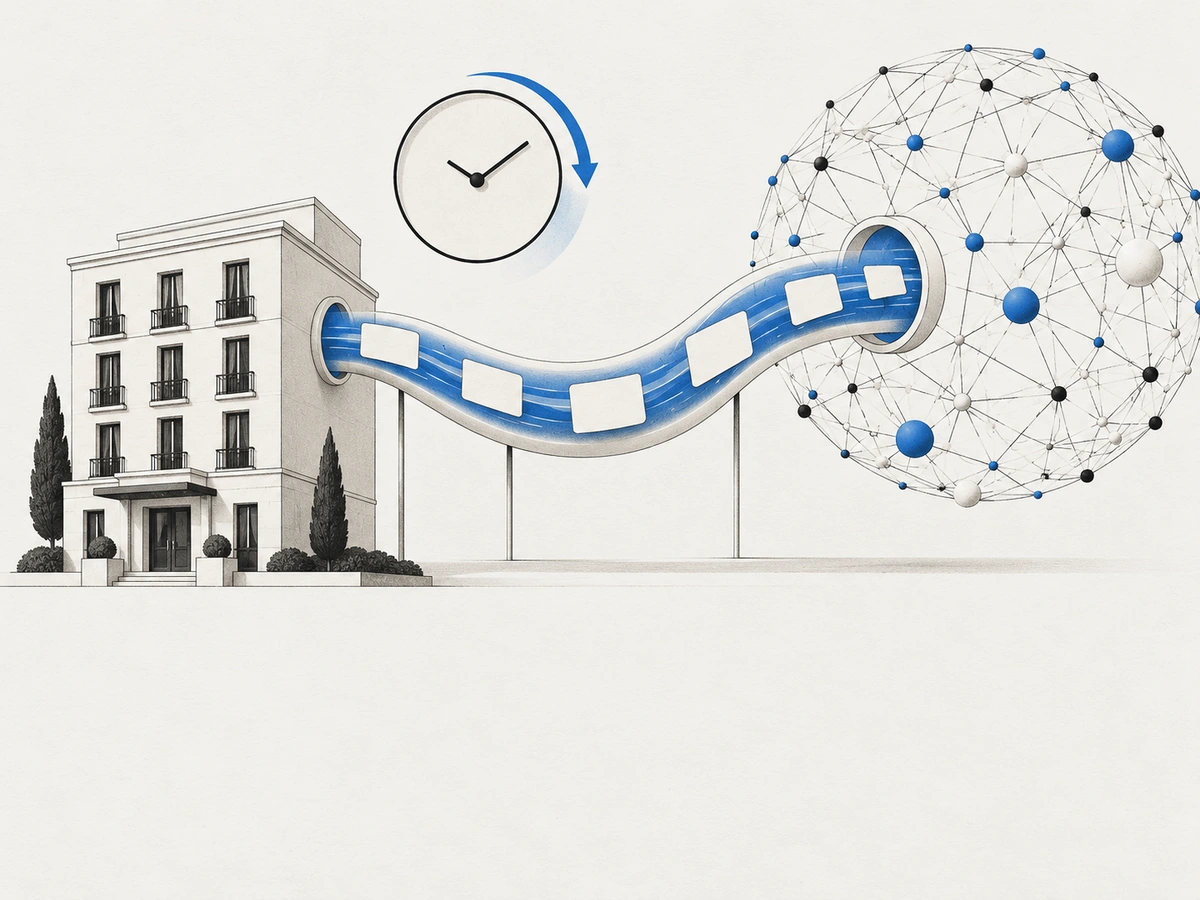
On 20 October 2026, Expedia Group announced Autonomous Onboarding, a way for properties to join its marketplace without leaving the connectivity software they already use [1][4]. According to the company, a property selects Expedia Group as a channel inside its connectivity provider, reviews and accepts its agreement, and connects [1]. Expedia’s technology then transfers room types, rates and rate plans, photos, amenities, payment setups, availability and other details, which Expedia validates [1]. The company says the property can go live in less than 24 hours [1].
Five connectivity providers took part in the pilot: HotelRunner, Yanolja Cloud Solutions, RoomCloud, RateGain and eviivo [1]. Once live, properties can reach travelers through Expedia’s consumer brands, its business to business network of more than 75,000 partners and 200,000 travel advisors, and what the company calls emerging AI travel partnerships [1]. Expedia cites more than one billion average monthly searches and more than 415 million booked room nights in 2025 [1]. Those figures come from its own fourth quarter 2025 earnings [1].
Chris Hodges, Expedia Group’s vice president for global connectivity and partner solutions, said adding a new source of demand should not add a new layer of work [1]. He called the launch a first step towards what Expedia calls Autonomous Distribution, a longer plan to simplify the full distribution cycle, including how partners manage and later optimize their business [1]. The company has not given dates for the later phases [1].
Expedia published research alongside the launch, from what it calls a connectivity gap study [2]. It says 74% of properties that do not use connectivity handle online travel site tasks partly or fully by hand [2]. It also says 81% report that a connectivity provider reduces friction and manual work, and that fully connected properties are 1.6 times more likely to report better occupancy, ADR or RevPAR [2]. The same research says 32% of hotel decision makers name concern about losing control over pricing or inventory as a leading reason for not adopting connectivity software [2].
What Expedia says its own research found
Unit: share of respondents. Expedia Group Connectivity Gap research, 2026. Sample size and method not published.
These are company figures, and the release does not give the sample size or method. The 1.6 times figure shows an association, not proof that connectivity causes better results. Hotels that invest in connectivity may also be larger or better run. I report the numbers because they explain how Expedia frames the problem, not because they settle it.
What does it mean for the sector?
For hotels, the main change is time and effort at the start. Independent properties without a revenue team gain most, since manual setup falls on staff who also run the front desk. Hospitality Technology describes the change as turning channel activation into an automated data sync instead of a manual integration project [4]. What does not change is the commercial side: the property still accepts an agreement, and no source says that commission levels are different [1][2]. Faster entry to a channel is not the same as cheaper distribution.
Hospitality Technology lists the work that the feature is meant to remove. Traditional onboarding, it says, means mapping rate codes line by line, tagging amenities to match each channel’s own categories and checking cancellation policies [4]. For a management company taking on several new boutique properties, that delay leaves new rooms unsold on major channels [4]. This independent description supports the need, though it does not test Expedia’s timing claim.
| Point | What Expedia says | What independent or partner sources add |
|---|---|---|
| Speed | Live in less than 24 hours | Hospitality Technology repeats the claim; no independent timing data yet |
| Data moved | Room types, rates, photos, amenities, payment setup and availability | Hospitality Technology describes it as an automated data sync replacing manual extranet setup |
| Pilot partners | HotelRunner, Yanolja Cloud Solutions, RoomCloud, RateGain, eviivo | HotelRunner confirms it is a pilot partner and live |
| Reach after go live | Consumer brands, B2B network of more than 75,000 partners and 200,000 travel advisors, AI partnerships | HotelRunner quotes the same 2025 figures |
| Commercial terms | Agreement accepted in the connectivity software | Commission levels are not disclosed in any source |
The control question matters as much as speed. Expedia’s own research says one in three decision makers worries about losing control of pricing or inventory [2]. Its partner blog says that pricing and inventory stay in the hotel’s hands and that automation handles repetitive tasks [2]. In my reading, the content of the automated transfer, especially rate plans, restrictions and payment rules, is the main operational point before a hotel accepts the agreement. In my experience, errors in room mapping are the most common cause of guest complaints after a new channel goes live.


For connectivity providers, the feature is a selling point. HotelRunner said its partner properties could go live on Expedia Group in under 24 hours and that it was the first partner to commit to the launch, after an announcement at Expedia’s Explore 2026 conference [3]. Rıza Kaynak, HotelRunner’s director of demand partnerships, said the program turns one of the most manual steps in distribution into a simple guided flow [3]. HotelRunner also said a broader initiative to remove manual work from distribution would be announced soon [3]. These are partner statements and share the same interest as Expedia in the launch.
For agencies, DMCs and travel advisors, the business to business network is the key line. Properties that join through Autonomous Onboarding become available to Expedia’s partner network of more than 75,000 partners and 200,000 travel advisors [1]. For agencies, that could mean a wider choice of small hotels in markets where they were hard to source. In regions such as Türkiye and southern Europe, where many small properties work through channel managers, the effect may show first. That is my reading, and there is no public data by market yet.
HotelRunner’s release adds figures that Expedia uses in its sales pitch. It says travelers on Expedia’s platform spend 21% more and stay 11% longer than the industry average, citing an Expedia traveler value study from 2024 [3]. These are company figures repeated by a partner, not independent measures. Until they can be compared with booking data, they remain marketing claims.
For airlines, the launch has no direct effect. It covers lodging only. The wider point is that online travel groups are competing to make supply easy to add, at a time when AI assistants may change where travelers start. Airlines face a similar question in their own distribution, but nothing in this launch addresses flights.
For congress and event organizers, faster onboarding could widen the pool of rooms that appear on large platforms near a venue. That helps when official blocks sell out, but it can also pull delegates away from the official housing programme. For organizers who manage room blocks, the indicator is whether small hotels near their venues appear on more channels in 2027.
For destination management, the effect is on visibility. If small properties can join large platforms with little effort, more of a destination’s supply becomes searchable and comparable. That improves the picture for destination data, but it also increases reliance on a few platforms for sales.
What is my reading of Autonomous Onboarding?
My reading is that this is a supply move, aimed at the long tail of independent properties. Expedia does not need more large chains, which are already connected. It needs small hotels and rentals that never finished a manual setup. By working through channel managers, Expedia meets those properties where their data already lives [1][4].
The second point is the AI angle. Expedia names AI travel partnerships among the places where newly connected properties can be sold [1]. In August 2026, Expedia and Hotels.com were among the launch partners for hotel booking in Google’s AI Mode [6]. Skift reports that Google passes partners only the data needed to complete a booking [7].
For Expedia, more supply means more options to offer in those AI channels, where it remains the merchant of record [6]. Booking Holdings is pursuing its own AI routes, including the Vayo startup [8]. More supply is the common goal.


The third point is about commission. Easier onboarding lowers the cost of joining an online travel site, but it does not lower the cost of each booking. A property that adds Expedia in a day may find that more of its demand shifts to a commission channel. In my reading, the speed makes channel mix a planning question rather than a reason to add every channel. The terms in the agreement matter more than the setup time.
My fourth point is about who is included. Hospitality Technology describes the feature as open to hotels and vacation rental operators [4]. That matters for coastal and rural regions, where much of the supply is small rentals managed through software rather than by a sales team. If those operators can reach Expedia’s network in a day, the competition for visibility in those regions will rise. Early data from the pilot partners would show whether rentals or hotels make more use of it.
What does this commentary cover?
What to watch next
| Indicator | What it shows | When to publish |
|---|---|---|
| Expedia third quarter results | Any figures on new properties and B2B growth | 4 November 2026 |
| More connectivity providers join | Reach beyond the five pilot partners | Not announced |
| Next phase of Autonomous Distribution | Whether automation moves into rates and content management | Not announced |
| Property count growth by market | Whether small independents in Türkiye and southern Europe sign up faster | Through 2027 |
| Contract and commission terms | What a property accepts in a few clicks | At sign up, per property |
Expedia Group reports its third quarter 2026 results on 4 November 2026, with a webcast at 1:30 p.m. Pacific Time, which is 00:30 on 5 November in Istanbul time (UTC+3) [5]. Any figures on new properties, business to business growth or AI channels will help show the effect. The next steps are new connectivity partners beyond the first five and the later phases of Autonomous Distribution [1]. For hotels, the most useful signal will come from their own channel managers: how long the setup really takes and how accurate the transferred data is.
Analysis result
Expedia Group has launched Autonomous Onboarding, which lets properties join its marketplace from inside their existing software [1]. The company says the process takes less than 24 hours, with data transferred automatically and validated [1]. Five pilot partners support it, and HotelRunner confirms it is live [1][3]. The research behind the launch is Expedia’s own, and commercial terms are not described in any source [1][2]. For hotels, the change saves setup time; it does not change what each booking costs.
If joining a new channel took one day instead of several weeks, which part of your distribution would you review first?
Frequently asked questions
What is Expedia Autonomous Onboarding? It is a way for properties to join Expedia Group through their existing connectivity software, without a separate onboarding process [1]. Expedia says property data transfers automatically and the hotel can go live in under 24 hours [1][2].
Which software providers support it? The five pilot partners are HotelRunner, Yanolja Cloud Solutions, RoomCloud, RateGain and eviivo [1][3].
What data moves automatically? Expedia says room types, rates and rate plans, photos, amenities, payment setups, availability and other property details, which it then validates [1].
Does it change commission terms? No source describes a change to commercial terms. The property still reviews and accepts an agreement inside the software, and commission levels are not published [1][2].
Is the under 24 hours claim independently verified? Not yet. It comes from Expedia Group and its pilot partners, and Hospitality Technology repeats it without its own timing data [1][3][4].
Sources
- Expedia Group, Expedia Group Launches AUTONOMOUS ONBOARDING, Helping Properties Access Global Travel Demand Faster, 20 October 2026
- Expedia Group Partner Central, Go live faster with Autonomous Onboarding, October 2026
- HotelRunner, HotelRunner Hotels Can Now Join Expedia Group in Less Than 24 Hours with AUTONOMOUS ONBOARDING, 21 October 2026
- Hospitality Technology, Expedia Group Debuts Autonomous Onboarding to Cut Property Go Live Times to Under 24 Hours, 20 October 2026
- Expedia Group, Expedia Group to Webcast Third Quarter 2026 Results on November 4, 2026, October 2026
- Google, 3 new ways to plan and book travel in Search, 27 August 2026
- Skift, Google’s agentic hotel booking tool comes to AI Mode, 27 August 2026
- Skift, Booking Holdings’ second AI startup Vayo launches in private beta, 14 October 2026