
Contents
- What does this analysis cover?
- What are the key facts?
- How did the ticket model compare with the other 2026 finals?
- What did the final contribute to Istanbul?
- What worked well?
- Where are the weaknesses and risks?
- What the final shows for destination professionals
- What the Istanbul case shows
- Indicators to track
- Analysis result
- Frequently asked questions
- Sources
The 2026 UEFA Europa League final was played on 20 May 2026 at Beşiktaş Park in Istanbul, where Aston Villa beat SC Freiburg 3 to 0 before 37,324 spectators. UEFA offered 27,500 of 37,500 tickets to fans and the public, up to 11,000 per club. No economic impact study has been published.
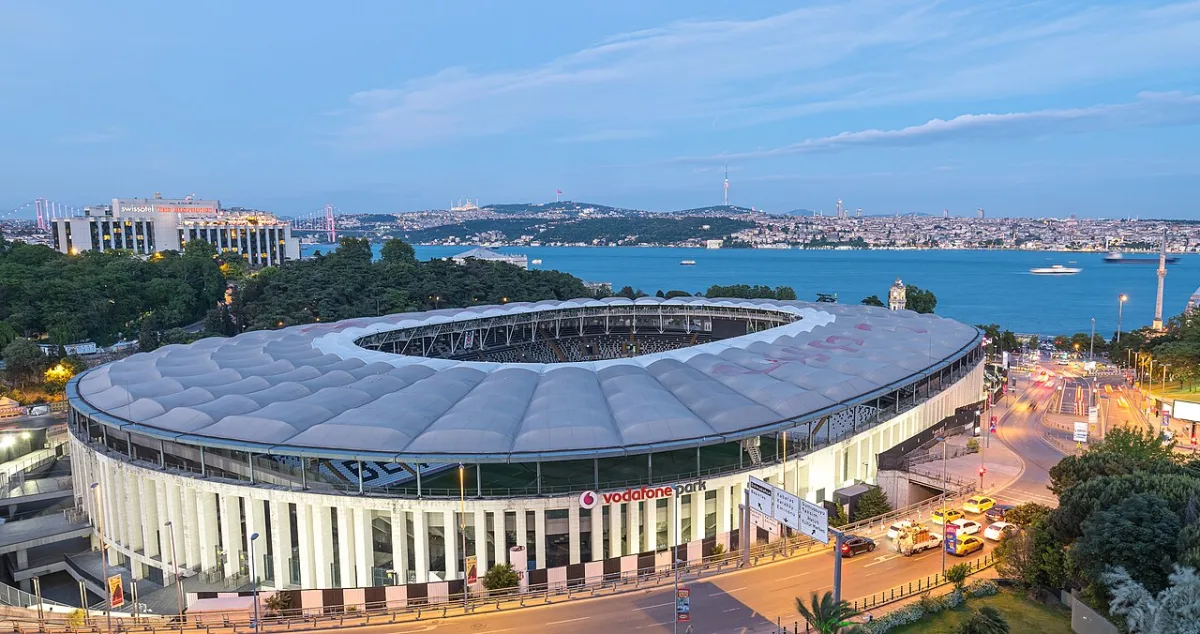
On the evening of 20 May 2026, supporters in claret and blue and in red and black walked the Bosphorus shore toward the stadium at Dolmabahçe. By midnight Aston Villa had beaten SC Freiburg 3 to 0 at Beşiktaş Park, with goals from Youri Tielemans, Emiliano Buendía and Morgan Rogers [1]. The DFB data centre records 37,324 spectators [2]. For Istanbul, the match was the second major UEFA event at the venue after the 2019 Super Cup, and it will not be the last [4][6].
The main point of this analysis is that a one match final gives a host city a short, intense and well documented peak, but very little published evidence on what that peak is worth. UEFA sets the ticket model, the clubs move the fans, and the city carries the operation. Istanbul has strong reasons to keep hosting, with a Conference League final in 2027 and EURO 2032 shared with Italy [6][7]. What it lacks so far is a public record of visitors, nights and costs from 2026.

What does this analysis cover?
What are the key facts?
UEFA describes the final as the 55th edition of the competition and the 17th since it became the Europa League [4]. Kickoff was at 22:00 local time, and the venue, home of Beşiktaş, has a capacity of around 40,000 [3][4]. It was Freiburg’s first continental final and Villa’s first UEFA final since 1982 [4]. Spectators included Prince William and Türkiye’s Minister of Youth and Sports, Osman Aşkın Bak, according to the TFF [1]. Referee François Letexier of France led the officiating team [1][2].
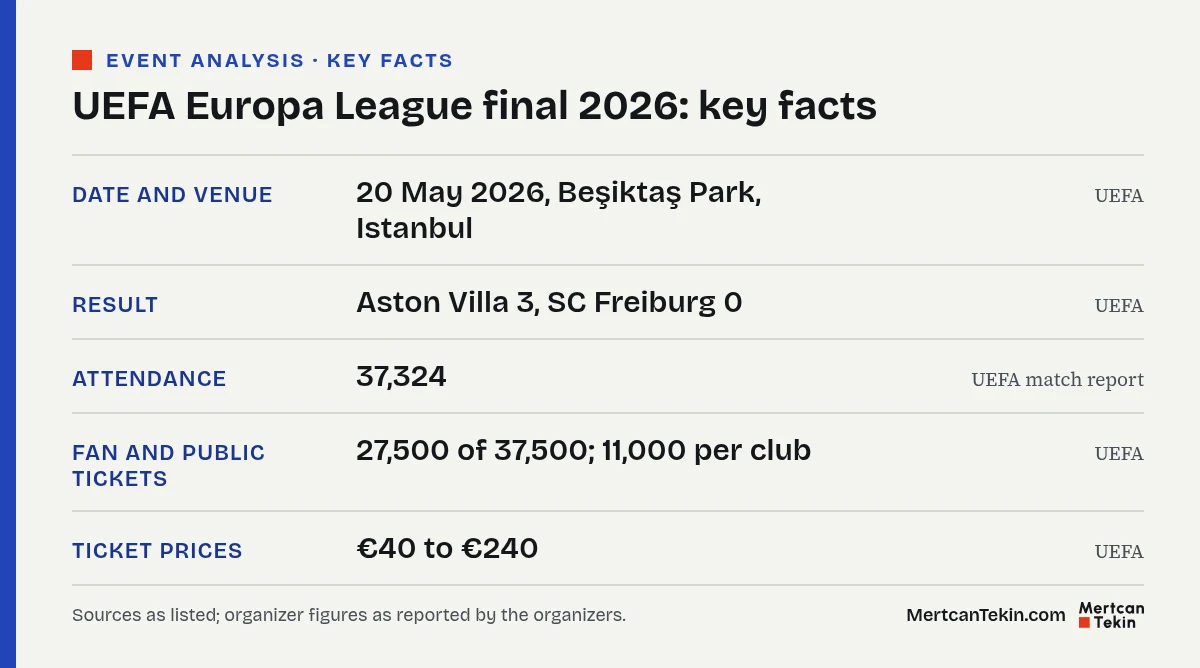
UEFA opened general public sales on 16 March 2026, with tickets allocated by lottery rather than first come, first served, and a limit of two tickets per applicant [3]. Of the 37,500 matchday tickets, 27,500 were available to fans and the general public, and each finalist could receive up to 11,000 [3]. SC Freiburg reported on 19 May that all 11,000 of its tickets had sold online within minutes, and that many more supporters had travelled hoping to find one [5].
How much of each final went to fans and the public
Unit: share of matchday tickets, as announced by UEFA on 16 March 2026. Shares calculated from UEFA figures.
| Item | Figure |
|---|---|
| Matchday tickets | 37,500 |
| For fans and the general public | 27,500 |
| Per finalist, maximum | 11,000 |
| Fans First, finalists only | €40 |
| Category 3 | €65 |
| Category 2 | €160 |
| Category 1 | €240 |
| Accessibility ticket | €40, companion free on request |
How did the ticket model compare with the other 2026 finals?
UEFA published allocations for all four 2026 club finals on the same day, which allows a clean comparison of organizer figures [3]. Istanbul offered 73% of its tickets directly to fans and the public, against 84% for the Conference League final in Leipzig, 81% for the Women’s Champions League final in Oslo and 64% for the Champions League final in Budapest. Istanbul’s lowest price, €40, sat between Leipzig’s €25 and Budapest’s €70 [3]. Tickets were mobile only and non transferable, with resale at face value on UEFA’s own platform [3].
There was no published forecast of visiting fans, so a forecast against result test is only possible for tickets. On that measure the result matched the plan closely, with 37,324 recorded spectators against 37,500 tickets announced [2][3]. My reading is that the ticket model worked as designed. The open question is what happened outside the stadium, where most of the visitor economy sits.
What did the final contribute to Istanbul?
The honest answer is that the contribution is not yet measured. What can be done is to place the final against the city’s normal flow. According to TÜRSAB, citing ministry border statistics, Istanbul received 6,953,482 foreign visitors from January to May 2026, down 0.7% on the same period of 2025 [8]. That is about 1.39 million a month on average, by my calculation. The two finalist allocations together came to at most 22,000 tickets, about 1.6% of an average month [3][8].
| Measure | Figure | Source type |
|---|---|---|
| Foreign visitors to Istanbul, January to May 2026 | 6,953,482, down 0.7% | Official, via TÜRSAB |
| Average per month, January to May | About 1.39 million | My calculation |
| Maximum finalist allocations, two clubs | 22,000 | Organizer, UEFA |
| Allocations as a share of an average month | About 1.6% | My calculation |
| Foreign visitors to Türkiye, May 2026 | 4,856,862, down 3.6% | Official, via TÜRSAB |
That share is small, but the composition matters for hotels and agencies. Finalist fans arrive in two concentrated waves from two source markets, the United Kingdom and Germany, and most stay one or two nights. TÜRSAB data show the UK among Türkiye’s top five markets in the first five months, while the German market grew by 5.4% [8]. A final therefore adds less to the annual total than to the visibility of the city in two markets that already matter. That is where sports tourism and city branding meet.

What worked well?
The first strength is a proven venue. Beşiktaş Park has now hosted the 2019 Super Cup and the 2026 final, and UEFA has given it the 2027 Conference League final [6]. Repeat hosting builds operational memory in policing, transport and stadium management that a one off host cannot match. For a city that will also share EURO 2032, that memory is an asset [7].
The second strength is the ticket design. Fans First pricing at €40, accessibility tickets at the same price with a free companion seat, and a lottery for general sales are all clear rules published in advance [3]. Non transferable mobile tickets and face value resale reduce the room for touting, which also protects the host city from crowds of fans without valid tickets at the gates. The match itself, with a recorded attendance very close to capacity, suggests the allocation process ran to plan [2][3].
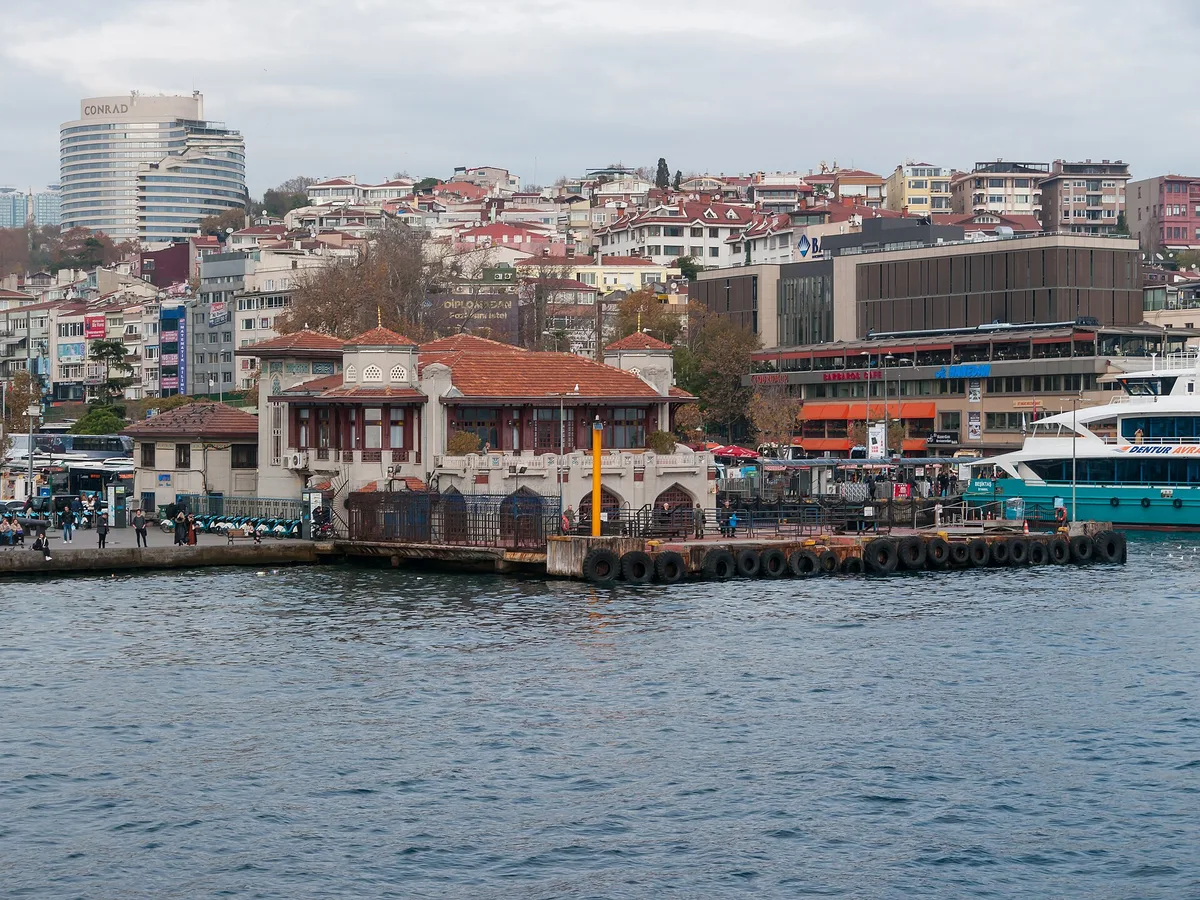
The third strength is location. The stadium sits on the European shore near Dolmabahçe, within walking distance of hotels in Beşiktaş and Taksim and of ferry piers. Few finals take place in a stadium so close to the centre of a city of this size. Visiting fans could combine the match with a short city break without long transfers, which raises the chance of spending in restaurants, museums and shops on the day before and after kickoff.
Where are the weaknesses and risks?
The main weakness is evidence. No public body has released visitor numbers, hotel occupancy or spending for the final week, and no impact study was found [1][3][8]. Without that data, the city cannot show residents or future rights holders what the event returned. For a city that hosts finals regularly, a short, standard report after each one would close that gap.
The second risk is demand above allocation. Freiburg sold its 11,000 tickets within minutes, and the club itself said many fans travelled without one [5]. Ticketless fans are a normal feature of finals, but they need space, screens and transport plans that a ticket count does not capture. For crowd management, the number of travelling fans, not the number of tickets, is the relevant planning figure.
The third risk is timing. The match kicked off at 22:00 local time on a Wednesday, which suited European television but left tens of thousands of spectators leaving the stadium close to midnight [3]. Late exits put pressure on public transport and on residents near the venue. They also push departures for many visiting fans into the early morning, which shortens the time they spend in the city after the match.

What the final shows for destination professionals
My reading is that a one match final is a visibility event first and a volume event second. For hotels, the value lies in two or three nights of high rates and full rooms in the districts closest to the stadium. For agencies and DMCs, it lies in packages for club travel offices and official partners, which are sold months ahead. For airlines, it means charter peaks on two days rather than a seasonal shift. For destination data teams, it is a test of whether the city can isolate an event effect in arrivals and nights.
The harder question for Istanbul is whether repeat hosting turns into a record that improves from one final to the next. Each final is short, but the city now has a sequence of them, and the event legacy of a host comes from what it records and improves between events. The 2027 Conference League final, on 2 June, is the next chance to show that [6].
What the Istanbul case shows
The first point is data agreed before the event. Understanding a final depends on ticket data by country from the rights holder, airport arrivals by origin for the match window and hotel figures from a sample of properties near the venue. None of that is difficult to collect if it is agreed in advance. After the event, the same request becomes slow and partial. A simple template, used for every final, would let the city compare 2026 with 2027 on equal terms.
The second point is the fans who do not hold tickets. Freiburg’s experience shows that the number of travelling supporters can exceed the allocation by a wide margin [5]. Fan zones, public screenings and clear transport information shape how those visitors experience the city, and they also shape how residents experience the match day. That wider crowd is the starting point of a visitor flow plan.
The third point is the separation of image from volume in reporting. A final can place a city on screens across Europe for one evening, and that is a real benefit for destination image. It is a media reach and sentiment measure, not a visitor number, and no visitor count was measured for it. Keeping the two apart makes both figures more credible.
Indicators to track
| Indicator | What it shows | When to publish |
|---|---|---|
| Visiting fans by origin | Arrivals linked to the match, from airport and ticket data | Within 1 month |
| Hotel nights and rates, match week | Occupancy and rate against the same week a year earlier | Within 1 month |
| Ticket demand against supply | Applications in the public lottery against tickets available | After the lottery |
| Transport and fan zone flows | Peak loads on ferries, metro and walking routes | Within 1 month |
| Public cost of hosting | City and state spending on operations and security | Within 6 months |
| Repeat hosting record | Changes recorded ahead of the 2027 Conference League final | Before June 2027 |
The first two indicators are the most useful for the visitor economy. Visiting fans by origin and match week hotel performance would show whether the final added nights or only replaced other visitors. The last indicator is the one that compounds, because it links 2026 to 2027.
Analysis result
The 2026 Europa League final delivered a near full stadium, a clean ticket process and a strong image of Istanbul in two key source markets [2][3][5]. Its scale is small against the city’s monthly visitor flow, at most about 1.6% of an average month in finalist allocations, by my calculation [8]. Its value lies in visibility, repeat hosting and preparation for 2027 and 2032 [6][7]. What is missing is the measurement that would prove that value to residents and rights holders. A final lasts ninety minutes, while its evidence remains useful until the next one.
How would this change your plans for the next twelve months?
Frequently asked questions
Where was the 2026 Europa League final played? At Beşiktaş Park in Istanbul, Türkiye, on 20 May 2026 at 22:00 local time [3][4].
Who won the 2026 Europa League final? Aston Villa beat SC Freiburg 3 to 0, with goals from Youri Tielemans, Emiliano Buendía and Morgan Rogers, according to the TFF match report [1].
What was the attendance? The DFB data centre records 37,324 spectators [2]. UEFA had announced 37,500 matchday tickets [3].
How much did tickets cost? UEFA set prices from €40 for Fans First and accessibility tickets to €240 for Category 1, with Category 3 at €65 and Category 2 at €160 [3].
Will Istanbul host another UEFA final soon? Yes. Beşiktaş Stadium will stage the UEFA Conference League final on 2 June 2027, according to UEFA [6].
Sources
- Turkish Football Federation, Aston Villa crowned winners of 2026 UEFA Europa League final in Istanbul, 21 May 2026
- DFB Datencenter, UEFA Europa League final 2026, match data
- UEFA, Ticket sales for general public open for 2026 UEFA club competition finals, 16 March 2026
- UEFA, 2026 UEFA Europa League final: where is it, who is involved, 20 May 2026
- SC Freiburg, Nothing to lose, so much to gain, 19 May 2026
- UEFA, 2027 UEFA Conference League final: Istanbul, 22 October 2026
- UEFA, Hosts appointed for UEFA EURO 2028 and 2032, 10 October 2023
- TÜRSAB, Visitor statistics bulletin, January to May 2026, 22 June 2026